Harald A. Wiltsche – författare
Visar alla böcker från författaren Harald A. Wiltsche. Handla med fri frakt och snabb leverans.
10 produkter
Phenomenology and QBism
New Approaches to Quantum Mechanics
Av Harald A. Wiltsche, Philipp Berghofer
E-bok, 2023
745 kr
Lägg i varukorg
This volume brings together philosophers and physicists to explore the parallels between Quantum Bayesianism, or QBism, and the phenomenological tradition. It is the first book exclusively devoted to phenomenology and quantum mechanics. By emphasizing the role of the subject’s experiences and …
Phenomenology and QBism
New Approaches to Quantum Mechanics
Av Harald A. Wiltsche, Philipp Berghofer
E-bok, 2023
745 kr
Lägg i varukorg
This volume brings together philosophers and physicists to explore the parallels between Quantum Bayesianism, or QBism, and the phenomenological tradition. It is the first book exclusively devoted to phenomenology and quantum mechanics. By emphasizing the role of the subject’s experiences and …
Phenomenology and QBism
New Approaches to Quantum Mechanics
Av Philipp Berghofer, Harald A. Wiltsche
Inbunden, 2023
2512 kr
Lägg i varukorg
This volume brings together philosophers and physicists to explore the parallels between Quantum Bayesianism, or QBism, and the phenomenological tradition. It is the first book exclusively devoted to phenomenology and quantum mechanics.By emphasizing the role of the subject’s experiences and …
Phenomenology and QBism
New Approaches to Quantum Mechanics
Av Philipp Berghofer, Harald A. Wiltsche
Häftad, 2025
706 kr
Lägg i varukorg
This volume brings together philosophers and physicists to explore the parallels between Quantum Bayesianism, or QBism, and the phenomenological tradition. It is the first book exclusively devoted to phenomenology and quantum mechanics.By emphasizing the role of the subject’s experiences and …
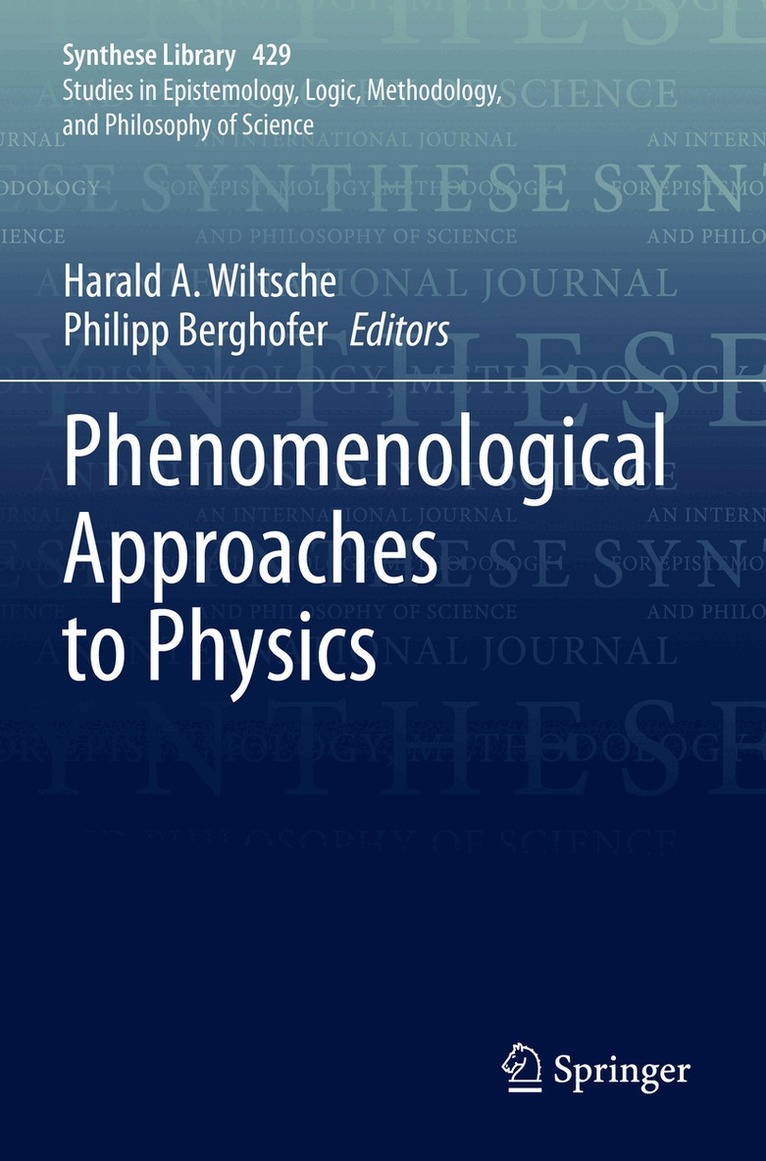
Phenomenological Approaches to Physics
Av Harald A. Wiltsche, Philipp Berghofer
Inbunden, 2020
1542 kr
Lägg i varukorg
This book offers fresh perspective on the role of phenomenology in the philosophy of physics which opens new avenues for discussion among physicists, "standard" philosophers of physics and philosophers with phenomenological leanings.Much has been written on the interrelations between philosophy and …
Phenomenological Approaches to Physics
Av Philipp Berghofer, Harald A. Wiltsche
E-bok, 2020
1948 kr
Lägg i varukorg
This book offers fresh perspective on the role of phenomenology in the philosophy of physics which opens new avenues for discussion among physicists, "standard" philosophers of physics and philosophers with phenomenological leanings. Much has been written on the interrelations between philosophy …
Phenomenological Approaches to Physics
Av Harald A. Wiltsche, Philipp Berghofer
Häftad, 2021
1542 kr
Lägg i varukorg
This book offers fresh perspective on the role of phenomenology in the philosophy of physics which opens new avenues for discussion among physicists, "standard" philosophers of physics and philosophers with phenomenological leanings.Much has been written on the interrelations between philosophy and …
Analytic and Continental Philosophy
Methods and Perspectives. Proceedings of the 37th International Wittgenstein Symposium
Av Sonja Rinofner-Kreidl, Harald A. Wiltsche
Inbunden, 2016
2679 kr
Lägg i varukorg
Publications of the series include the official proceedings of the ALWS-conferences and of their special workshops. The series is open also for other high-quality publications, especially on the philosophy of Ludwig Wittgenstein and its influence on contemporary analytic philosophy.
Analytic and Continental Philosophy
Methods and Perspectives. Proceedings of the 37th International Wittgenstein Symposium
Av Harald A. Wiltsche, Sonja Rinofner-Kreidl
E-bok, 2016
2717 kr
Lägg i varukorg
Analytic and Continental Philosophy
Methods and Perspectives. Proceedings of the 37th International Wittgenstein Symposium
Av Harald A. Wiltsche, Sonja Rinofner-Kreidl
E-bok, 2016
2717 kr
Lägg i varukorg