Harold R. Parks – författare
Visar alla böcker från författaren Harold R. Parks. Handla med fri frakt och snabb leverans.
18 produkter
Geometry of Domains in Space
Av Steven G. Krantz, Harold R. Parks
Inbunden, 1999
550 kr
Lägg i varukorg
The analysis of Euclidean space is well-developed. The classical Lie groups that act naturally on Euclidean space-the rotations, dilations, and trans lations-have both shaped and guided this development. In particular, the Fourier transform and the theory of translation invariant operators …
Primer of Real Analytic Functions
Av Steven G. Krantz, Harold R. Parks
Inbunden, 2002
930 kr
Lägg i varukorg
It is a pleasure and a privilege to write this new edition of A Primer 0/ Real Ana lytic Functions. The theory of real analytic functions is the wellspring of mathe matical analysis. It is remarkable that this is the first book on the subject, and we want to keep it up to date and as correct as …
Geometric Integration Theory
Av Steven G. Krantz, Harold R. Parks
Inbunden, 2008
1202 kr
Lägg i varukorg
Geometric measure theory has roots going back to ancient Greek mathematics, for considerations of the isoperimetric problem (to ?nd the planar domain of given perimeter having greatest area) led naturally to questions about spatial regions and boundaries. In more modern times, the Plateau problem …
Geometric Integration Theory
Av Harold R. Parks, Steven G. Krantz
E-bok, 2008
1539 kr
Lägg i varukorg
Geometric measure theory has roots going back to ancient Greek mathematics, for considerations of the isoperimetric problem (to ?nd the planar domain of given perimeter having greatest area) led naturally to questions about spatial regions and boundaries. In more modern times, the Plateau problem …
Primer of Real Analytic Functions
Av Harold R. Parks, Steven G. Krantz
E-bok, 2012
1188 kr
Lägg i varukorg
It is a pleasure and a privilege to write this new edition of A Primer 0/ Real Ana lytic Functions. The theory of real analytic functions is the wellspring of mathe matical analysis. It is remarkable that this is the first book on the subject, and we want to keep it up to date and as correct as …
Elements of Algebraic Topology
Av James R. Munkres, Steven G. Krantz m. fl.
Inbunden, 2025
1826 kr
Lägg i varukorg
This classic text appears here in a new edition for the first time in four decades. The new edition, with the aid of two new authors, brings it up to date for a new generation of mathematicians and mathematics students.Elements of Algebraic Topology provides the most concrete approach to the …
Elements of Algebraic Topology
Av James R. Munkres, Steven G. Krantz m. fl.
E-bok, 2025
1864 kr
Lägg i varukorg
This classic text appears here in a new edition for the first time in four decades. The new edition, with the aid of two new authors, brings it up to date for a new generation of mathematicians and mathematics students.Elements of Algebraic Topology provides the most concrete approach to the …
Elements of Algebraic Topology
Av James R. Munkres, Steven G. Krantz m. fl.
E-bok, 2025
1905 kr
Lägg i varukorg
This classic text appears here in a new edition for the first time in four decades. The new edition, with the aid of two new authors, brings it up to date for a new generation of mathematicians and mathematics students.Elements of Algebraic Topology provides the most concrete approach to the …
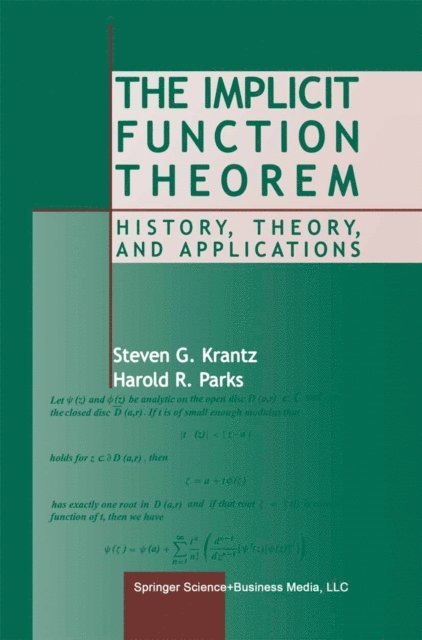
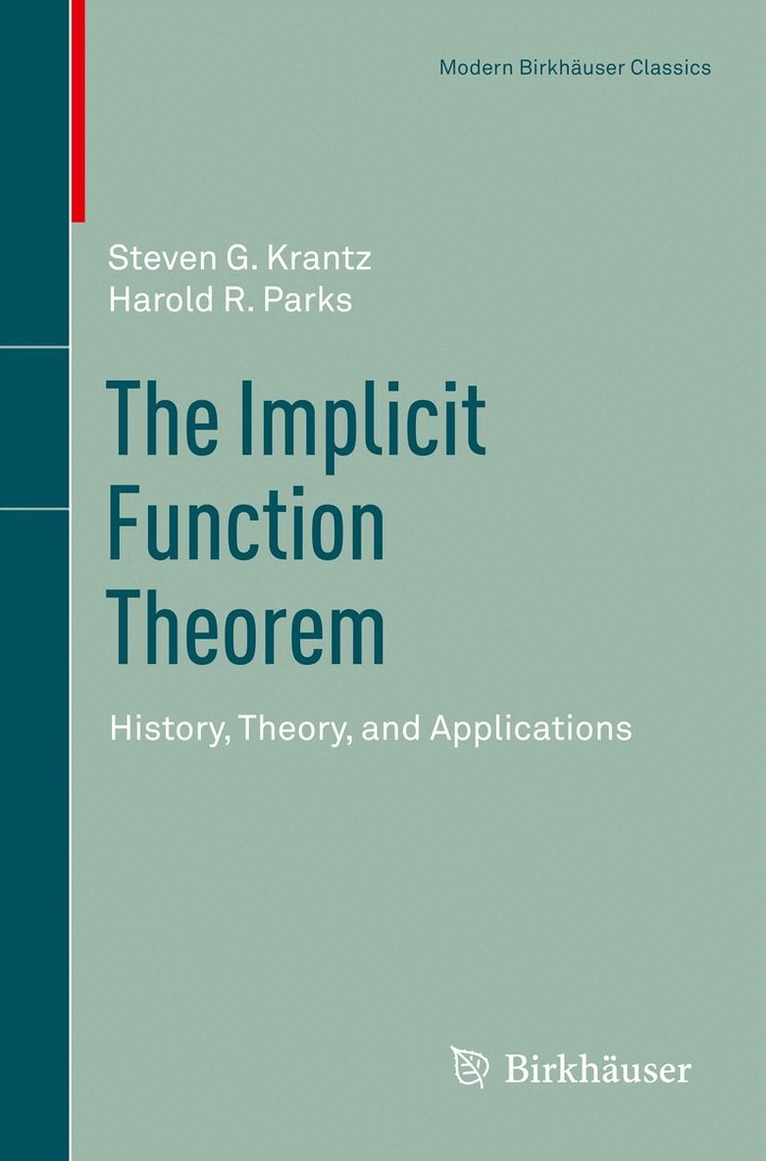
Implicit Function Theorem
History, Theory, and Applications
Av Harold R. Parks, Steven G. Krantz
E-bok, 2012
929 kr
Lägg i varukorg
The implicit function theorem is part of the bedrock of mathematical analysis and geometry. Finding its genesis in eighteenth century studies of real analytic functions and mechanics, the implicit and inverse function theorems have now blossomed into powerful tools in the theories of partial …
Geometry of Domains in Space
Av Harold R. Parks, Steven G. Krantz
E-bok, 2012
718 kr
Lägg i varukorg
The analysis of Euclidean space is well-developed. The classical Lie groups that act naturally on Euclidean space-the rotations, dilations, and trans lations-have both shaped and guided this development. In particular, the Fourier transform and the theory of translation invariant operators …
Primer of Real Analytic Functions
Av Steven G. Krantz, Harold R. Parks
Häftad, 2012
930 kr
Lägg i varukorg
It is a pleasure and a privilege to write this new edition of A Primer 0/ Real Ana lytic Functions. The theory of real analytic functions is the wellspring of mathe matical analysis. It is remarkable that this is the first book on the subject, and we want to keep it up to date and as correct as …
Geometry of Domains in Space
Av Steven G. Krantz, Harold R. Parks
Häftad, 2012
550 kr
Lägg i varukorg
The analysis of Euclidean space is well-developed. The classical Lie groups that act naturally on Euclidean space-the rotations, dilations, and trans lations-have both shaped and guided this development. In particular, the Fourier transform and the theory of translation invariant operators …
Implicit Function Theorem
History, Theory, and Applications
Av Steven G. Krantz, Harold R. Parks
Häftad, 2012
984 kr
Lägg i varukorg
The implicit function theorem is part of the bedrock of mathematical analysis and geometry. Finding its genesis in eighteenth century studies of real analytic functions and mechanics, the implicit and inverse function theorems have now blossomed into powerful tools in the theories of partial …
Implicit Function Theorem
History, Theory, and Applications
Av Harold R. Parks, Steven G. Krantz
E-bok, 2012
1296 kr
Lägg i varukorg
The implicit function theorem is part of the bedrock of mathematical analysis and geometry. Finding its genesis in eighteenth century studies of real analytic functions and mechanics, the implicit and inverse function theorems have now blossomed into powerful tools in the theories of partial …
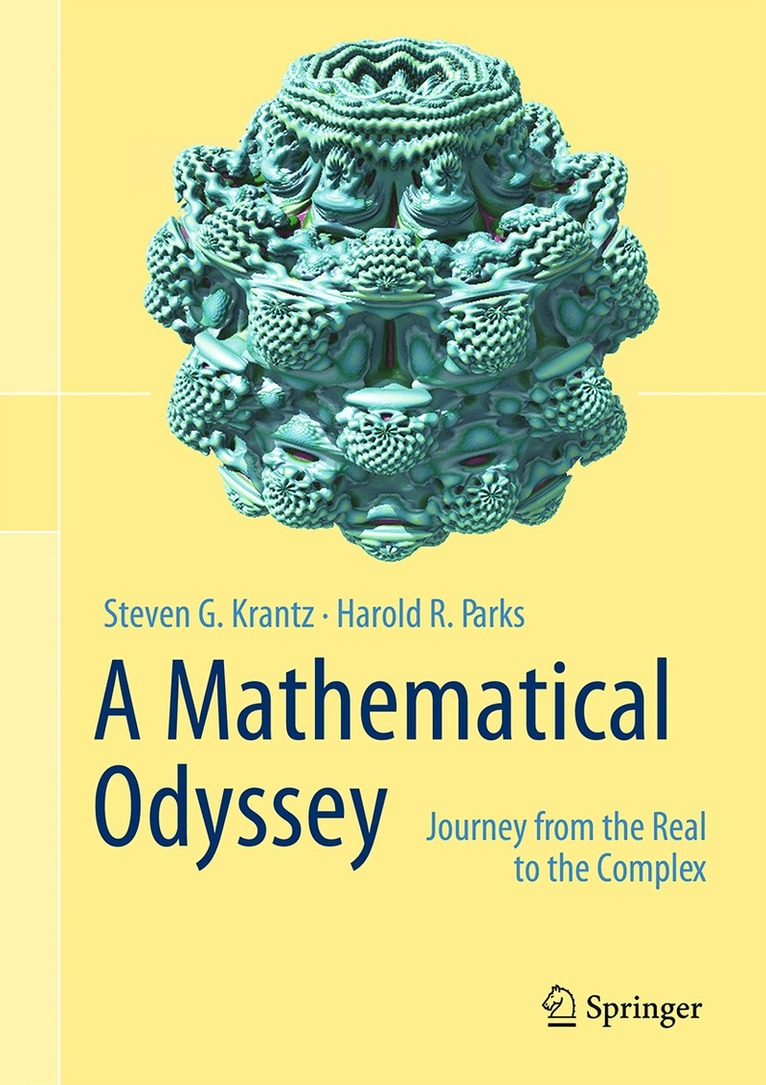
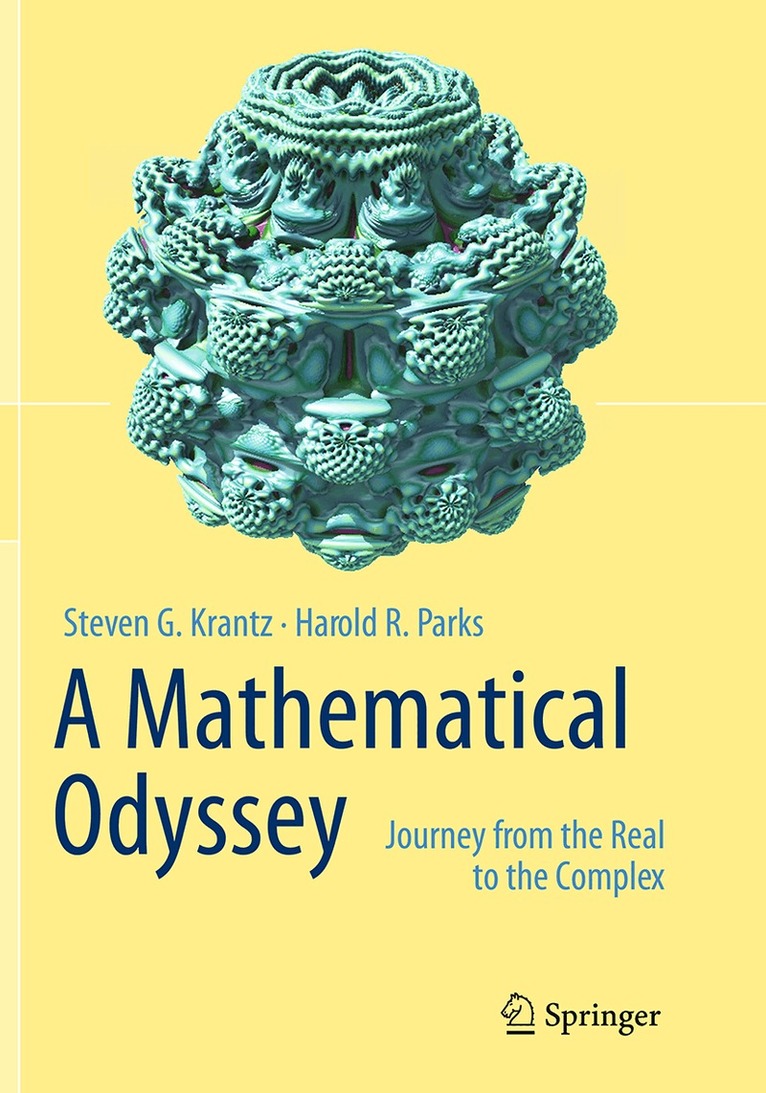
Mathematical Odyssey
Journey from the Real to the Complex
Av Steven G. Krantz, Harold R. Parks
Inbunden, 2014
654 kr
Lägg i varukorg
Mathematics is a poem. It is a lucid, sensual, precise exposition of beautiful ideas directed to specific goals. It is worthwhile to have as broad a cross-section of mankind as possible be conversant with what goes on in mathematics. Just as everyone knows that the Internet is a powerful and …
Mathematical Odyssey
Journey from the Real to the Complex
Av Harold R. Parks, Steven G. Krantz
E-bok, 2014
929 kr
Lägg i varukorg
Mathematics is a poem. It is a lucid, sensual, precise exposition of beautiful ideas directed to specific goals. It is worthwhile to have as broad a cross-section of mankind as possible be conversant with what goes on in mathematics. Just as everyone knows that the Internet is a powerful and …
Mathematical Odyssey
Journey from the Real to the Complex
Av Steven G. Krantz, Harold R. Parks
Häftad, 2016
604 kr
Lägg i varukorg
Mathematics is a poem. It is a lucid, sensual, precise exposition of beautiful ideas directed to specific goals. It is worthwhile to have as broad a cross-section of mankind as possible be conversant with what goes on in mathematics. Just as everyone knows that the Internet is a powerful and …
The Implicit Function Theorem: History, Theory, and Applications
Av Steven G. Krantz, Harold R. Parks
Inbunden
1187 kr
Tillfälligt slut