Harry G. Johnson – författare
Visar alla böcker från författaren Harry G. Johnson. Handla med fri frakt och snabb leverans.
14 produkter
14 produkter
721 kr
Skickas inom 10-15 vardagar
Macroeconomics is an outgrowth from the main stream of classical monetary theory following Keynes. Keynes changed the emphasis from determination of the level of money prices to determination of the level of output and employment. He also changed the key relationship from demand and supply of money as determining the price level to the relationship between consumption expenditure and income, in conjunction with private investment expenditure, as determining the level of output and therefore employment demanded. The income multiplier replaced the velocity of circulation as the key concept of monetary theory. The tendency of the past twenty-five years has been to reintegrate Keynesian and classical monetary theory into one general system of analysis. Moreover, as inflation has succeeded mass unemployment as a major policy problem, interest in classical monetary theory has revived, while Keynesians have increasingly' emphasized the monetary aspects of Keynesian theory. The proper contemporary distinction is not between two separate branches of economic theory, but between two areas of application or contexts of the theory of rational maximizing behavior. In the one (the microeconomic) context, it is assumed either that the overall workings of the economic system can be disregarded, or that the macroeconomic relationships are in full general equilibrium. In the other (the macroeconomic) context, it is assumed that the maximizing decisions of individual economic units (firms and households) will not necessarily add up to a macroeconomic equilibrium, but will produce a disequilibrium situation that will in the course of time produce changes in the individual decisions.
721 kr
Skickas inom 10-15 vardagar
This is a new kind of textbook in microeconomic theory. In place of the usual concentration on partial equilibrium analysis and discussion of a standard series of topics, the authors seek to introduce the student from the start to the general equilibrium approach to microeconomics, in the form of the two-sector model. This model is then applied to a variety of subjects in different special fields of economic analysis: welfare economics, international trade, public finance and income distribution. This book represents a very different approach to the teaching of micro-economic theory than normally followed, and one that will be of greater long-run value to the serious student of economics. In place of the usual textbook development of the subject as traditionally conceived through topics of increasing complexity and analytical difficulty, using partial equilibrium techniques of analysis, the book concentrates on the exposition and application of a more logically integrated set of tools that have been found of greater use in the analysis of problems arising not only in traditional micro-economics but also in a number of fields of economics that have customarily been hived off into separate specialized advanced courses. General Equilibrium Analysis starts with the description of the two-sector model and how these two sectors are built based on the individual micro-units in which they made up of and how they fit into the concept of the circular flow of income. Subsequent chapters deal with the evaluation of changes in factor endowment, demand preferences and technical progress by means of the model; and the theory of government, which includes both the theory of government expenditure, or public goods, and the theory of government tax and/or subsidy programmes-changes in budgetary scale, tax substitution and expenditure substitution. The model is then extended to an open economy-the so-called "two by two by two"--to consider both the normative effect of international trade and the possible determinants of international trade, with special attention being given to the relationship between commodity trade and factor mobility. Lastly this model is opened into a dynamic model of growth with its emphasis on requirements for the economy to maximize consumption per head on its long-run equilibrium growth path, and the effect of international trade on the growth path itself.
693 kr
Skickas inom 10-15 vardagar
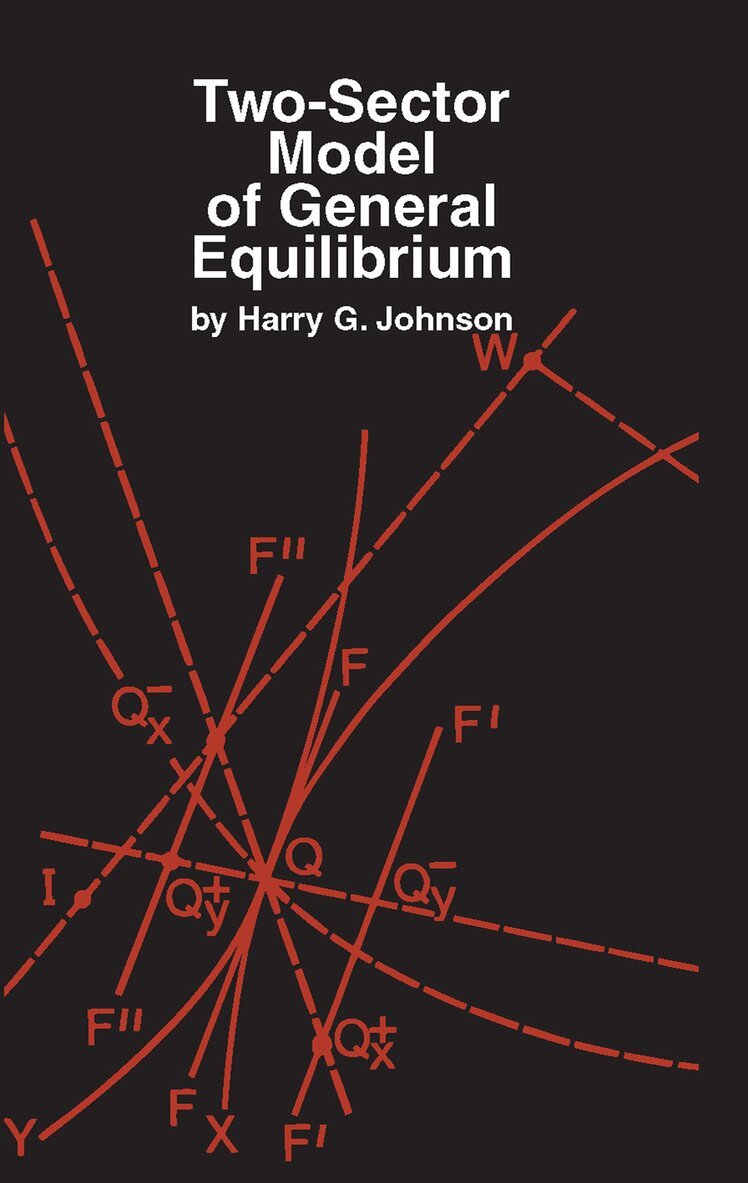
This important book presents a theory of general equilibrium and was the first to present in condensed form the construction of the two-sector model, its applications to the theory of distribution and public finance for income redistribution, and its conversion into a growth model. It assembles a body of analysis that was previously available only in scattered journal articles and a few textbook chapters.In the first of three chapters Johnson constructs the two-sector model, using only geometric tools, and establishes the basic relationships between commodity and factor prices and between production allocation and the distribution of income. He then discusses the determination of full general equilibrium and the possibility of multiple equilibrium. In a second chapter he examines the effects of various kinds of changes in the parameter of the system on the distribution of income. He also considers both changes in factor quantities and changes in technology, and the economics of various kinds of government policies for the redistribution of income, with special reference to the possibility of altering the distribution of income by trade union action and by minimum wage laws. Finally the author converts the two-sector model into a model of economic growth by converting one of the sectors into a capital-goods producing sector. He discusses questions such as the stability of equilibrium and the uniqueness of the steady-state growth path of the economy.The book is rounded out with three appendixes: the basic mathematics of the one-sector growth model, the standard against which the analysis of the two-sector model is mainly constructed; an analysis of the distributional effects of excise taxation; and an extension of the analysis to the general equilibrium consequences of the existence of public goods. This is an essential text for students and is especially useful for courses in price theory, international economics, and public finance.
406 kr
Skickas inom 7-10 vardagar
These essays, which make the science of economics intelligible to a general audience, are grouped into six areas: the relevance of economics; the "Keynesian revolution"; economics and the university; economics and contemporary problems; world inflation, money, trade, growth, and investment; and economics and the environment.
21 953 kr
Skickas inom 10-15 vardagar
Supervised by Maurice Dobb, Harry Johnson was particularly impressed by the breadth and the ideas of Joseph Schumpeter, which greatly influenced his writings in later years. Johnson made many contributions to the development of Heckscher-Ohlin theory and also helped to found the monetary approach to the balance of payments. He wrote many surveys of monetary economics that helped to clarify the issues in question.
6 806 kr
Skickas inom 10-15 vardagar
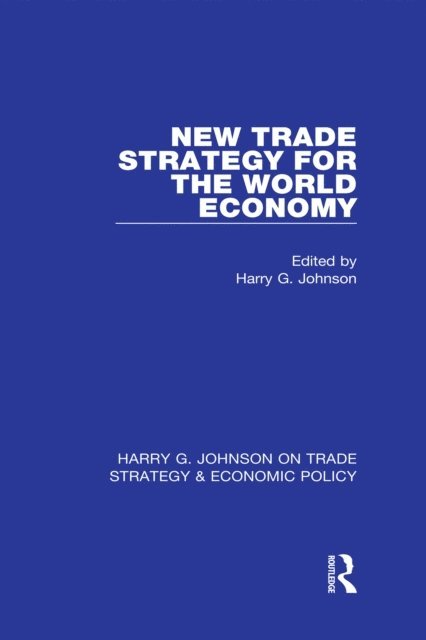
Harry G. Johnson was best known for his work on monetary theory and international economics, but he was also very active in the theory of distribution, trade strategy and development economics. These 4 books, originally published between 1967 and 1971 explore: The relationship between nationalism and economic development Trade policy to promote development The use of geometrical tools in international trade theory Issues surrounding multi-lateral free trade.
1 266 kr
Skickas inom 10-15 vardagar
Originally published in 1971, this book presents in a lucid form the basic model of distribution in a two-sector general equilibrium system. While this model has been used by many economists, this was the first synoptic exposition of it to become readily available to students. The first part develops the two-sector model and its properties, using the geometrical tools of international trade theory. The second applies the model to some standard problems in the theory of income distribution, including the economics of redistributive taxes and subsidies, of trade union organization, and of minimum wage laws. The third part converts the model into a growth model and develops the conditions for convergence on a steady-state growth path and for the maximization of consumption per head at all points of time.
483 kr
Skickas inom 10-15 vardagar
Originally published in 1971, this book presents in a lucid form the basic model of distribution in a two-sector general equilibrium system. While this model has been used by many economists, this was the first synoptic exposition of it to become readily available to students. The first part develops the two-sector model and its properties, using the geometrical tools of international trade theory. The second applies the model to some standard problems in the theory of income distribution, including the economics of redistributive taxes and subsidies, of trade union organization, and of minimum wage laws. The third part converts the model into a growth model and develops the conditions for convergence on a steady-state growth path and for the maximization of consumption per head at all points of time.
1 266 kr
Skickas inom 10-15 vardagar
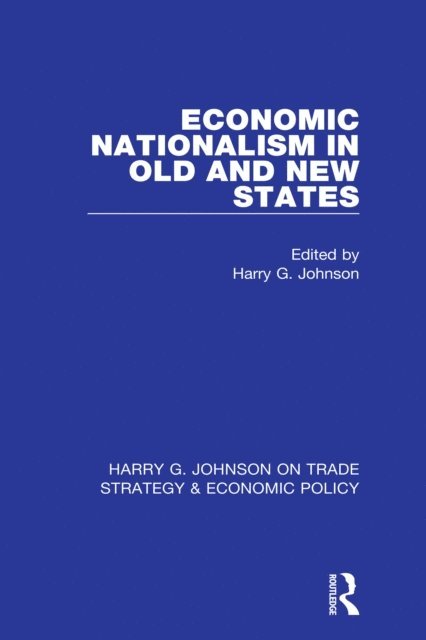
Originally published in 1968, this book brings together contributions from social scientists in anthropology, economic history, economics and political science in an exploration of the nature and effects of economic nationalism. The opening essays presents a formal theory of nationalism that relates the phenomenon to rational government processes. Following chapters explore whether nationalism and economic development went together and whether nationalistic economic polices actually promoted development. How far British economic policy was influence by nationalism, or its corollary for a successful country-imperialism is also assessed. Examples from China, Mali, Mexico and Canada are included.
483 kr
Skickas inom 10-15 vardagar
Originally published in 1968, this book brings together contributions from social scientists in anthropology, economic history, economics and political science in an exploration of the nature and effects of economic nationalism. The opening essays presents a formal theory of nationalism that relates the phenomenon to rational government processes. Following chapters explore whether nationalism and economic development went together and whether nationalistic economic polices actually promoted development. How far British economic policy was influence by nationalism, or its corollary for a successful country-imperialism is also assessed. Examples from China, Mali, Mexico and Canada are included.
1 966 kr
Skickas inom 10-15 vardagar
Originally published in 1969, the studies in tis volume deal with the proposal for a multilateral free trade association initiated by North Atlantic countries in the 1960s. Written at a time of protectionism in the USA, policy problems in the EEC and debates over Britain’s role within it, as well as discussions about tariff preferences mean that many of the themes in this volume remain as pertinent today as when the book was first published. As editor of the volume, Harry G. Johnson drew together the threads of a global concept that was commanding increasing attention around the world.
497 kr
Skickas inom 10-15 vardagar
Originally published in 1969, the studies in tis volume deal with the proposal for a multilateral free trade association initiated by North Atlantic countries in the 1960s. Written at a time of protectionism in the USA, policy problems in the EEC and debates over Britain’s role within it, as well as discussions about tariff preferences mean that many of the themes in this volume remain as pertinent today as when the book was first published. As editor of the volume, Harry G. Johnson drew together the threads of a global concept that was commanding increasing attention around the world.
2 386 kr
Skickas inom 10-15 vardagar
This is a new kind of textbook in microeconomic theory. In place of the usual concentration on partial equilibrium analysis and discussion of a standard series of topics, the authors seek to introduce the student from the start to the general equilibrium approach to microeconomics, in the form of the two-sector model. This model is then applied to a variety of subjects in different special fields of economic analysis: welfare economics, international trade, public finance and income distribution. This book represents a very different approach to the teaching of micro-economic theory than normally followed, and one that will be of greater long-run value to the serious student of economics. In place of the usual textbook development of the subject as traditionally conceived through topics of increasing complexity and analytical difficulty, using partial equilibrium techniques of analysis, the book concentrates on the exposition and application of a more logically integrated set of tools that have been found of greater use in the analysis of problems arising not only in traditional micro-economics but also in a number of fields of economics that have customarily been hived off into separate specialized advanced courses. General Equilibrium Analysis starts with the description of the two-sector model and how these two sectors are built based on the individual micro-units in which they made up of and how they fit into the concept of the circular flow of income. Subsequent chapters deal with the evaluation of changes in factor endowment, demand preferences and technical progress by means of the model; and the theory of government, which includes both the theory of government expenditure, or public goods, and the theory of government tax and/or subsidy programmes-changes in budgetary scale, tax substitution and expenditure substitution. The model is then extended to an open economy-the so-called "two by two by two"--to consider both the normative effect of international trade and the possible determinants of international trade, with special attention being given to the relationship between commodity trade and factor mobility. Lastly this model is opened into a dynamic model of growth with its emphasis on requirements for the economy to maximize consumption per head on its long-run equilibrium growth path, and the effect of international trade on the growth path itself.
2 176 kr
Skickas inom 10-15 vardagar
Macroeconomics is an outgrowth from the main stream of classical monetary theory following Keynes. Keynes changed the emphasis from determination of the level of money prices to determination of the level of output and employment. He also changed the key relationship from demand and supply of money as determining the price level to the relationship between consumption expenditure and income, in conjunction with private investment expenditure, as determining the level of output and therefore employment demanded. The income multiplier replaced the velocity of circulation as the key concept of monetary theory. The tendency of the past twenty-five years has been to reintegrate Keynesian and classical monetary theory into one general system of analysis. Moreover, as inflation has succeeded mass unemployment as a major policy problem, interest in classical monetary theory has revived, while Keynesians have increasingly' emphasized the monetary aspects of Keynesian theory. The proper contemporary distinction is not between two separate branches of economic theory, but between two areas of application or contexts of the theory of rational maximizing behavior. In the one (the microeconomic) context, it is assumed either that the overall workings of the economic system can be disregarded, or that the macroeconomic relationships are in full general equilibrium. In the other (the macroeconomic) context, it is assumed that the maximizing decisions of individual economic units (firms and households) will not necessarily add up to a macroeconomic equilibrium, but will produce a disequilibrium situation that will in the course of time produce changes in the individual decisions.