• Fri frakt över 249 kr
  • •
  • Snabba leveranser
  • •
  • Billiga böcker
Kundservice

Du är på sajten för privatpersoner.

Företag, bibliotek eller offentlig verksamhet?

Du handlar på classic.bokus.com, där alla dina funktioner finns intakta.
Till classic.bokus.com
Bokus logotyp. Gå till startsidan.
  • Erbjudanden
  • Nyheter
  • Student
  • Topplistor
  • Barn & ungdom
  • Bokus Play
  • E-böcker
  • Pocketböcker
  • Spel & pussel

10% rabatt på allt med kod: NYSTART10 →

Sidfot

Mina sidor

    Hjälp

    • Kundservice
    • Vanliga frågor och svar
    • Frakt och leverans
    • Retur vid ångerrätt
    • Reklamera vara
    • Betalning
    • Köpvillkor
    • Allmänna villkor
    • Information om webbplatsens tillgänglighet

    Om Bokus

    • Om oss
    • Pressrum
    • För studenter
    • För företag
    • För bibliotek och offentlig verksamhet
    • För leverantörer
    • Hållbarhet

    Populärt

    • Aktuella erbjudanden
    • Presentkort
    • Studentlitteratur
    • Nya böcker
    • Topplistor
    • Signerade böcker
    • Engelska böcker

    Inspiration

    • Boktips
    • BookTok
    • Populära bokserier
    • Barnbokskaraktärer
    • Populära författare
    Logotyp för Bokus
    Följ oss på Facebook (extern länk)Följ oss på Instagram (extern länk)Följ oss på YouTube (extern länk)Följ oss på TikTok (extern länk)
    bokus @ CookiesAnpassa cookiesIntegritetspolicyKöpvillkor
    Till Citymail hemsida (extern länk)Till Budbee hemsida (extern länk)Till Postnord hemsida (extern länk)Till Schenker hemsida (extern länk)Till Early Bird hemsida (extern länk)Till Walleys hemsida (extern länk)
    1. Ekonomi och Ledarskap
    2. Nationalekonomi
    3. Makroekonomi

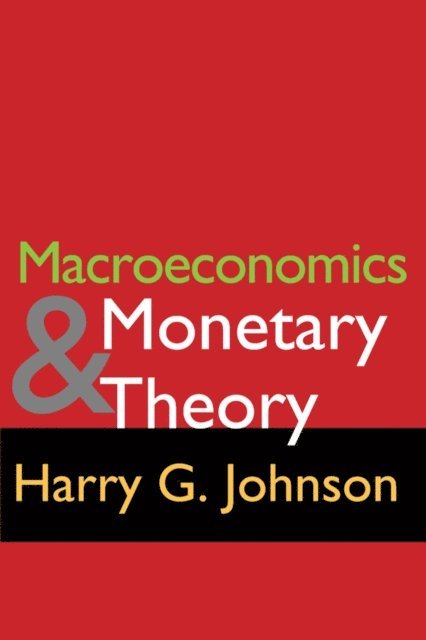
    Macroeconomics and Monetary Theory

    AvHarry G. Johnson,Harry G. Johnson

    Häftad, Engelska, 2006

    788 kr

    Beställningsvara. Skickas inom 10-15 vardagar. Fri frakt över 249 kr.

    Fler format och utgåvor

    Inbunden

    2 493 kr

    E-bok

    933 kr

    E-bok

    935 kr

    Beskrivning

    Macroeconomics is an outgrowth from the main stream of classical monetary theory following Keynes. Keynes changed the emphasis from determination of the level of money prices to determination of the level of output and employment. He also changed the key relationship from demand and supply of money as determining the price level to the relationship between consumption expenditure and income, in conjunction with private investment expenditure, as determining the level of output and therefore employment demanded. The income multiplier replaced the velocity of circulation as the key concept of monetary theory. The tendency of the past twenty-five years has been to reintegrate Keynesian and classical monetary theory into one general system of analysis. Moreover, as inflation has succeeded mass unemployment as a major policy problem, interest in classical monetary theory has revived, while Keynesians have increasingly' emphasized the monetary aspects of Keynesian theory. The proper contemporary distinction is not between two separate branches of economic theory, but between two areas of application or contexts of the theory of rational maximizing behavior. In the one (the microeconomic) context, it is assumed either that the overall workings of the economic system can be disregarded, or that the macroeconomic relationships are in full general equilibrium. In the other (the macroeconomic) context, it is assumed that the maximizing decisions of individual economic units (firms and households) will not necessarily add up to a macroeconomic equilibrium, but will produce a disequilibrium situation that will in the course of time produce changes in the individual decisions.
    Produktinformation

    • Utgivningsdatum:2006-07-15
    • Mått:152 x 229 x 12 mm
    • Vikt:420 g
    • Format:Häftad
    • Språk:Engelska
    • Antal sidor:224
    • Förlag:Taylor & Francis Inc
    • ISBN:9780202308654

    Utforska kategorier

    • Makroekonomi inom Ekonomi och Ledarskap

    Mer om författaren

    Harry G. Johnson was Professor of Economics at the London School of Economics and the University of Chicago.

    Innehållsförteckning

    • Part I Macroeconomics, Part II The Demand for Money, Part III Integration of Monetary and Value Theory, Part IV Empirical Work in Monetary Economics, Part V Some Major Policy Issues, Appendix