Haym Soloveitchik - Böcker
Visar alla böcker från författaren Haym Soloveitchik. Handla med fri frakt och snabb leverans.
8 produkter
8 produkter
435 kr
Skickas inom 7-10 vardagar
The essays in this volume reflect the author’s lifelong interest in the history of halakhah. What stimulated change, and why? What happened when strong forces impinged on halakhic observance and communities had to adapt to new circumstances? The volume opens with a brief description of the dramatis personae who figure throughout the essays: Rashi and the Tosafists. Further essays discuss halakhic commentaries and their authors; usury, moneylending, and pawnbroking; Gentile wine; and the self-image of the Ashkenazic community. Throughout, Haym Soloveitchik shows that the line between adaptation and deviance is a fine one, and that where a society draws that line is revelatory of its values and its self-perception. Many of the essays presented here are already well known in the field; two are completely new. Most of those previously published have been updated, and the major essay on pawnbroking has been significantly expanded.Volume II available: https://liverpooluniversitypress.co.uk/doi/book/10.3828/9781904113980Volume III available: https://liverpooluniversitypress.co.uk/doi/book/10.3828/9781904113997
448 kr
Skickas inom 7-10 vardagar
In this second volume of his essays on the history of halakhah, Haym Soloveitchik grapples with much-disputed topics in medieval Jewish history and takes issue with a number of reigning views. His insistence that proper understanding requires substantive, in-depth analysis of the sources leads him to a searching analysis of oft-cited halakhic texts of Ashkenaz, frequently with conclusions that differ from the current consensus. Medieval Jewish historians cannot, he argues, avoid engaging in detailed textual criticism, and texts must always be interpreted in the context of the legal culture of their time. Historians who shirk these tasks risk reinforcing a version that supports their own preconceptions, and retrojecting later notions on to an earlier age. These basic methodological points underlie every topic discussed.In Part I, devoted to the cultural origins of Ashkenaz and its lasting impact, Professor Soloveitchik questions the scholarly consensus that the roots of Ashkenaz lie deep in Palestinian soil. He challenges the widespread notion that it was immemorial custom (minhag kadmon) that primarily governed Early Ashkenaz, the culture that emerged in the Rhineland in the late tenth century and which was ended by the ravages of the First Crusade (1096). He similarly rejects the theory that it was only towards the middle of the eleventh century that the Babylonian Talmud came to be regarded as fully authoritative. On the basis of an in-depth analysis of the literature of the time, he shows that the scholars of Early Ashkenaz displayed an astonishing command of the complex corpus of the Babylonian Talmud and viewed it at all times as the touchstone of the permissible and the forbidden. The section concludes with his own radical proposal as to the source of Ashkenazi culture and the stamp it left upon the Jews of northern Europe for close to a millennium.The second part of the volume treats the issue of martyrdom as perceived and practised by Jews under Islam and Christianity. In one of the longer essays, Soloveitchik claims that Maimonides’ problematic Iggeret ha-Shemad is a work of rhetoric, not halakhah—a conclusion that has generated much criticism from other scholars, to whom he replies one by one. This is followed by a comprehensive study of kiddush ha-shem in Ashkenaz, which draws him into an analysis of whether aggadic sources were used by the Tosafists in halakhic arguments, as some historians claim; whether there was any halakhic validation of the widespread phenomenon of voluntary martyrdom; and, indeed, whether halakhic considerations played any part in such tragic life-and-death issues. The book concludes with two essays on Mishneh torah which argue that that famed code must also be viewed as a work of art which sustains, as masterpieces do, multiple conflicting interpretations.Volume I available: https://liverpooluniversitypress.co.uk/doi/book/10.3828/9781904113973Volume III available: https://liverpooluniversitypress.co.uk/doi/book/10.3828/9781904113997
446 kr
Skickas inom 7-10 vardagar
Continuing his contribution to medieval Jewish intellectual history, Haym Soloveitchik focuses here on the radical pietist movement of Ḥasidei Ashkenaz and its main literary work, Sefer {::}Ḥ{::}{::}asidim, and on the writings and personality of the Provençal commentator Ravad of Posquières. In both areas Soloveitchik challenges mainstream views to provide a new understanding of medieval Jewish thought. Some of the essays are revised and updated versions of work previously published and some are entirely new, but in all of them Soloveitchik challenges reigning views to provide a new understanding of medieval Jewish thought.The section on Sefer Ḥasidim brings together over half a century of Soloveitchik’s writings on German Pietism, many of which originally appeared in obscure publications, and adds two new essays. The first of these is a methodological study of how to read this challenging work and an exposition of what constitutes a valid historical inference, while the second reviews the validity of the sociological and anthropological inferences presented in contemporary historiography. In discussing Ravad’s oeuvre, Soloveitchik questions the widespread notion that Ravad’s chief accomplishment was his commentary on Maimonides’ Mishneh torah; his Talmud commentary, he claims, was of far greater importance and was his true masterpiece. He also adds a new study that focuses on the acrimony between Ravad, as the low-born genius of Posquières, and R. Zerahyah ha-Levi of Lunel, who belonged to the Jewish aristocracy of Languedoc, and considers the implications of that relationship.Volume I available: https://liverpooluniversitypress.co.uk/doi/book/10.3828/9781904113973Volume II available: https://liverpooluniversitypress.co.uk/doi/book/10.3828/9781904113980
573 kr
Skickas inom 7-10 vardagar
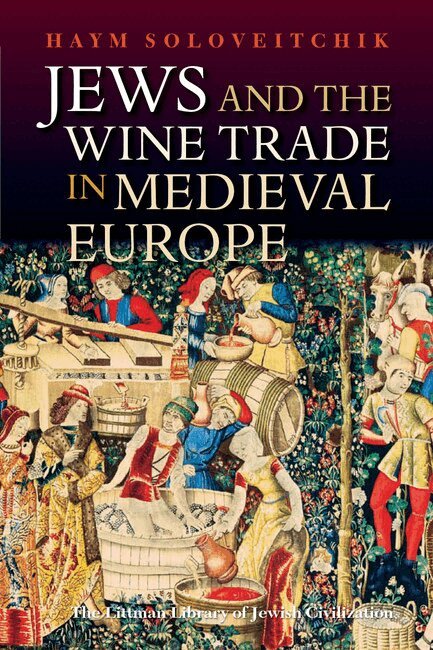
Although Jews were at the centre of commercial activity in medievalEurope, a talmudic ban on any wine touched by a Gentile prevented them fromengaging in the lucrative wine trade. Wine was consumed in vast quantities inthe Middle Ages, and the banks of the Rhineland hosted some of the finestvineyards in northern Europe. German Jews were, until the thirteenth century, amerchant class. How could they abstain from trading in one of the region’smajor commodities? In time, they ruled that it was permissible to accept winein payment of debt, but forbade trading in it, and they maintained that banthroughout the Middle Ages. Further study in the twelfth century, however, led Talmudists todiscover that Jews were only forbidden to profit from trading in Gentile wineif they dealt with idolaters, but that trade with Christians and Muslims waspermitted. Nevertheless, the German community refused to take advantage of thisclear licence. Using Jewish and Gentile sources, this study probes the sourcesof this powerful taboo. In describing the complex ways in which deeply held cultural valuesaffect Jews’ engagement in the economy of the surrounding society, this bookalso illustrates the law of unintended consequences—how the ban on Gentile wineled both to a major Jewish contribution to German viticulture and to theinvolvement of Jews in moneylending, with all its tragic consequences.
799 kr
Skickas inom 7-10 vardagar
Written at different times and for different audiences - some for scholars of rabbinic literature, some for laymen or for scholars not necessarily Jewish - the essays gathered together in this volume nevertheless have an inner coherence. They reflect the author's lifetime interest in the history of halakhah - not as intellectual history per se, but rather a concern to identify measurable deflection in the unfolding of halakhic ideas that could point to an undetected force at work. What was it that stimulated change, and why? What happened when strong forces impinged upon halakhic observance, and both the scholarly elite and the community as a whole had to grapple with upholding observance while adapting to a new set of circumstances? Haym Soloveitchik's elegant presentation shows skilfully that the line between adaptation and deviance is a fine one, and that where a society draws that line is revelatory of both its values and its self-perception. Many of the articles presented here are well known in the field but have been updated for this publication (the major essay on pawnbroking has been expanded to half again its original size); some have been previously published only in Hebrew, and two are completely new. An Introduction highlights the key themes of the collection and explains the underlying methodology. Having these essays in a single volume will enable scholars and students to consult all the material on each theme together, while also tracing the development of ideas. The opening section of the volume is a brief description and characterization of the dramatis personae who figure in all these essays: Rashi and the Tosafists. It covers the halakhic commentaries and their authors; the creativity of Ashkenaz; and the halakhic isolation of the Ashkenazic community. The second section focuses on usury and money-lending, including the practice of pawn-broking, while the third section deals with the ban on Gentile wine and how that connected to the development of money-lending. The final section presents general conclusions in the form of four studies of the communal self-image of Ashkenaz and its attitude to deviation and change.Volume II available: https://liverpooluniversitypress.co.uk/doi/book/10.3828/9781904113980Volume III available: https://liverpooluniversitypress.co.uk/doi/book/10.3828/9781904113997
799 kr
Skickas inom 7-10 vardagar
In this second volume of his essays on the history of halakhah, Haym Soloveitchik grapples with much-disputed topics in medieval Jewish history and takes issue with a number of reigning views. His insistence that proper understanding requires substantive, in-depth analysis of the sources leads him to a searching analysis of oft-cited halakhic texts of Ashkenaz, frequently with conclusions that differ from the current consensus. Medieval Jewish historians cannot, he argues, avoid engaging in detailed textual criticism, and texts must always be interpreted in the context of the legal culture of their time. Historians who shirk these tasks risk reinforcing a version that supports their own preconceptions, and retrojecting later notions on to an earlier age. These basic methodological points underlie every topic discussed.In Part I, devoted to the cultural origins of Ashkenaz and its lasting impact, Professor Soloveitchik questions the scholarly consensus that the roots of Ashkenaz lie deep in Palestinian soil. He challenges the widespread notion that it was immemorial custom (minhag kadmon) that primarily governed Early Ashkenaz, the culture that emerged in the Rhineland in the late tenth century and which was ended by the ravages of the First Crusade (1096). He similarly rejects the theory that it was only towards the middle of the eleventh century that the Babylonian Talmud came to be regarded as fully authoritative. On the basis of an in-depth analysis of the literature of the time, he shows that the scholars of Early Ashkenaz displayed an astonishing command of the complex corpus of the Babylonian Talmud and viewed it at all times as the touchstone of the permissible and the forbidden. The section concludes with his own radical proposal as to the source of Ashkenazi culture and the stamp it left upon the Jews of northern Europe for close to a millennium.The second part of the volume treats the issue of martyrdom as perceived and practised by Jews under Islam and Christianity. In one of the longer essays, Soloveitchik claims that Maimonides’ problematic Iggeret ha-Shemad is a work of rhetoric, not halakhah—a conclusion that has generated much criticism from other scholars, to whom he replies one by one. This is followed by a comprehensive study of kiddush ha-shem in Ashkenaz, which draws him into an analysis of whether aggadic sources were used by the Tosafists in halakhic arguments, as some historians claim; whether there was any halakhic validation of the widespread phenomenon of voluntary martyrdom; and, indeed, whether halakhic considerations played any part in such tragic life-and-death issues. The book concludes with two essays on Mishneh torah which argue that that famed code must also be viewed as a work of art which sustains, as masterpieces do, multiple conflicting interpretations.Volume I available: https://liverpooluniversitypress.co.uk/doi/book/10.3828/9781904113973Volume III available: https://liverpooluniversitypress.co.uk/doi/book/10.3828/9781904113997
791 kr
Skickas inom 7-10 vardagar
Continuing his contribution to medieval Jewish intellectual history, Haym Soloveitchik focuses here on the radical pietist movement of Ḥasidei Ashkenaz and its main literary work, Sefer {::}Ḥ{::}{::}asidim, and on the writings and personality of the Provençal commentator Ravad of Posquières. In both areas Soloveitchik challenges mainstream views to provide a new understanding of medieval Jewish thought. Some of the essays are revised and updated versions of work previously published and some are entirely new, but in all of them Soloveitchik challenges reigning views to provide a new understanding of medieval Jewish thought.The section on Sefer Ḥasidim brings together over half a century of Soloveitchik’s writings on German Pietism, many of which originally appeared in obscure publications, and adds two new essays. The first of these is a methodological study of how to read this challenging work and an exposition of what constitutes a valid historical inference, while the second reviews the validity of the sociological and anthropological inferences presented in contemporary historiography. In discussing Ravad’s oeuvre, Soloveitchik questions the widespread notion that Ravad’s chief accomplishment was his commentary on Maimonides’ Mishneh torah; his Talmud commentary, he claims, was of far greater importance and was his true masterpiece. He also adds a new study that focuses on the acrimony between Ravad, as the low-born genius of Posquières, and R. Zerahyah ha-Levi of Lunel, who belonged to the Jewish aristocracy of Languedoc, and considers the implications of that relationship.Volume I available: https://liverpooluniversitypress.co.uk/doi/book/10.3828/9781904113973Volume II available: https://liverpooluniversitypress.co.uk/doi/book/10.3828/9781904113980
621 kr
Skickas inom 7-10 vardagar
The essay that formsthe core of this book is an attempt to understand the developments that haveoccurred in Orthodox Jewry in America in the last seventy years, and to analysetheir implications. The prime change is what is often described as ‘the swing tothe right’, a marked increase in ritual stringency, a rupture in patterns ofbehaviour that has had major consequences not only for Jewish society but alsofor the nature of Jewish spirituality. For Haym Soloveitchik, the key featureat the root of this change is that, as a result of migration to the ‘New Worlds’ of England, the US,and Israel and acculturation to its new surroundings, AmericanJewry—indeed, much of the Jewish world— had to reconstruct religious practicefrom normative texts: observance could no longer be transmitted mimetically, onthe basis of practices observed in home and street. In consequence, behaviouronce governed by habit is now governed by rule. This new edition allows theauthor to deal with criticisms raised since the essay, long established as aclassic in the field, was originally published, and enables readers to gain afuller perspective on a topic central to today’s Jewish world and itsdevelopment.