Heath Pearson - Böcker
Visar alla böcker från författaren Heath Pearson. Handla med fri frakt och snabb leverans.
4 produkter
4 produkter
552 kr
Skickas inom 7-10 vardagar
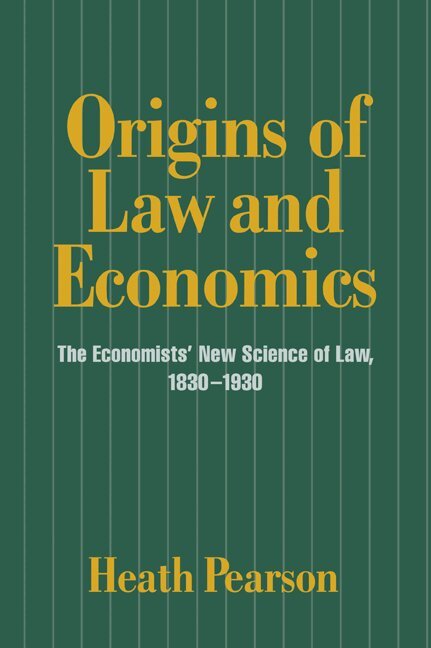
This work analyzes the centrality of law in nineteenth-century historical and institutional economics and is a prehistory to the new institutional economics of the late twentieth century. In the 1830s the 'new science of law' aimed to explain the working rules of human society by using the methodologically individualist terms of economic discourse, stressing determinism and evolutionism. Practitioners stood readier than contemporary institutionalists to admit the possibilities of altruistic values, bounded rationality, and institutional inertia into their research program. Professor Pearson shows that the positive analysis of law tended to push normative discussions up from the level of specific laws to that of society's political organization. The analysis suggests that the professionalization of the social sciences - and the new science's own imprecision - condemned the program to oblivion around 1930. Nonetheless, institutional economics is currently developing greater resemblances to the now-forgotten new science.
1 266 kr
Skickas inom 7-10 vardagar
This work analyzes the centrality of law in nineteenth-century historical and institutional economics and is a prehistory to the new institutional economics of the late twentieth century. In the 1830s the 'new science of law' aimed to explain the working rules of human society by using the methodologically individualist terms of economic discourse, stressing determinism and evolutionism. Practitioners stood readier than contemporary institutionalists to admit the possibilities of altruistic values, bounded rationality, and institutional inertia into their research program. Professor Pearson shows that the positive analysis of law tended to push normative discussions up from the level of specific laws to that of society's political organization. The analysis suggests that the professionalization of the social sciences - and the new science's own imprecision - condemned the program to oblivion around 1930. Nonetheless, institutional economics is currently developing greater resemblances to the now-forgotten new science.
1 085 kr
Skickas inom 7-10 vardagar
In Life beside Bars, Heath Pearson showcases dynamic, interdependent community as the best hope for undoing the systems of confinement that reproduce capital in Cumberland County, New Jersey-a place that is home to three state prisons, one federal prison, and the regional jail. Pearson places today’s prisons within the region’s longer history of Lenape genocide, chattel slavery, Japanese American labor camps, and other forms of racialized punishment and carceral control. From this vantage, prisons appear not as the structural fix for the region’s failed political economy but as a continuation of the carceral principle that has always sustained it. This ongoing use of confinement, though, is merely the backdrop. Through ethnographic vignettes written in story form, Pearson offers an alternative history of the unruly and unexpected ways that people resist, get by, make money, find joy, and build radical social life in the small, unseen spaces beside large-scale confinement. As such, Pearson enriches our understanding of daily life in and around prisons-in any American community-while providing a kaleidoscope of possibilities for theorizing and organizing alternative paths.
270 kr
Skickas inom 7-10 vardagar
In Life beside Bars, Heath Pearson showcases dynamic, interdependent community as the best hope for undoing the systems of confinement that reproduce capital in Cumberland County, New Jersey-a place that is home to three state prisons, one federal prison, and the regional jail. Pearson places today’s prisons within the region’s longer history of Lenape genocide, chattel slavery, Japanese American labor camps, and other forms of racialized punishment and carceral control. From this vantage, prisons appear not as the structural fix for the region’s failed political economy but as a continuation of the carceral principle that has always sustained it. This ongoing use of confinement, though, is merely the backdrop. Through ethnographic vignettes written in story form, Pearson offers an alternative history of the unruly and unexpected ways that people resist, get by, make money, find joy, and build radical social life in the small, unseen spaces beside large-scale confinement. As such, Pearson enriches our understanding of daily life in and around prisons-in any American community-while providing a kaleidoscope of possibilities for theorizing and organizing alternative paths.