Heinz J. Skala - Böcker
Visar alla böcker från författaren Heinz J. Skala. Handla med fri frakt och snabb leverans.
4 produkter
4 produkter
536 kr
Skickas inom 10-15 vardagar
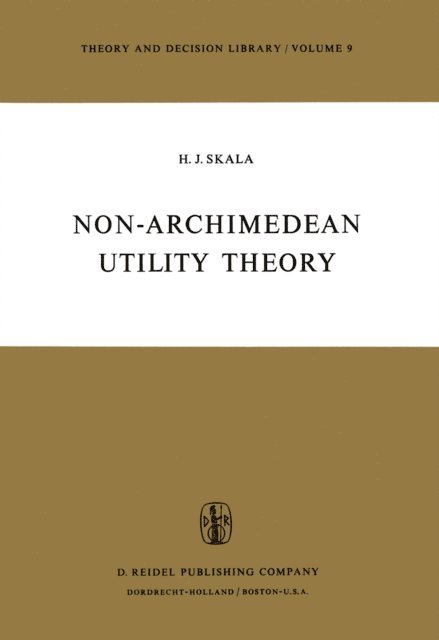
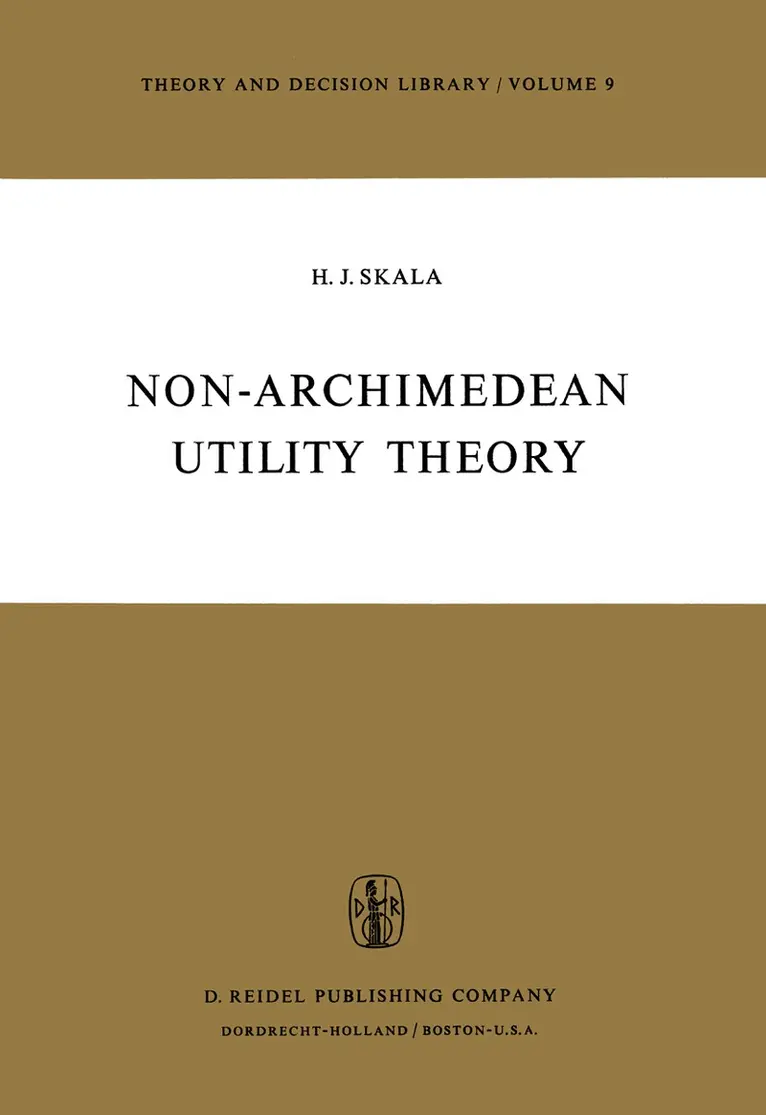
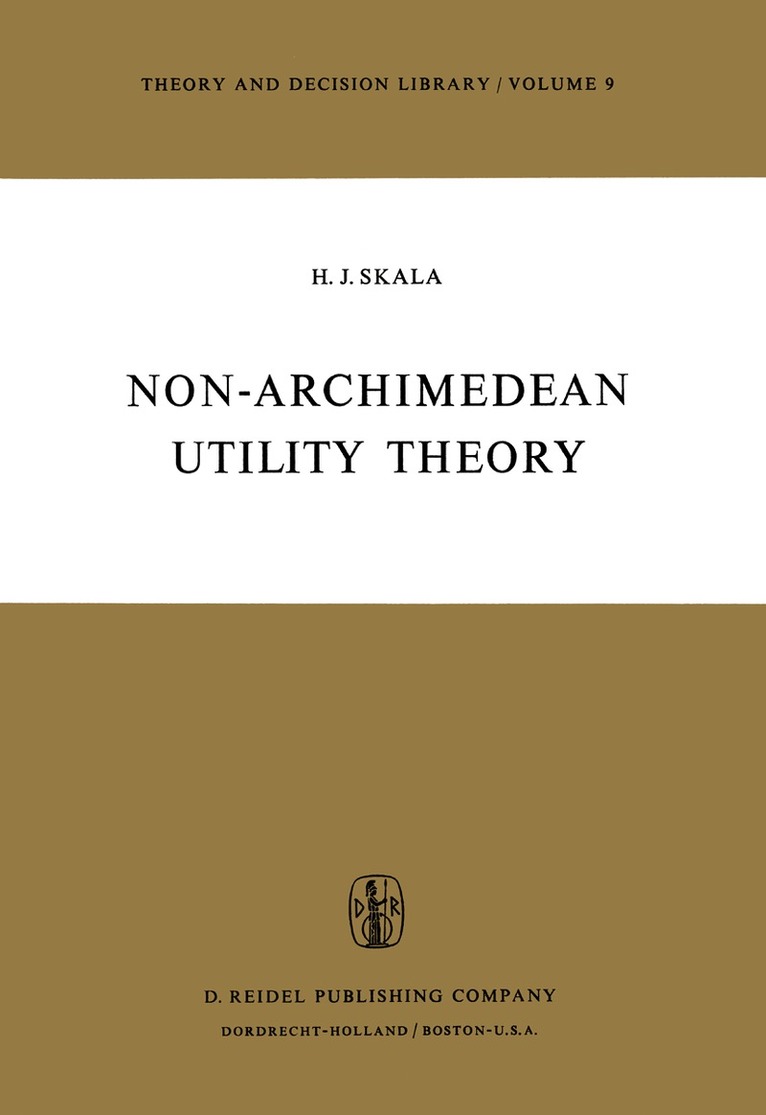
My interest in non-Archimedean utility theory and the problems related to it was aroused by discussions which I have had with Professors Werner Leinfellner and Günter Menges. On the occasion of the Second Inter national Game Theory Workshop, Berkeley, 1970, which was sponsored by the National Science Foundation, I had the opportunity to report about a result on non-standard utilities. Work on this subject continued when I was a research assistant of Professor Günter Menges at the Uni versity of Heidelberg. The present mono graph is essentially a translation of my habilitation thesis which was accepted on February 15, 1973 by the Faculty of Economics and Social Sciences at the Universtity of Heidelberg. On translating my thesis I took up some suggestions made by ProfessorWerner Böge from the Faculty of Mathematics at the Uni versity of Heidelberg. Through lack of time many of his ideas have not been taken into consideration but I hope to do so in a future paper. The first chapter should be considered as a short introduction to pref erence orderings and to the notion of a utility theory proposed by Dana Scott and Patrick Suppes. In the second chapter I discuss in some detail various problems of ordinal utility theory. Except when introducing non-standard models of the reals no use is made of concepts of model theory. This is done in deference to those readers who do not wish to be troubled by formal languages and model theory.
1 064 kr
Skickas inom 10-15 vardagar
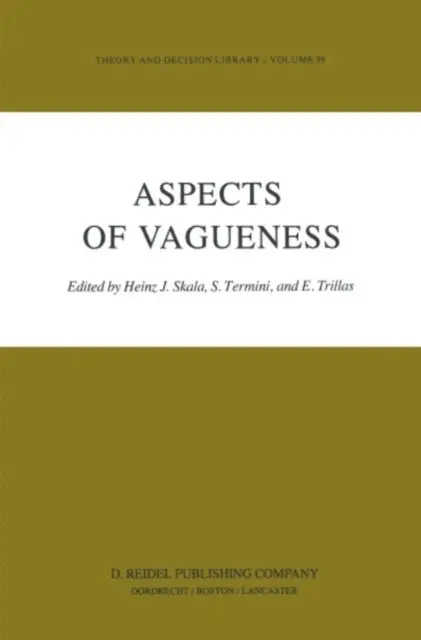
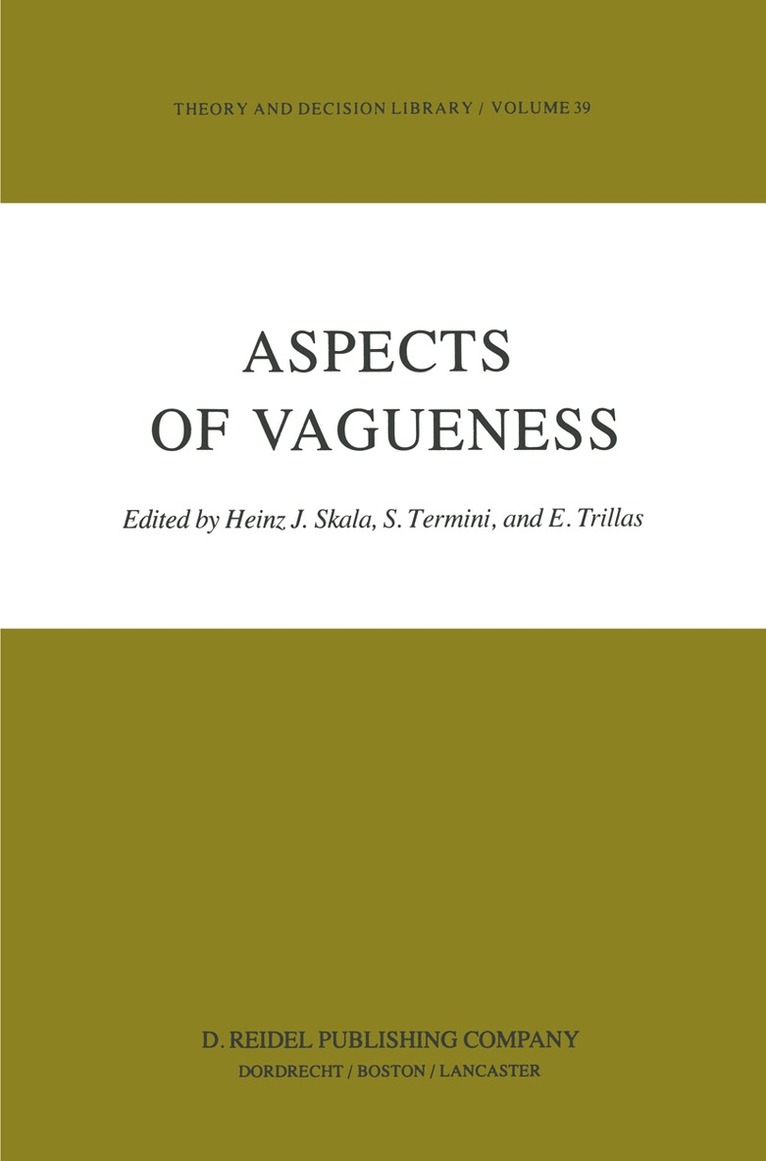
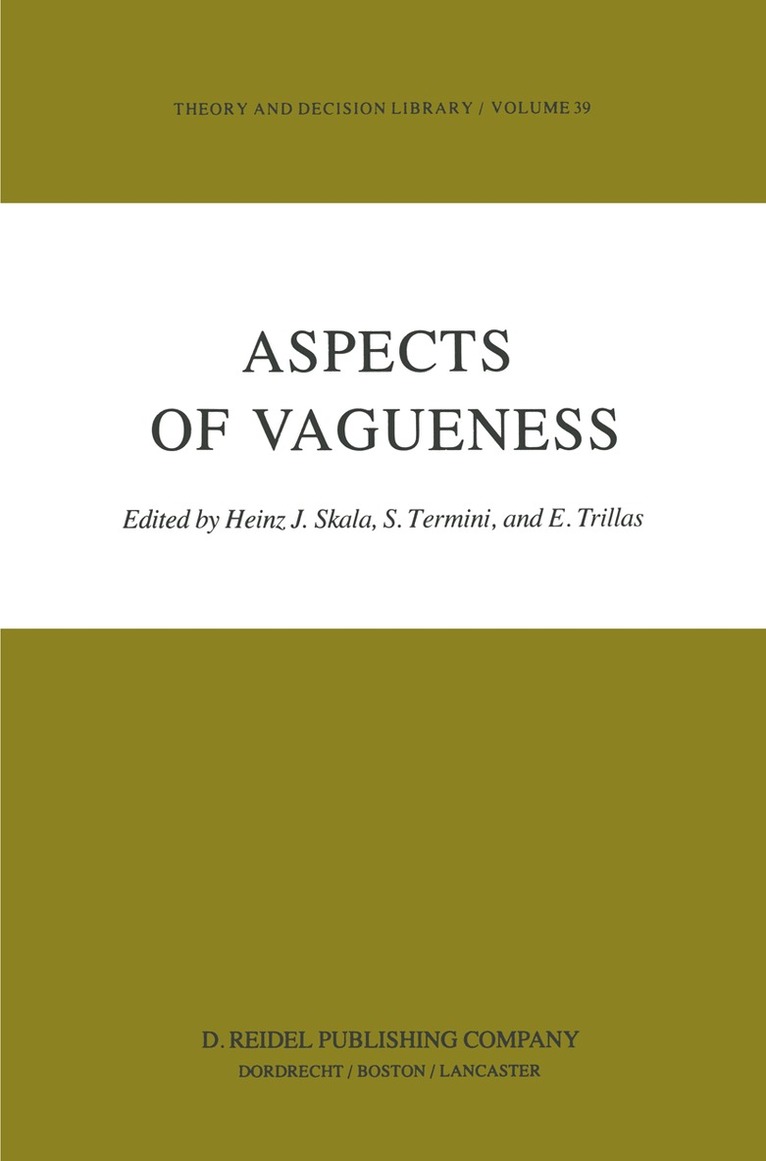
The Second World Conference on Mathematics at the Service of Man was held at the Universidad Politecnica de Las Palmas, Canary Islands, Spain, June 28 to July 3, 1982. The first volume of the Proceedings of the Conference, entitled "Functional Equations-Theory and Applications" has appeared in the Reidel series "Mathematics and Its Applications". The papers in this volume consist of the invited lectures delivered at the Conference, Section 7: Non-Classical Logics and Modelling, as well as some selected papers which offer an introduction to the philosophy, methodology and to the lite rature of the broad and fascinating field of vagueness, imprecision and uncertainty. The contributed papers appeared in the volume of photo-offset preprints distributed at the Conference. It is our hope that the papers present a good sample with respect to the background, the formalism and practice of this area of research as far as we understand it today. As the subject "Vagueness" touches many aspects of human thinking, the contributions have been made from a broad spectrum ranging from philo~ophy through pure mathematics to probability theory and mathematical economics, therefore the careful reader should find some new insights here. In conclusion, the editors want to thank all authors who have contributed to this volume; the publishers of "Commenta tiones Mathematicae Universitatis Carolinae" for permission to reprint the paper "Fuzziness and Fuzzy Equality", Commentationes Mathematicae Universitatis Carolinae 23 (1982), 249-267, and D. Reidel for friendly cooperation.
1 064 kr
Skickas inom 10-15 vardagar
The Second World Conference on Mathematics at the Service of Man was held at the Universidad Politecnica de Las Palmas, Canary Islands, Spain, June 28 to July 3, 1982. The first volume of the Proceedings of the Conference, entitled "Functional Equations-Theory and Applications" has appeared in the Reidel series "Mathematics and Its Applications". The papers in this volume consist of the invited lectures delivered at the Conference, Section 7: Non-Classical Logics and Modelling, as well as some selected papers which offer an introduction to the philosophy, methodology and to the lite rature of the broad and fascinating field of vagueness, imprecision and uncertainty. The contributed papers appeared in the volume of photo-offset preprints distributed at the Conference. It is our hope that the papers present a good sample with respect to the background, the formalism and practice of this area of research as far as we understand it today. As the subject "Vagueness" touches many aspects of human thinking, the contributions have been made from a broad spectrum ranging from philo~ophy through pure mathematics to probability theory and mathematical economics, therefore the careful reader should find some new insights here. In conclusion, the editors want to thank all authors who have contributed to this volume; the publishers of "Commenta tiones Mathematicae Universitatis Carolinae" for permission to reprint the paper "Fuzziness and Fuzzy Equality", Commentationes Mathematicae Universitatis Carolinae 23 (1982), 249-267, and D. Reidel for friendly cooperation.
536 kr
Skickas inom 10-15 vardagar
My interest in non-Archimedean utility theory and the problems related to it was aroused by discussions which I have had with Professors Werner Leinfellner and Günter Menges. On the occasion of the Second Inter national Game Theory Workshop, Berkeley, 1970, which was sponsored by the National Science Foundation, I had the opportunity to report about a result on non-standard utilities. Work on this subject continued when I was a research assistant of Professor Günter Menges at the Uni versity of Heidelberg. The present mono graph is essentially a translation of my habilitation thesis which was accepted on February 15, 1973 by the Faculty of Economics and Social Sciences at the Universtity of Heidelberg. On translating my thesis I took up some suggestions made by ProfessorWerner Böge from the Faculty of Mathematics at the Uni versity of Heidelberg. Through lack of time many of his ideas have not been taken into consideration but I hope to do so in a future paper. The first chapter should be considered as a short introduction to pref erence orderings and to the notion of a utility theory proposed by Dana Scott and Patrick Suppes. In the second chapter I discuss in some detail various problems of ordinal utility theory. Except when introducing non-standard models of the reals no use is made of concepts of model theory. This is done in deference to those readers who do not wish to be troubled by formal languages and model theory.