Henk A. Dijkstra - Böcker
Visar alla böcker från författaren Henk A. Dijkstra. Handla med fri frakt och snabb leverans.
8 produkter
8 produkter
797 kr
Skickas inom 7-10 vardagar
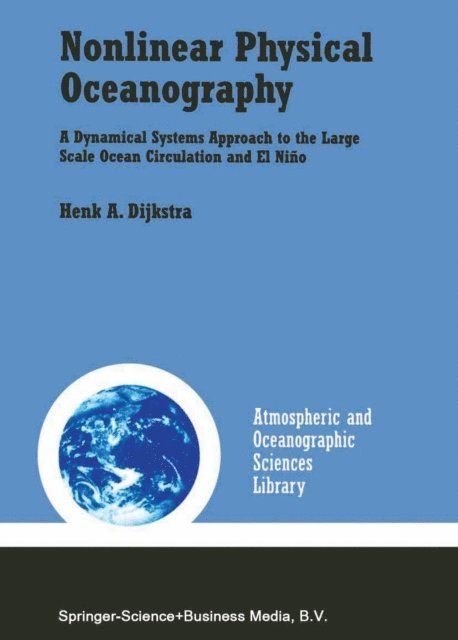
This book introduces stochastic dynamical systems theory in order to synthesize our current knowledge of climate variability. Nonlinear processes, such as advection, radiation and turbulent mixing, play a central role in climate variability. These processes can give rise to transition phenomena, associated with tipping or bifurcation points, once external conditions are changed. The theory of dynamical systems provides a systematic way to study these transition phenomena. Its stochastic extension also forms the basis of modern (nonlinear) data analysis techniques, predictability studies and data assimilation methods. Early chapters apply the stochastic dynamical systems framework to a hierarchy of climate models to synthesize current knowledge of climate variability. Later chapters analyse phenomena such as the North Atlantic Oscillation, El Niño/Southern Oscillation, Atlantic Multidecadal Variability, Dansgaard-Oeschger events, Pleistocene ice ages and climate predictability. This book will prove invaluable for graduate students and researchers in climate dynamics, physical oceanography, meteorology and paleoclimatology.
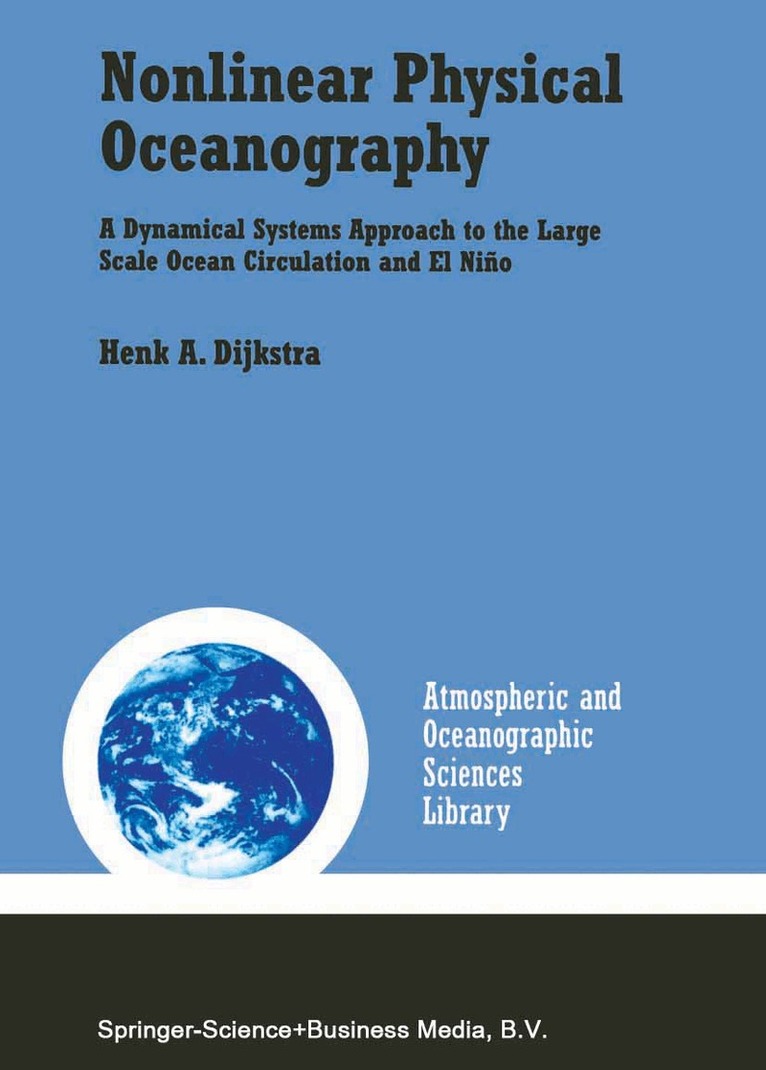
Nonlinear Physical Oceanography
A Dynamical Systems Approach to the Large Scale Ocean Circulation and El Niño
Inbunden, Engelska, 2000
1 578 kr
Skickas inom 10-15 vardagar
In this book, the methodology of dynamical systems theory is applied to investigate the physics of the global ocean circulation. Topics include the dynamics of the Gulf Stream in the Atlantic Ocean, the stability of the thermohaline circulation and the El Nino/Southern Oscillation phenomenon in the Tropical Pacific. On the other hand, the book also deals with the numerical methods for applying bifurcation analysis on large dimensional dynamical systems, with thousands or more degrees of freedom, which arise through discretization of ocean models. The novel approach in understanding the phenomena of climate variability is through a systematic analysis within a hierarchy of models using these techniques. In this way, an overview is obtained of the relations between the results of the different models within the hierarchy. Mechanistic description of the physics of the results is provided and, where possible, links with results of state-of-the-art models and observations are sought. The reader is expected to have a background in basic incompressible fluid dynamics and applied mathematics, although the level of the text is mixed and sometimes quite introductory.Each of the chapters is rather self-contained and many details of derivations are provided. The book is aimed at graduate students and researchers in meteorology, oceanography, and related fields who are interested in tackling fundamental problems in dynamical oceanography and climate dynamics.
1 521 kr
Skickas inom 7-10 vardagar
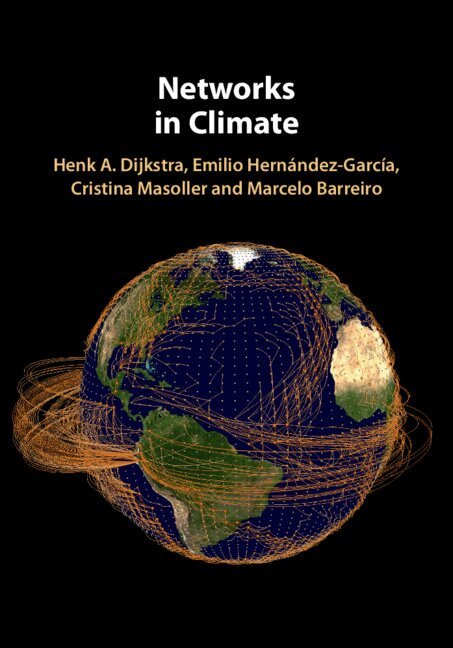
Over the last two decades the complex network paradigm has proven to be a fruitful tool for the investigation of complex systems in many areas of science; for example, the Internet, neural networks and social networks. This book provides an overview of applications of network theory to climate variability, such as the El Niño/Southern Oscillation and the Indian Monsoon, presenting recent important results obtained with these techniques and showing their potential for further development and research. The book is aimed at researchers and graduate students in climate science. A basic background in physics and mathematics is required. Several of the methodologies presented here will also be valuable to a broader audience of those interested in network science, for example, from biomedicine, ecology and economics.
825 kr
Skickas inom 7-10 vardagar
A better understanding of the mechanisms leading a fluid system to exhibit turbulent behavior is one of the grand challenges of the physical and mathematical sciences. Over the last few decades, numerical bifurcation methods have been extended and applied to a number of flow problems to identify critical conditions for fluid instabilities to occur. This book provides a state-of-the-art account of these numerical methods, with much attention to modern linear systems solvers and generalized eigenvalue solvers. These methods also have a broad applicability in industrial, environmental and astrophysical flows. The book is a must-have reference for anyone working in scientific fields where fluid flow instabilities play a role. Exercises at the end of each chapter and Python code for the bifurcation analysis of canonical fluid flow problems provide practice material to get to grips with the methods and concepts presented in the book.
Del 28 - Atmospheric and Oceanographic Sciences Library
Nonlinear Physical Oceanography
A Dynamical Systems Approach to the Large Scale Ocean Circulation and El Niño,
Inbunden, Engelska, 2005
1 064 kr
Skickas inom 10-15 vardagar
In the ?rst edition of this book (publishedby Kluwer Academic in November 2000) the methodology of dynamical systems theory was introduced and appli- ˜ cations of this theory to the large-scale ocean circulation and El Nino were p- vided. Surprisedby the favorable reactions, I decided to make a second edition of the book which could be more easily used as a textbook for a graduate (700-level) course. The ?rst edition has undergone a substantial rewrite on three aspects: (i)thetext has been adapted at manylocations to improve clarity and readability, (ii)many recent results on thewind-driven ocean circulation, thethermohaline ˜ circulation and El Nino have been included, and (iii) a number of exercises have been added at the end of each chapter. In chapter 1, the description of what is known from observations on the global ocean circulation has been improved by including, for example, recent estimates of transport quantities. Both thechapters 2 and 3 have only slightly changed; in chapter 3, the text on homoclinic orbits has been extended as these type of phenomena have now clearly been found in the wind-driven double-gyre ocean circulation (as presented in chapter 5). In chapter 4, I have added a paragraph on the computation of isolated branches of steady states and the text on the iterative linear systems solvers has been shortened.
536 kr
Skickas inom 10-15 vardagar
This textbook provides a mathematical introduction to the theory of large-scale ocean circulation and is accessible for readers with an elementary knowledge of mathematics and physics, including continuum mechanics and solution methods for ordinary differential equations. The book consists of four parts. Part I (chapters 1 - 4) is a very brief introduction to ocean circulation and the mathematical formulation of the governing equations of ocean flows. In addition, concepts are introduced that are necessary to describe and understand large-scale ocean currents. In part II (chapters 5 - 10), the theory of mid-latitude wind-driven ocean circulation is presented. The consideration of model development includes a top-down approach and reduced equations are derived using asymptotics and scaling. Part III (chapters 11 - 12) focuses on the understanding of equatorial currents and El Nino. In the last part IV, chapters 13 - 16, the theory of planetary scale flows is presented, covering topics such as the thermocline problem, the Antarctic Circumpolar Current, the stability of the thermohaline circulation and the Arctic Ocean circulation. At the end of each chapter several exercises are formulated. Many of these are aimed to further develop methodological skills and to get familiar with the physical concepts. New material is introduced in only a few of these exercises. Fully worked out answers to all exercises can be downloaded from the book web site.
536 kr
Skickas inom 10-15 vardagar
This textbook provides a mathematical introduction to the theory of large-scale ocean circulation and is accessible for readers with an elementary knowledge of mathematics and physics, including continuum mechanics and solution methods for ordinary differential equations. The book consists of four parts. Part I (chapters 1 - 4) is a very brief introduction to ocean circulation and the mathematical formulation of the governing equations of ocean flows. In addition, concepts are introduced that are necessary to describe and understand large-scale ocean currents. In part II (chapters 5 - 10), the theory of mid-latitude wind-driven ocean circulation is presented. The consideration of model development includes a top-down approach and reduced equations are derived using asymptotics and scaling. Part III (chapters 11 - 12) focuses on the understanding of equatorial currents and El Nino. In the last part IV, chapters 13 - 16, the theory of planetary scale flows is presented, covering topics such as the thermocline problem, the Antarctic Circumpolar Current, the stability of the thermohaline circulation and the Arctic Ocean circulation. At the end of each chapter several exercises are formulated. Many of these are aimed to further develop methodological skills and to get familiar with the physical concepts. New material is introduced in only a few of these exercises. Fully worked out answers to all exercises can be downloaded from the book web site.
Nonlinear Physical Oceanography
A Dynamical Systems Approach to the Large Scale Ocean Circulation and El Niño
Häftad, Engelska, 2011
1 578 kr
Skickas inom 10-15 vardagar
In this book, the methodology of dynamical systems theory is applied to investigate the physics of the global ocean circulation. Topics include the dynamics of the Gulf Stream in the Atlantic Ocean, the stability of the thermohaline circulation and the El Niño/Southern Oscillation phenomenon in the Tropical Pacific. On the other hand, the book also deals with the numerical methods for applying bifurcation analysis on large dimensional dynamical systems, with thousands or more degrees of freedom, which arise through discretization of ocean models. The novel approach in understanding the phenomena of climate variability is through a systematic analysis within a hierarchy of models using these techniques. In this way, a nice overview is obtained of the relations between the results of the different models within the hierarchy. Mechanistic description of the physics of the results is provided and, where possible, links with results of state-of-the-art models and observations are sought. The reader is expected to have a background in basic incompressible fluid dynamics and applied mathematics, although the level of the text is mixed and sometimes quite introductory. Each chapter is rather self-contained and many details of derivations are provided. The book is aimed at graduate students and researchers in meteorology, oceanography, and related fields who are interested in tackling fundamental problems in dynamical oceanography and climate dynamics.