Henk Meuzelaar - Böcker
Visar alla böcker från författaren Henk Meuzelaar. Handla med fri frakt och snabb leverans.
4 produkter
4 produkter
1 593 kr
Skickas inom 10-15 vardagar
The past decade has witnessed major advances in our understanding of the chemical composition, structure, and reactivity of the complex organic-rich fossil matter known as "coal.
534 kr
Skickas inom 10-15 vardagar
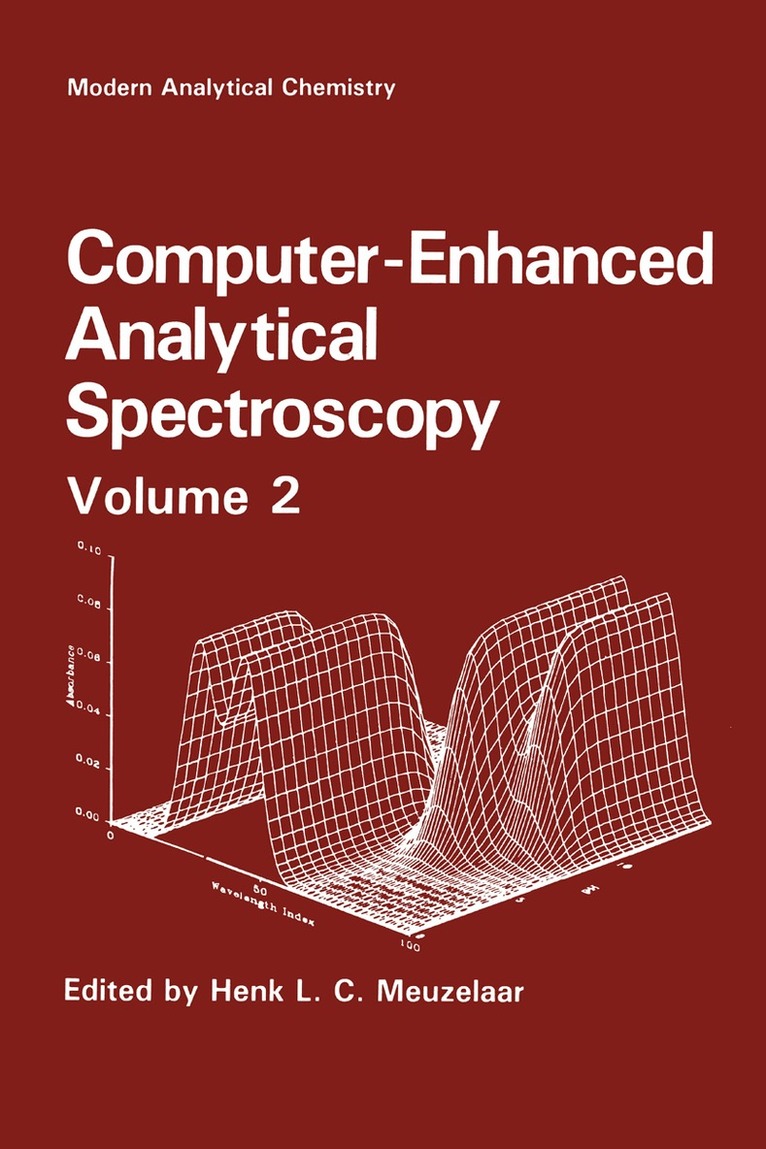
The Second Hidden Peak Symposium on Computer-Enhanced Analytical Spectroscopy, held in June, 1988, at the Snowbird Resort (Salt Lake City, Utah), centered around twelve keynote lectures delivered by some of the foremost experts and pioneers in this rapidly expanding field. The editor is highly indebted to each of these colleagues for contributing a chapter to the second volume of Computer-Enhanced Analytical Spec troscopy. The primary objective of this volume is to present a repre sentative cross-section of current activities in the field while balancing out the lighter coverage of some topics and areas in Volume 1. An exciting new topic, remote IR sensing, is covered in Chapters 4 and 5. Deconvolution and signal-processing methods have now been extended to UV/VIS (Chapter 1) and GC/MS (Chapter 3) applications. Furthermore, the development and testing of novel factor analysis techniques in the areas of UV /VIS and IR spectroscopy are discussed in Chapters 2 and 12, respectively. Fundamental aspects of library search techniques are presented in Chapters 7 (MS) and 9 (NMR). Chapters 6, 10, and 11 cover selected uses of expert systems in NMR, IR, and MS, respectively. Finally, an integrated expert system approach to the interpretation of GC/IR/MS data is outlined in Chapter 8. In an attempt to facilitate access to the various topics for the newcomer to the field, the twelve chapters have been organized into two main parts: Unsupervised Methods: Spectral Enhancement, Deconvolu tion, and Data Reduction, and Supervised Methods: Expert Systems, Modeling, and Quantitation.
534 kr
Skickas inom 10-15 vardagar
June 1986 brought together some of the world's leaders in computer enhanced analytical spectroscopy at Snowbird, Utah, for what the attendees decided to call "The First Hidden Peak Symposium." With the remarkable advances in both computer hardware and software, it is interesting to observe that, while many computational aspects of spectroscopic analysis have become routine, some of the more fundamental problems remain unsolved. The group that assembled included many of those who started trying to interpret chemical spectroscopy when computers were ponderous, slow, and not very accessible, as well as newcomers who never knew the day that spectrometers were delivered without attached computers. The synergism was excellent. Many new ideas, as well as this volume, resulted from interactions among the participants. The conclusion was that progress would be made on more fundamen tal problems now that hardware, software, and mathematics were coming together on a more sophisticated level. The feeling was that the level of sophistication is now adequate and that it is only a matter of time before automated spectral interpretation surpasses all but the most advanced human experts.
1 588 kr
Skickas inom 10-15 vardagar
The past decade has witnessed major advances in our understanding of the chemical composition, structure, and reactivity of the complex organic-rich fossil matter known as "coal. " Nevertheless, important scientific questions concerning molecular weight distributions, degree of crosslinking, typical duster sizes, type of interconnecting bridges, the possible role of a "mobile phase," and the nature of organic sulfur forms remain topics of heated debate. Moreover, there appears to be a notable lack of consensus regarding the overall direction and goals of structural elucidation work. Is it worthwhile to study whole coal samples, or should we separate out the various, more or less well-defined, maceral and mineral constituents before attempting to describe the structural and compositional features of coal at the molecular Ievel? Second, should there be more emphasis on key structural features and average statistical parameters, or is it necessary to identify individual chemical structures in considerable detail? From the developments of the past decade it is clear that advanced spectroscopic techniques are playing an increasingly important role in resolving difficult questions with regard to the chemical structure and composition of coal. Moreover, it has become equally clear that no single spectroscopic approach can provide all the answers but multiple techniques need to be used in a highly integrated and synergistic manner.