Henry Reichman - Böcker
Visar alla böcker från författaren Henry Reichman. Handla med fri frakt och snabb leverans.
4 produkter
4 produkter
412 kr
Skickas inom 7-10 vardagar
Railwaymen and Revolution: Russia, 1905 provides a deep and meticulously researched exploration of the role that railroad workers played in shaping one of the most transformative moments in Russian revolutionary history. More than a simple prelude to the October Revolution of 1917, the events of 1905 fundamentally redefined class struggle, social consciousness, and the relationship between workers and the broader revolutionary movement. This book situates railway workers within the broader context of Russia’s rapidly industrializing landscape, revealing how their unique position—both economically and geographically—made them central to the strike movements that characterized the revolution. As a workforce spanning across vast stretches of the empire, railroad laborers served as both a conduit for revolutionary ideas and a formidable force in their own right, shaping the dynamics of class consciousness in ways that extended beyond traditional factory settings.Through a combination of historical analysis and political theory, the book examines how railway workers navigated the complex intersection of economic grievances, professional identity, and political struggle. The author highlights the conflicting pressures exerted by the managerial elite, liberal reformers, and socialist radicals, illustrating how these tensions played out within the labor movement itself. The study also challenges traditional interpretations of Russian labor history by demonstrating that class consciousness was not an inevitable byproduct of industrialization but rather a contested and evolving process. By focusing on the railroads, the book offers a fresh perspective on the 1905 revolution, making it an essential read for scholars of Russian history, labor studies, and revolutionary movements.This title is part of UC Press's Voices Revived program, which commemorates University of California Press’s mission to seek out and cultivate the brightest minds and give them voice, reach, and impact. Drawing on a backlist dating to 1893, Voices Revived makes high-quality, peer-reviewed scholarship accessible once again using print-on-demand technology. This title was originally published in 1987.
1 513 kr
Skickas inom 3-6 vardagar
Railwaymen and Revolution: Russia, 1905 provides a deep and meticulously researched exploration of the role that railroad workers played in shaping one of the most transformative moments in Russian revolutionary history. More than a simple prelude to the October Revolution of 1917, the events of 1905 fundamentally redefined class struggle, social consciousness, and the relationship between workers and the broader revolutionary movement. This book situates railway workers within the broader context of Russia’s rapidly industrializing landscape, revealing how their unique position—both economically and geographically—made them central to the strike movements that characterized the revolution. As a workforce spanning across vast stretches of the empire, railroad laborers served as both a conduit for revolutionary ideas and a formidable force in their own right, shaping the dynamics of class consciousness in ways that extended beyond traditional factory settings.Through a combination of historical analysis and political theory, the book examines how railway workers navigated the complex intersection of economic grievances, professional identity, and political struggle. The author highlights the conflicting pressures exerted by the managerial elite, liberal reformers, and socialist radicals, illustrating how these tensions played out within the labor movement itself. The study also challenges traditional interpretations of Russian labor history by demonstrating that class consciousness was not an inevitable byproduct of industrialization but rather a contested and evolving process. By focusing on the railroads, the book offers a fresh perspective on the 1905 revolution, making it an essential read for scholars of Russian history, labor studies, and revolutionary movements.This title is part of UC Press's Voices Revived program, which commemorates University of California Press’s mission to seek out and cultivate the brightest minds and give them voice, reach, and impact. Drawing on a backlist dating to 1893, Voices Revived makes high-quality, peer-reviewed scholarship accessible once again using print-on-demand technology. This title was originally published in 1987.
302 kr
Tillfälligt slut
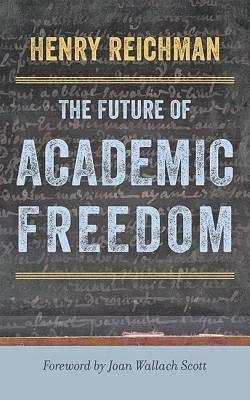
Few issues are as hotly debated or misunderstood as academic freedom. Reichman's book sheds light on and brings clarity to those debates.Winner of the Eli M. Oboler Memorial Award by the American Library AssociationAcademic freedom—crucial to the health of American higher education—is threatened on many fronts. In The Future of Academic Freedom, a leading scholar equips us to defend academic freedom by illuminating its meaning, the challenges it faces, and its relation to freedom of expression.In the wake of the 2016 election, challenges to academic freedom have intensified, higher education has become a target of attacks by conservatives, and issues of free speech on campus have grown increasingly controversial. In this book, Henry Reichman cuts through much of the rhetoric to issue a clarion call on behalf of academic freedom as it has been defined and defended by the American Association of University Professors (AAUP) for over a hundred years. Along the way, he makes it clear that this is the issue of our day.Over the course of ten audacious essays, Reichman explores the theory, history, and contemporary practice of academic freedom. He pays attention to such varied concerns as the meddling of politicians and corporate trustees in curriculum and university governance, the role of online education, the impact of social media, the rights of student protesters and outside speakers, the relationship between collective bargaining and academic freedom, and the influence on research and teaching of ideologically motivated donors. Significantly, he debunks myths about the strength of the alleged opposition to free expression posed by student activism and shows that the expressive rights of students must be defended as part of academic freedom.Based on broad reading in such diverse fields as educational theory, law, history, and political science, as well as on the AAUP's own investigative reporting, The Future of Academic Freedom combines theoretical sweep with the practical experience of its author, a leader and activist in the AAUP who is an expert on campus free speech. The issues Reichman considers—which are the subjects of daily conversation on college and university campuses nationwide as well as in the media—will fascinate general readers, students, and scholars alike.
296 kr
Skickas inom 7-10 vardagar
In the evolving landscape of academic freedom in America, this second edition addresses the latest challenges and developments in the field.Since the publication of the first edition of Understanding Academic Freedom, the never-ending struggle to defend academic freedom has entered a demonstrably new phase. Legislation determining what can and cannot be taught in schools in Florida, Texas, and other states has intensified governing board activism that impinges on widely accepted faculty prerogatives. Major donors in research, teaching, and institutional governance have grown bold in their interference. Highly polarizing controversies over antisemitism and the Israeli-Palestinian conflict, as well as debates over diversity, equity, and inclusion policies, continue to broil. Taken as a whole, these developments indicate that we have entered a new period in the history of American academic freedom. Academic freedom, long heralded as a core value of American higher education, may now be in as much danger as at any time since the 1950s. But what is academic freedom? Is it the right of faculty members to teach whatever they wish; a value upheld for supporters, but not opponents, amid polarizing controversy; or a narrow claim of privilege by a professorial elite, immune from public accountability? Henry Reichman, who chaired the American Association of University Professors' Committee A on Academic Freedom and Tenure for nearly a decade, mounts a rigorous defense of academic freedom and its principal means of protection: the system of academic tenure. Probing academic freedom's role in multiple contexts, Reichman draws on a wealth of historical and contemporary examples to offer a comprehensive introduction to the concept in all its manifestations. This second edition addresses the most recent and pressing issues in academic freedom, making it an indispensable resource for understanding the current controversial climate.