Herbert Hoijtink - Böcker
Visar alla böcker från författaren Herbert Hoijtink. Handla med fri frakt och snabb leverans.
4 produkter
4 produkter
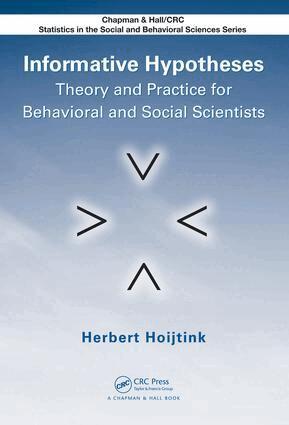
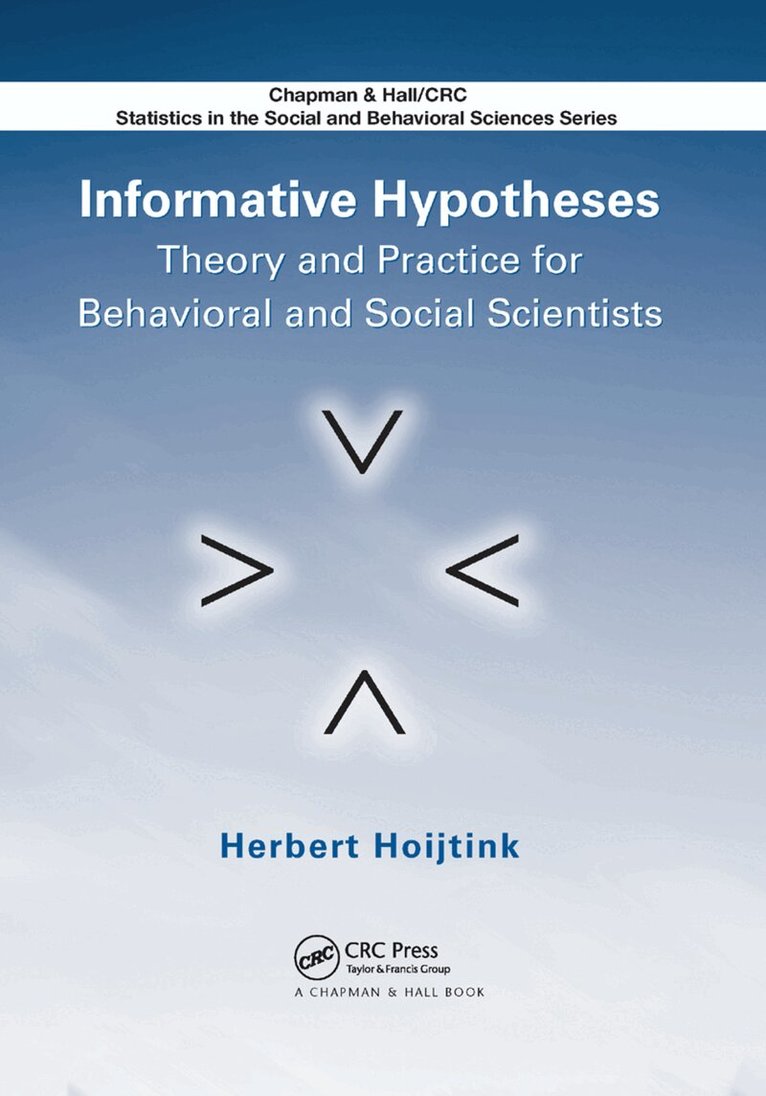
Informative Hypotheses
Theory and Practice for Behavioral and Social Scientists
Häftad, Engelska, 2019
929 kr
Skickas inom 10-15 vardagar
When scientists formulate their theories, expectations, and hypotheses, they often use statements like: ``I expect mean A to be bigger than means B and C"; ``I expect that the relation between Y and both X1 and X2 is positive"; and ``I expect the relation between Y and X1 to be stronger than the relation between Y and X2". Stated otherwise, they formulate their expectations in terms of inequality constraints among the parameters in which they are interested, that is, they formulate Informative Hypotheses.There is currently a sound theoretical foundation for the evaluation of informative hypotheses using Bayes factors, p-values and the generalized order restricted information criterion. Furthermore, software that is often free is available to enable researchers to evaluate the informative hypotheses using their own data. The road is open to challenge the dominance of the null hypothesis for contemporary research in behavioral, social, and other sciences.
1 034 kr
Skickas inom 10-15 vardagar
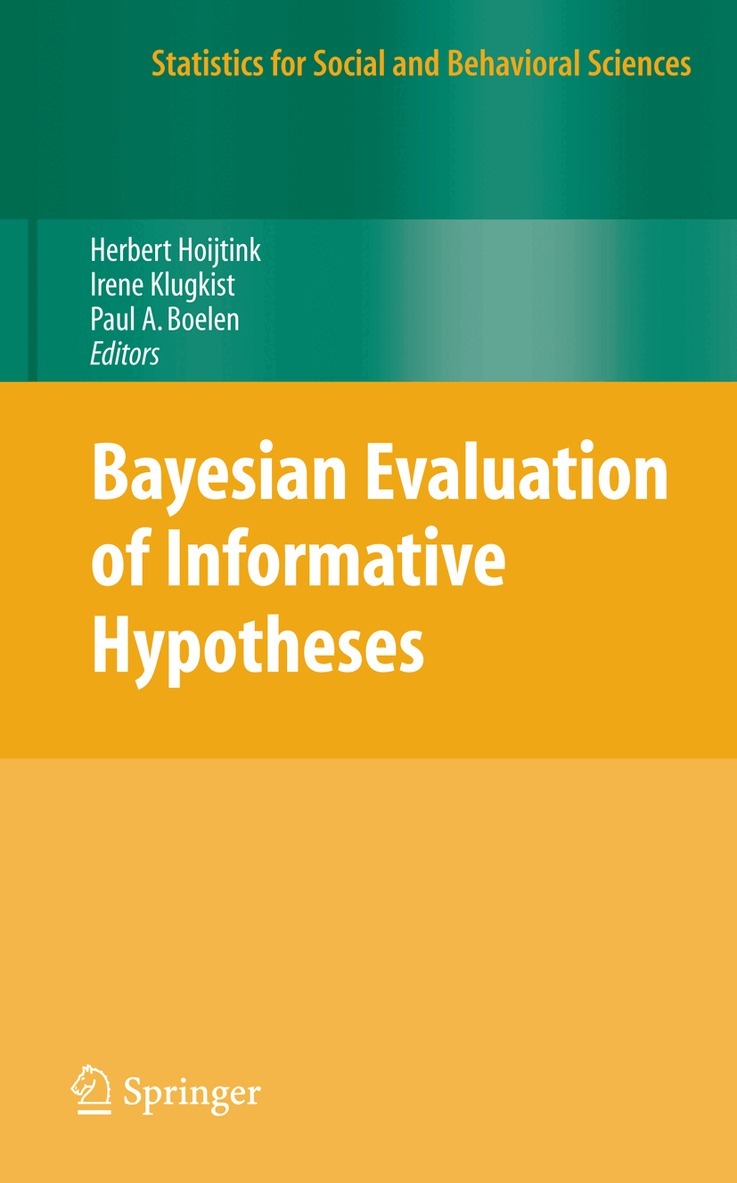
This book provides an overview of the developments in the area of Bayesian evaluation of informative hypotheses that took place since the publication of the ?rst paper on this topic in 2001 [Hoijtink, H. Con?rmatory latent class analysis, model selection using Bayes factors and (pseudo) likelihood ratio statistics. Multivariate Behavioral Research, 36, 563–588]. The current state of a?airs was presented and discussed by the authors of this book during a workshop in Utrecht in June 2007. Here we would like to thank all authors for their participation, ideas, and contributions. We would also like to thank Sophie van der Zee for her editorial e?orts during the construction of this book. Another word of thanks is due to John Kimmel of Springer for his con?dence in the editors and authors. Finally, we would like to thank the Netherlands Organization for Scienti?c Research (NWO) whose VICI grant (453-05-002) awarded to the ?rst author enabled the organization of the workshop, the writing of this book, and continuation of the research with respect to Bayesian evaluation of informative hypotheses.
Informative Hypotheses
Theory and Practice for Behavioral and Social Scientists
Inbunden, Engelska, 2011
1 397 kr
Skickas inom 10-15 vardagar
When scientists formulate their theories, expectations, and hypotheses, they often use statements like: ``I expect mean A to be bigger than means B and C"; ``I expect that the relation between Y and both X1 and X2 is positive"; and ``I expect the relation between Y and X1 to be stronger than the relation between Y and X2". Stated otherwise, they formulate their expectations in terms of inequality constraints among the parameters in which they are interested, that is, they formulate Informative Hypotheses.There is currently a sound theoretical foundation for the evaluation of informative hypotheses using Bayes factors, p-values and the generalized order restricted information criterion. Furthermore, software that is often free is available to enable researchers to evaluate the informative hypotheses using their own data. The road is open to challenge the dominance of the null hypothesis for contemporary research in behavioral, social, and other sciences.
1 175 kr
Skickas inom 10-15 vardagar
This book provides an overview of the developments in the area of Bayesian evaluation of informative hypotheses that took place since the publication of the ?rst paper on this topic in 2001 [Hoijtink, H. Con?rmatory latent class analysis, model selection using Bayes factors and (pseudo) likelihood ratio statistics. Multivariate Behavioral Research, 36, 563–588]. The current state of a?airs was presented and discussed by the authors of this book during a workshop in Utrecht in June 2007. Here we would like to thank all authors for their participation, ideas, and contributions. We would also like to thank Sophie van der Zee for her editorial e?orts during the construction of this book. Another word of thanks is due to John Kimmel of Springer for his con?dence in the editors and authors. Finally, we would like to thank the Netherlands Organization for Scienti?c Research (NWO) whose VICI grant (453-05-002) awarded to the ?rst author enabled the organization of the workshop, the writing of this book, and continuation of the research with respect to Bayesian evaluation of informative hypotheses.