Herbert I. London – författare
Visar alla böcker från författaren Herbert I. London. Handla med fri frakt och snabb leverans.
11 produkter
11 produkter
The Sunni Vanguard: Can Egypt, Turkey, and Saudi Arabia Survive the New Middle East?
Häftad, Engelska
230 kr
Skickas inom 3-6 vardagar
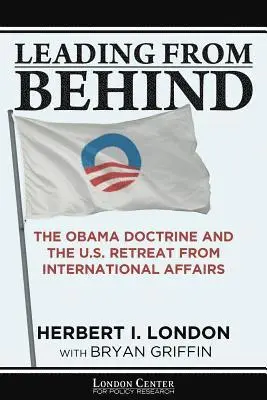
Leading From Behind: The Obama Doctrine and the U.S. Retreat From International Affairs
Häftad, Engelska, 2017
240 kr
Skickas inom 3-6 vardagar
466 kr
Skickas inom 10-15 vardagar
Diary of a Dean is a memoir of Herbert London's years at New York University. It follows his personal path from professor and ombudsman to dean of a new "experimental" college. The period in question parallels a tumultuous era in higher education. London's experiences placed him in the eye of the academic hurricane.Although there was considerable debate about the content and nature of higher education in this overheated period, London attempted to maintain a balance between a traditional devotion to the canon of western civilization and emerging technologies and innovations that permit a flexible delivery of education. Maintaining this balance, as London's words indicate, was not easy. There were pressures from many quarters including, most significantly, the polarization of the faculty. Serving as a dean in an experimental college and, at the same time, remaining devoted to a Matthew Arnoldian view of the curriculum was not something he anticipated as a youthful professor. But for anyone eager to learn about the evolution of higher education in the last few decades, this book is indispensable reading.
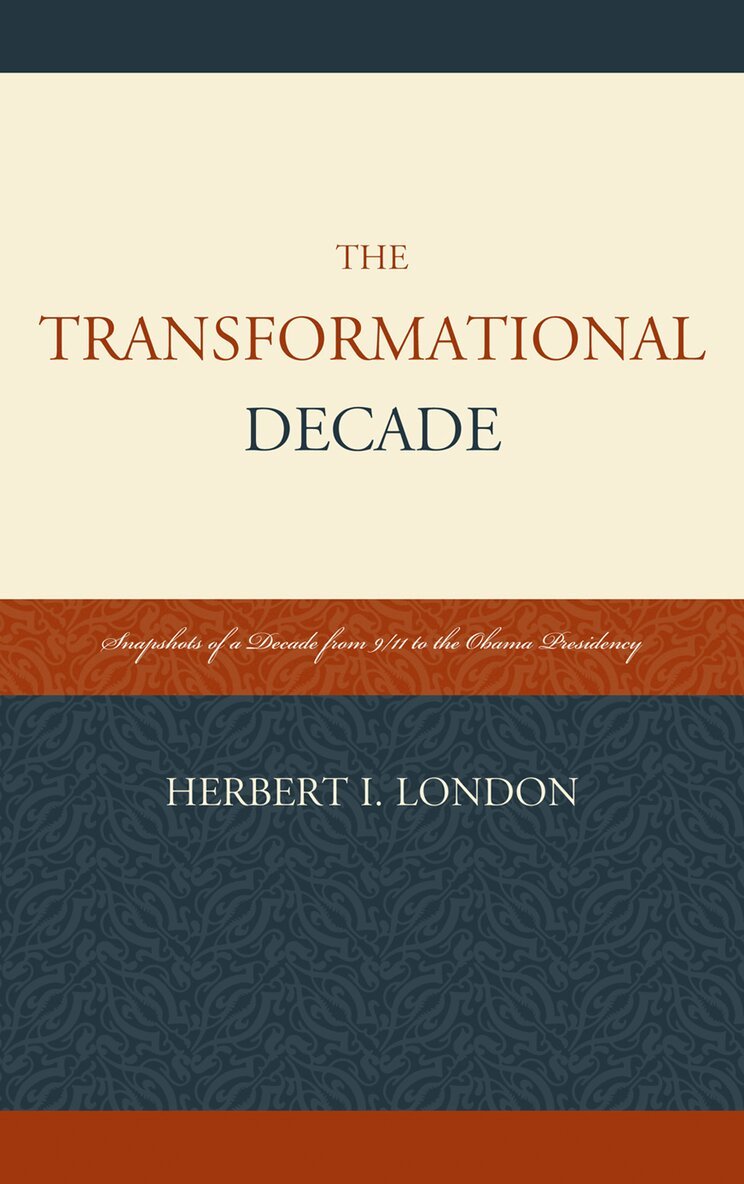
Transformational Decade
Snapshots of a Decade from 9/11 to the Obama Presidency
Häftad, Engelska, 2013
507 kr
Skickas inom 10-15 vardagar
The Transformational Decade shows the transformation that took place in American life from the attack on the World Trade Center to the emergence of the Obama presidency. It is not a strict history, but rather snapshots of a decade that has fundamentally altered perceptions of the United States.In some respects, this book is modeled after Frederick Lewis Allen’s Only Yesterday and Since Yesterday, acclaimed books that sought to capture the spirit of the 1920s and ’30s. London sees the period from 2001 to 2008 as “post yesterday,” a period that broke with the past, challenged the essence of the free market, and contested America’s role on the world stage.In an effort to limn these snapshots from recent history, London has written several “decade” books: The Overheated Decade, The Counterfeit Decade, and The Decade of Denial. This book, The Transformational Decade, differs in that it represents a separation from the past. London illuminates a decade that he considers to be a new and more frightful period than any in recent American history.
612 kr
Tillfälligt slut
The classroom texts presently in use on the subject of nuclear weapons provide ample evidence that a biased version of peace studies has insinuated itself into the school curriculum at all levels of study, whereby these guides represent a blatant ideological slant in the direction of unilateral disarmament and portray the United States as the culprit in the 'arms race.' This book advocates the restoration of a balanced view to the study of national security.
300 kr
Tillfälligt slut
The classroom texts presently in use on the subject of nuclear weapons provide ample evidence that a biased version of peace studies has insinuated itself into the school curriculum at all levels of study, whereby these guides represent a blatant ideological slant in the direction of unilateral disarmament and portray the United States as the culprit in the 'arms race.' This book advocates the restoration of a balanced view to the study of national security.
570 kr
Tillfälligt slut
"In the mid 1930s, with war clouds already on the European horizon, George Orwell surveyed the conditions and noted 'The first duty of intelligent men is the restatement of the obvious.' That same condition exists and the same conclusion is warranted. It is obvious that the West has lost a sense of ideological purpose. It is obvious that we do not use our strengthóour traditionóas the bulwark of policy. It is obvious that we have lost the moral high ground in international politics. It is obvious that internal political fissures make it very difficult to establish a bipartisan foreign policy. It is obvious that the enemies of 'peace' have preempted the word for their own malevolent or naive purposes. It is obvious that we do not exploit Soviet weaknesses. And it is especially obvious that the consensus needed for building a firm Western Alliance is not evident. There is no easy statement to redress the obvious. But I am confident that the assertion of a commonly held principle derived from our tradition can help articulate policy and build the consensus needed for our relationship with the Soviet Union. It is on the unalloyed rock of freedom that this policy recommendation rests and for which there will be no apologies."óHerbert I. London from the text Co-published with the Hudson Institute.
1 132 kr
Tillfälligt slut
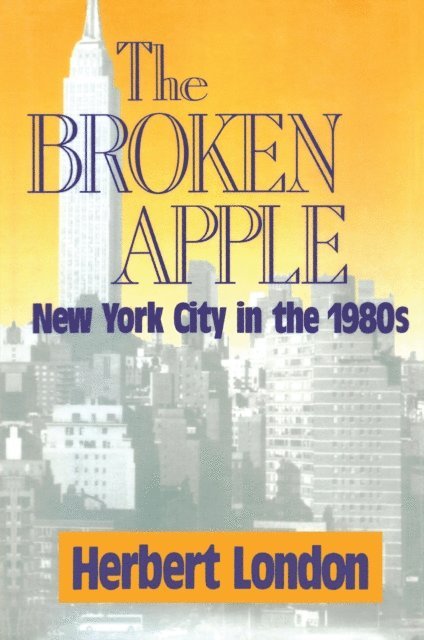
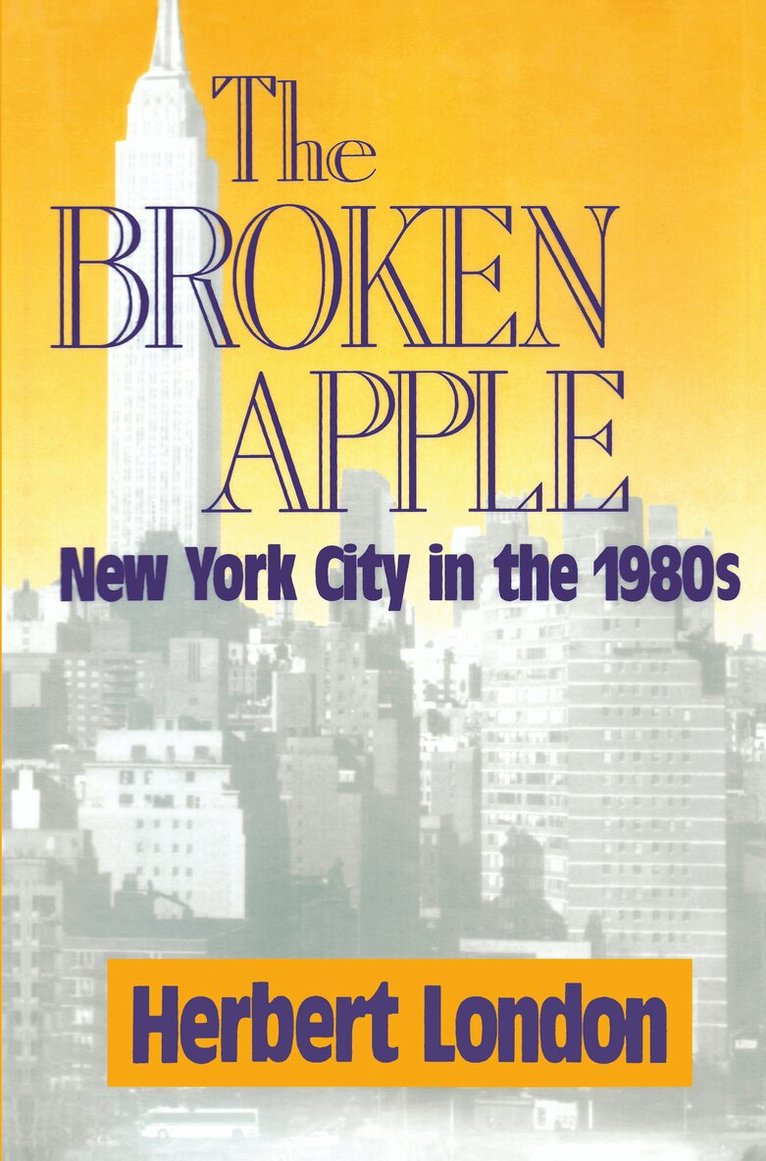
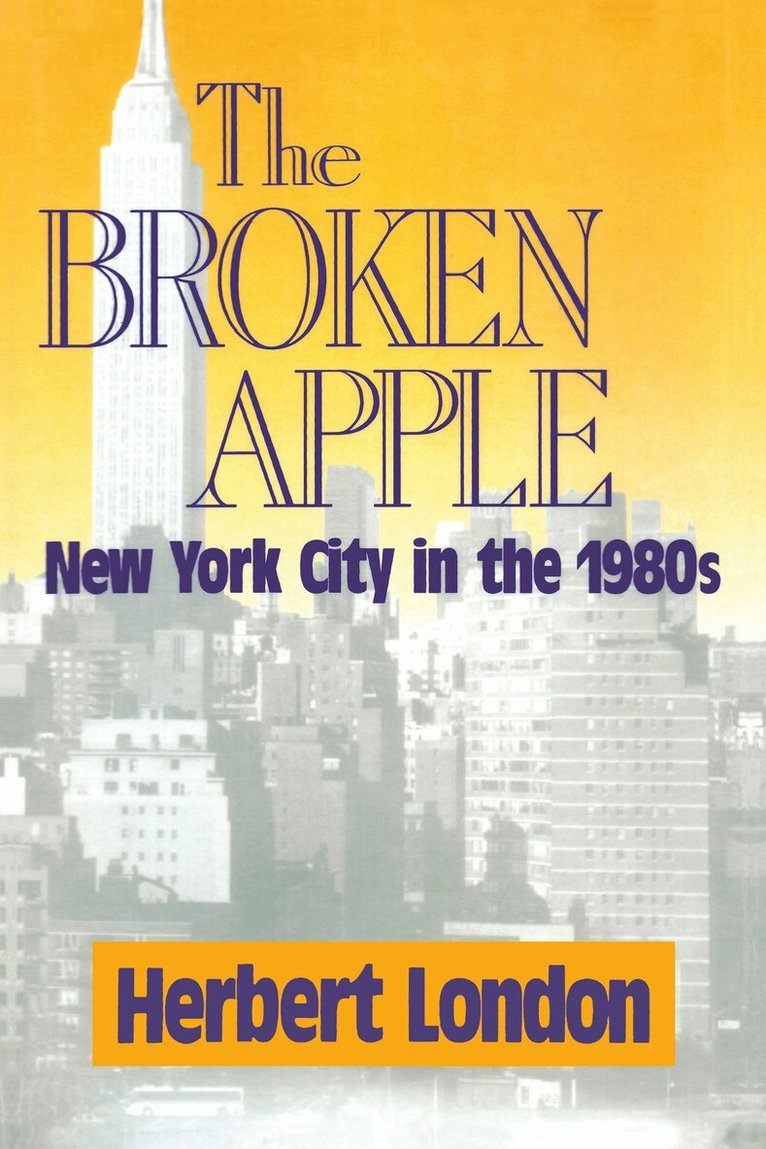
On the brink of bankruptcy in the 1970s, New York City has been restored as a center of economic and cultural vitality in the 1980s. But it has also become an increasingly brutal place, where incivility reigns, drugs lace the streets, and crime is so pervasive that most New Yorkers now consider it a permanent fixture, like gray skies and impossible traffic. What is it that continues to draw people to this city of contradictions?Born and educated in New York, Herbert London knows this city of dreams as few do. The Broken Apple is based on his keen observations of New York's social, political, and cultural life over the critical decade of the 1980s. London examines the city's continuing failures, including a city administration unable to meet the most basic citizen needs or to assure safety and security. He sees schools that have become mean-spirited, with teachers unable to teach, administrators unable to maintain order, and students unable to learn. He describes the new slaves of New York as those in search of a place to live, in a city where housing is in shorter supply than in any other major city in the nation. London asks why, despite all this, everything is bigger than life in New York, and finds the answer in New York's role as the nation's communications hub and the measuring rod by which other cities are judged.London writes with knowledgeable affection about this very special place, where the mundane is freely converted into the metaphorical. His book is an excursion, a guide to what is good, what is bad, and what is awful in the city. It is a montage of the years of Mayor Koch, the period many have described as the city's fin de siecle. But it is also a perscriptive book, pointing out what can be done in practical ways to improve life.The Broken Apple will be of interest to urban specialists as well as those for whom New York is an aspiration or a reality. Like the city itself, the book has something for everyone, from visions of political corruption to acts of redemption. Above all, it captures the pulsating rhythm of this unique city
180 kr
Skickas inom 10-15 vardagar
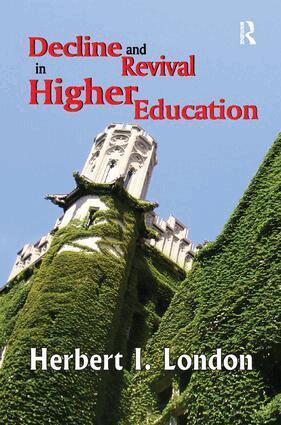
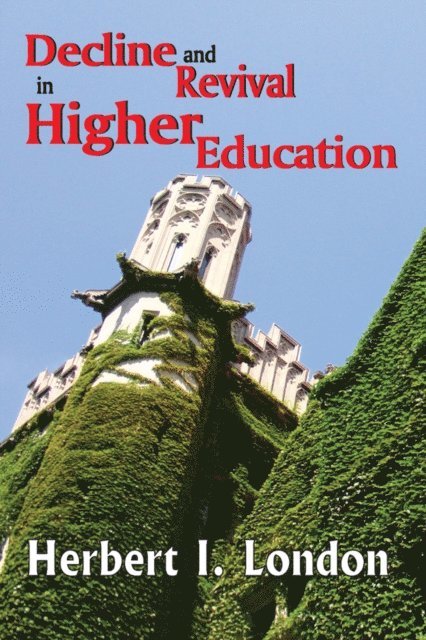
This is an analysis of higher education in the past half century, a period of dramatic change and democratization. But it is more than that. The author has been a participant in the struggle to stem the decline in higher education, as it moved from an emphasis on classical liberal values toward relativism and ideological extremism. This volume reflects an awareness of what has been lost, but sees hope for a revival of traditional values as technological change and awareness of failure forces institutions to examine their premise. Herbert I. London has provided here fuel for fundamental redirection in American college and university affairs. Decline and Revival in Higher Education is uncompromising in its concerns, but points the way toward a future linked to the best of the past.The work follows the personal evolution of the author, while at the same time, describes the devolution of university standards in such institutions as Columbia, Duke, the University of California at Berkeley, and New York University. While seeing optimistic trends in oases of traditional programming that can serve as a counterweight to campus orthodoxies, London argues that the dramatic transformation of the academy cannot be denied. The social sciences and humanities in particular have become isolated from mainstream requirements in the nation.London deals with concrete concerns, such as the collapse of classic book programs in the contemporary curriculum, the decline and even vigilante raids on opposition in campus publications, the collapse of moral judgment in favor of pure relativism, the transformation of many museums into a storage houses of debris, and the confusion of coarse language with democratization. These developments lead the author to write this book, for if the culture wars are over, the American people may be the losers.
624 kr
Skickas inom 10-15 vardagar
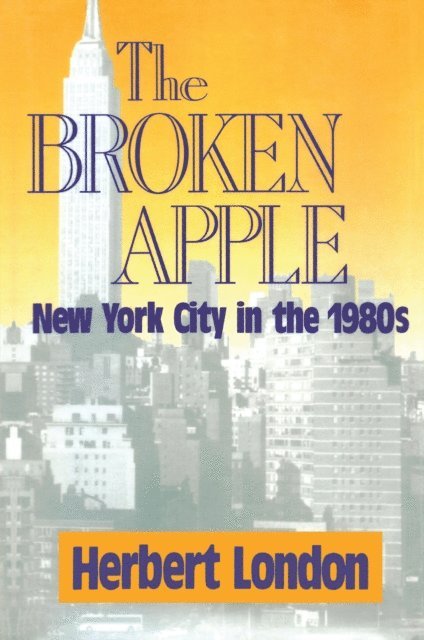
On the brink of bankruptcy in the 1970s, New York City has been restored as a center of economic and cultural vitality in the 1980s. But it has also become an increasingly brutal place, where incivility reigns, drugs lace the streets, and crime is so pervasive that most New Yorkers now consider it a permanent fixture, like gray skies and impossible traffic. What is it that continues to draw people to this city of contradictions?Born and educated in New York, Herbert London knows this city of dreams as few do. The Broken Apple is based on his keen observations of New York's social, political, and cultural life over the critical decade of the 1980s. London examines the city's continuing failures, including a city administration unable to meet the most basic citizen needs or to assure safety and security. He sees schools that have become mean-spirited, with teachers unable to teach, administrators unable to maintain order, and students unable to learn. He describes the new slaves of New York as those in search of a place to live, in a city where housing is in shorter supply than in any other major city in the nation. London asks why, despite all this, everything is bigger than life in New York, and finds the answer in New York's role as the nation's communications hub and the measuring rod by which other cities are judged.London writes with knowledgeable affection about this very special place, where the mundane is freely converted into the metaphorical. His book is an excursion, a guide to what is good, what is bad, and what is awful in the city. It is a montage of the years of Mayor Koch, the period many have described as the city's fin de siecle. But it is also a perscriptive book, pointing out what can be done in practical ways to improve life.The Broken Apple will be of interest to urban specialists as well as those for whom New York is an aspiration or a reality. Like the city itself, the book has something for everyone, from visions of political corruption to acts of redemption. Above all, it captures the pulsating rhythm of this unique city
2 196 kr
Skickas inom 10-15 vardagar
This is an analysis of higher education in the past half century, a period of dramatic change and democratization. But it is more than that. The author has been a participant in the struggle to stem the decline in higher education, as it moved from an emphasis on classical liberal values toward relativism and ideological extremism. This volume reflects an awareness of what has been lost, but sees hope for a revival of traditional values as technological change and awareness of failure forces institutions to examine their premise. Herbert I. London has provided here fuel for fundamental redirection in American college and university affairs. Decline and Revival in Higher Education is uncompromising in its concerns, but points the way toward a future linked to the best of the past.The work follows the personal evolution of the author, while at the same time, describes the devolution of university standards in such institutions as Columbia, Duke, the University of California at Berkeley, and New York University. While seeing optimistic trends in oases of traditional programming that can serve as a counterweight to campus orthodoxies, London argues that the dramatic transformation of the academy cannot be denied. The social sciences and humanities in particular have become isolated from mainstream requirements in the nation.London deals with concrete concerns, such as the collapse of classic book programs in the contemporary curriculum, the decline and even vigilante raids on opposition in campus publications, the collapse of moral judgment in favor of pure relativism, the transformation of many museums into a storage houses of debris, and the confusion of coarse language with democratization. These developments lead the author to write this book, for if the culture wars are over, the American people may be the losers.