Howell Tong – författare
Visar alla böcker från författaren Howell Tong. Handla med fri frakt och snabb leverans.
8 produkter
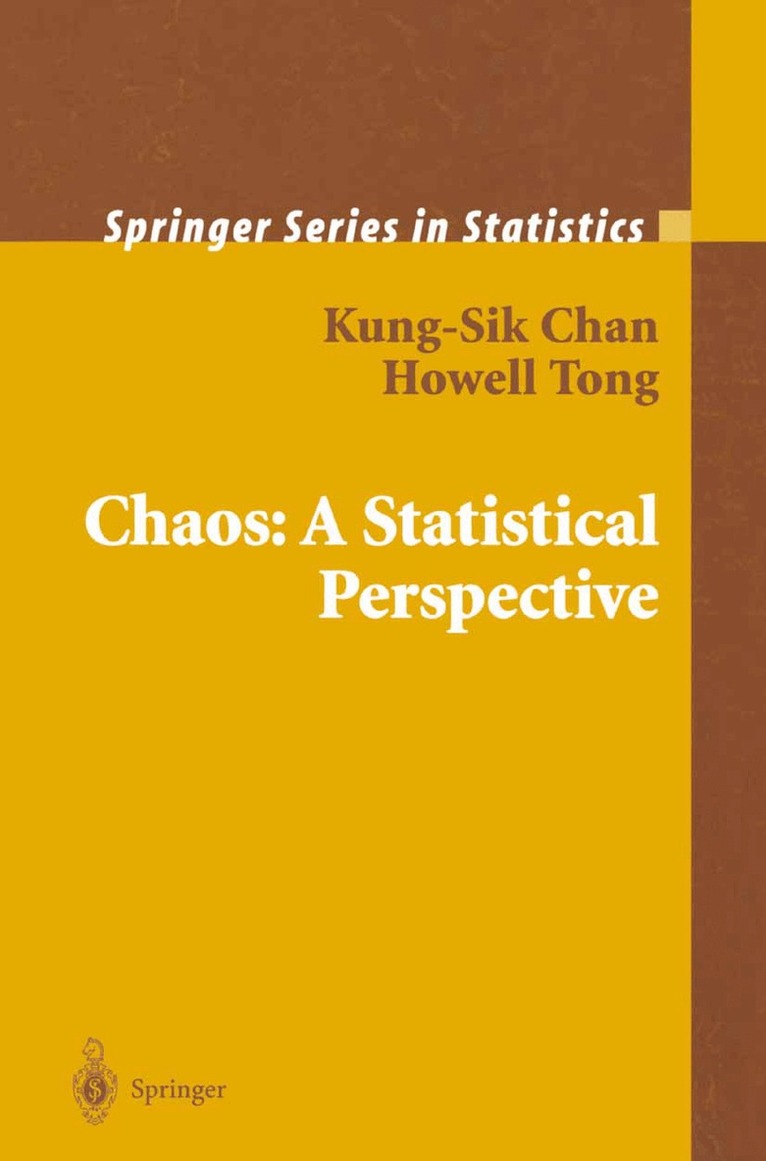
Chaos: A Statistical Perspective
Inbunden, 2001
1089 kr
Lägg i varukorg
It was none other than Henri Poincare who at the turn of the last century, recognised that initial-value sensitivity is a fundamental source of random ness. For statisticians working within the traditional statistical framework, the task of critically assimilating randomness generated by a purely …
Chaos: A Statistical Perspective
Häftad, 2010
1096 kr
Lägg i varukorg
It was none other than Henri Poincare who at the turn of the last century, recognised that initial-value sensitivity is a fundamental source of random ness. For statisticians working within the traditional statistical framework, the task of critically assimilating randomness generated by a purely …
Chaos: A Statistical Perspective
E-bok, 2013
1427 kr
Lägg i varukorg
It was none other than Henri Poincare who at the turn of the last century, recognised that initial-value sensitivity is a fundamental source of random ness. For statisticians working within the traditional statistical framework, the task of critically assimilating randomness generated by a purely …
DIMENSION ESTIMATION AND MODELS
Av TONG H, Howell Tong
Inbunden, 1993
1646 kr
Lägg i varukorg
This volume is the first in the new series Nonlinear Time Series and Chaos. The general aim of the series is to provide a bridge between the two communities by inviting prominent researchers in their respective fields to give a systematic account of their chosen topics, starting at the beginning …
STATISTICS AND FINANCE: AN INTERFACE - PROCEEDINGS OF THE HONG KONG INTERNATIONAL WORKSHOP ON STATISTICS IN FINANCE
Av CHAN WAI SUM, Wai-Sum Chan m. fl.
Inbunden, 2000
2643 kr
Tillfälligt slut
This volume constitutes the proceedings of the Hong Kong International Workshop on Statistics in Finance, held at the University of Hong Kong in July 1999. Topics covered include heavy-tailed and nonlinear continuous-time ARMA models for financial time series, and forecast evaluation.
CHAOS AND FORECASTING - PROCEEDINGS OF THE ROYAL SOCIETY DISCUSSION MEETING
Inbunden, 1995
2100 kr
Tillfälligt slut
It is now generally recognised that very simple dynamical systems can produce apparently random behaviour. In the last couple of years, attention has turned to focus on the flip side of this coin: random-looking time series (or random-looking patterns in space) may indeed be the result of very …
CHAOS AND FORECASTING - PROCEEDINGS OF THE ROYAL SOCIETY DISCUSSION MEETING
Av H TONG, Howell Tong
Häftad, 1995
547 kr
Tillfälligt slut
It is now generally recognised that very simple dynamical systems can produce apparently random behaviour. In the last couple of years, attention has turned to focus on the flip side of this coin: random-looking time series (or random-looking patterns in space) may indeed be the result of very …
ASSET PRICING: A STRUCTURAL THEORY AND ITS APPLICATIONS
Inbunden, 2008
1229 kr
Tillfälligt slut
Modern asset pricing models play a central role in finance and economic theory and applications. This book introduces a structural theory to evaluate these asset pricing models and throws light on the existence of Equity Premium Puzzle. Based on the structural theory, some algebraic …