Ibrahim al-Koni - Böcker
Visar alla böcker från författaren Ibrahim al-Koni. Handla med fri frakt och snabb leverans.
12 produkter
12 produkter
192 kr
Skickas inom 10-15 vardagar
The Puppet, a mythic tale of greed and political corruption, traces the rise, flourishing, and demise of a Saharan oasis community. Aghulli, a noble if obtuse man who has been chosen leader of the oasis, hankers after the traditional nomadic pastoralist life of the Tuareg. He sees commerce (understood as including trade in gold, marriage, agriculture, and even recreation) as the prime culprit in the loss of the nomadic ethos. Thus he is devastated to learn that his supporters are hoarding gold. The novel's title notwithstanding, the author has stressed repeatedly that he is not a political author. He says that The Puppet portrays a good man who has been asked to lead a corrupt society. The subplot about star-crossed young lovers introduces a Sufi theme of the possibility of transforming carnal into mystical love. The Puppet, though, is first and foremost a gripping, expertly crafted tale of bloody betrayal and revenge inspired by gold lust and an ancient love affair.
265 kr
Skickas inom 7-10 vardagar
Winner, National Translation Award, American Literary Translators Association, 2015Upon the death of their leader, a group of Tuareg, a nomadic Berber community whose traditional homeland is the Sahara Desert, turns to the heir dictated by tribal custom; however, he is a poet reluctant to don the mantle of leadership. Forced by tribal elders to abandon not only his poetry but his love, who is also a poet, he reluctantly serves as leader. Whether by human design or the meddling of the Spirit World, his death inspires his tribe to settle down permanently, abandoning not only nomadism but also the inherited laws of the tribe. The community they found, New Waw, which they name for the mythical paradise of the Tuareg people, is also the setting of Ibrahim al-Koni’s companion novel, The Puppet.For al-Koni, this Tuareg tale of the tension between nomadism and settled life represents a choice faced by people everywhere, in many walks of life, as a result of globalism. He sees an inevitable interface between myth and contemporary life.
129 kr
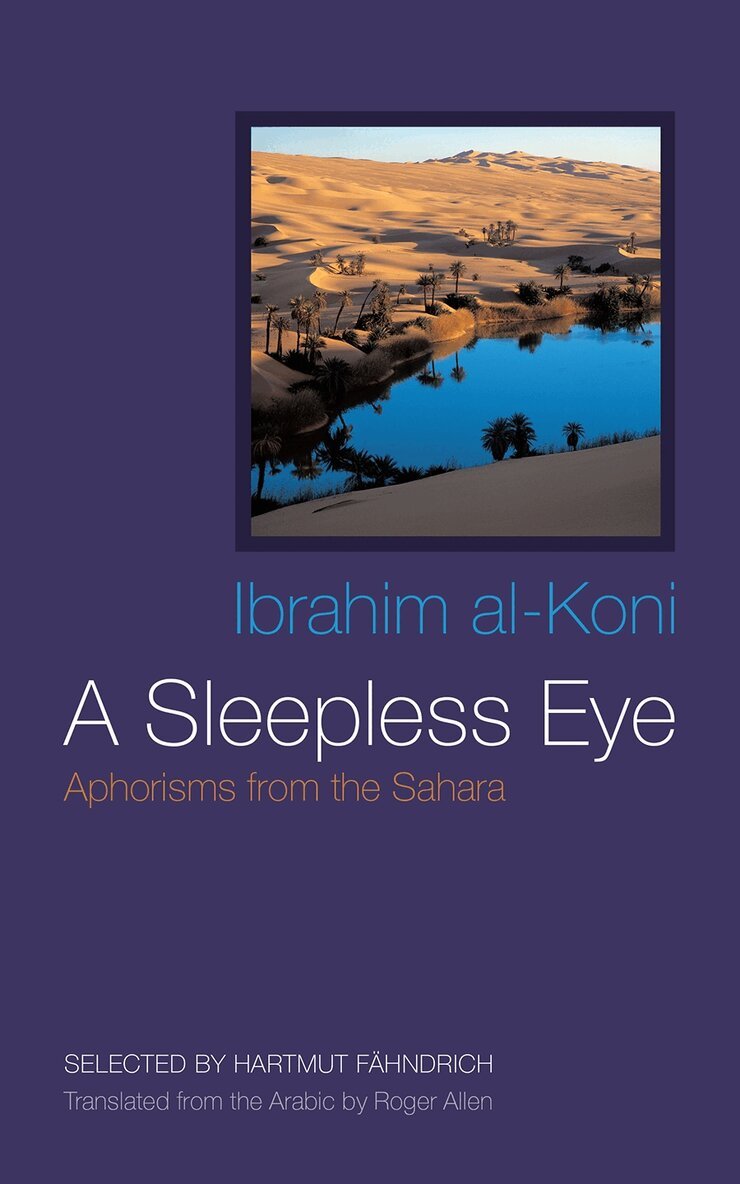
The Libyan landscape is one of the most diverse and breathtaking, replete with barren deserts, vast ocean coasts, and a stunning display of earth’s elements. Al-Koni, an award-winning and critically acclaimed Arabic writer, reflects on this fragile environment and the increasing threats to its existence in A Sleepless Eye, a collection of the poet’s desert wisdom. He highlights the relationships between humans and Libya’s natural features, grouping them by theme: nature, desert, water, sea, wind, rock, trees, and fire. Each theme contains a set of aphorisms that deliver thoughtful perspectives on what it means to coexist with an evolving planet. This volume is the result of the author’s collaboration with the celebrated French nature photographer, Alain Sèbe, and English translator Allen. The product is a body of work that calls upon readers to question their relationship with the earth through meditative ideas and photos, familiarising English readers with the fundamental philosophies of environmental stewardship that transcend all boundaries.
269 kr
Skickas inom 10-15 vardagar
The Scarecrow is the final volume of Ibrahim al-Koni’s Oasis trilogy, which chronicles the founding, flourishing, and decline of a Saharan oasis. Fittingly, this continuation of a tale of greed and corruption opens with a meeting of the conspirators who assassinated the community’s leader at the end of the previous novel, The Puppet. They punished him for opposing the use of gold in business transactions-a symptom of a critical break with their nomadic past-and now they must search for a leader who shares their fetishistic love of gold. A desert retreat inspires the group to select a leader at random, but their “choice,” it appears, is not entirely human. This interloper from the spirit world proves a self-righteous despot, whose intolerance of humanity presages disaster for an oasis besieged by an international alliance. Though al-Koni has repeatedly stressed that he is not a political author, readers may see parallels not only to a former Libyan ruler but to other tyrants-past and present-who appear as hollow as a scarecrow.
208 kr
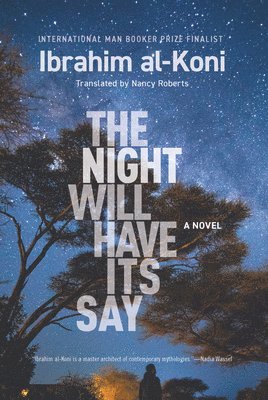
International Booker Prize finalist and "one of the Arab world's most innovative novelists" (Roger Allen) delivers a brilliant retelling of the Muslim wars of conquest in North AfricaThe year is 693 and a tense exchange, mediated by an interpreter, takes place between Berber warrior queen al-Kahina and an emissary from the Umayyad General Hassan ibn Nu'man. Her predecessor had been captured and killed by the Umayyad forces some years earlier, but she will go on to defeat them.The Night Will Have Its Say is a retelling of the Muslim wars of conquest in North Africa during the seventh century CE, narrated from the perspective of the conquered peoples. Written in Ibrahim al-Koni's unique and enchanting voice, his lyrical and deeply poetic prose speaks to themes that are intensely timely. Through the wars and conflicts of this distant, turbulent era, he addresses the futility of war, the privilege of an elite few at the expense of the many, the destruction of natural habitats and indigenous cultures, and questions about literal and fundamentalist interpretations of religious texts.Al-Koni's masterly account of conquest and resistance is both timeless and timely, infused with a sense of disaster and exile—from language, the desert, and homeland.
730 kr
Skickas inom 5-8 vardagar
International Booker Prize finalist and "one of the Arab world's most innovative novelists" (Roger Allen) delivers a brilliant retelling of the Muslim wars of conquest in North AfricaThe year is 693 and a tense exchange, mediated by an interpreter, takes place between Berber warrior queen al-Kahina and an emissary from the Umayyad General Hassan ibn Nu'man. Her predecessor had been captured and killed by the Umayyad forces some years earlier, but she will go on to defeat them.The Night Will Have Its Say is a retelling of the Muslim wars of conquest in North Africa during the seventh century CE, narrated from the perspective of the conquered peoples. Written in Ibrahim al-Koni's unique and enchanting voice, his lyrical and deeply poetic prose speaks to themes that are intensely timely. Through the wars and conflicts of this distant, turbulent era, he addresses the futility of war, the privilege of an elite few at the expense of the many, the destruction of natural habitats and indigenous cultures, and questions about literal and fundamentalist interpretations of religious texts.Al-Koni's masterly account of conquest and resistance is both timeless and timely, infused with a sense of disaster and exile—from language, the desert, and homeland.
195 kr
Skickas inom 3-6 vardagar
401 kr
Skickas inom 7-10 vardagar
356 kr
Skickas
Ibrahim Al-Koni föddes 1948 i Fazzan-öknen i södra Libyen. Han är tuareg, alltså ättling till de ökennomader som kallas ?det blå? eller det beslöjade folket, ett folk som än idag korsar Sahara-öknen med sina kameler utan att ta av sig den karakteristiska slöjan framför ansiktet, och som har sitt eget alfabet, tifi nag, och sitt eget språk, tamasheq. Ibrahim al-Koni levde ett bofast liv, fick sin utbildning på arabiska, arbetade sedan för olika libyska tidningar där han publicerade sina första essäer och litteraturkritik. Han vidareutbildade sig vid Gorkijinstitutet i Moskva, och åberopar andligt släktskap med en av de stora ryska författarna. ?Jag är ett barn av Dostojevskij?, sade han i en intervju 1995. Förutom vissa uppenbara olikheter kan hans noveller och romaner jämföras med Gabriel Garcia Márquez´ s.k. magiska realism. I al-Konis prosa är öknen befolkad av både människor, djur och djinner (demoner). Förutom vatten, en handfull fikon och gräs och bete för boskapen är magin oumbärlig för ökenfolkets liv, som tar bruk av den för att handskas med djinner och djur. Då används amuletter, talismaner och besvärjelser. Tuaregerna ärver magin från generation till generation och vördar sina förfäder. Man ser också med vördnad på de grottmålningar som finns i Fazzan, eftersom man ser sina förfäders egenskaper avspegla sig i dem. Tuaregerna lider, men de kan inte leva utan denna rymd, där de känner frihet och där deras hjärtan fylls med en oändlig glädje. Nomaderna kallar öknen för både himmelrike och helvete. Och i al-Konis verk förstår man anledningen till båda epiteten. Men människorna som skildras lever inte i en oföränderlig värld. I romanen ?Stenblödning? har den moderna civilisationen nått in till hjärtat av öknen och på så sätt förstört urgamla lagar. Författaren låter den sista överlevande gasellen berätta om de sista av hennes artfränder. Den jägare som är likgiltig för dessa djurs överlevnad blir plågad av hemska mardrömmar...
177 kr
Skickas inom 5-8 vardagar
A Tuareg youth ventures into trackless desert on a life-threatening quest to find the father he remembers only as a shadow from his childhood, but the spirit world frustrates and tests his resolve. For a time, he is rewarded with the Eden of a lost oasis, but eventually, as new settlers crowd in, its destiny mimics the rise of human civilization. The Libyan Tuareg author Ibrahim al-Koni, who has earned a reputation as a major figure in Arabic literature with his many novels and collections of short stories, has used Tuareg folklore about Anubis, the ancient Egyptian god of the underworld, to craft a novel that is both a lyrical evocation of the desert's beauty and a chilling narrative in which thirst, incest, patricide, animal metamorphosis, and human sacrifice are more than plot devices. In this novel, fantastic mythology becomes universal, specific, and modern.
199 kr
Skickas
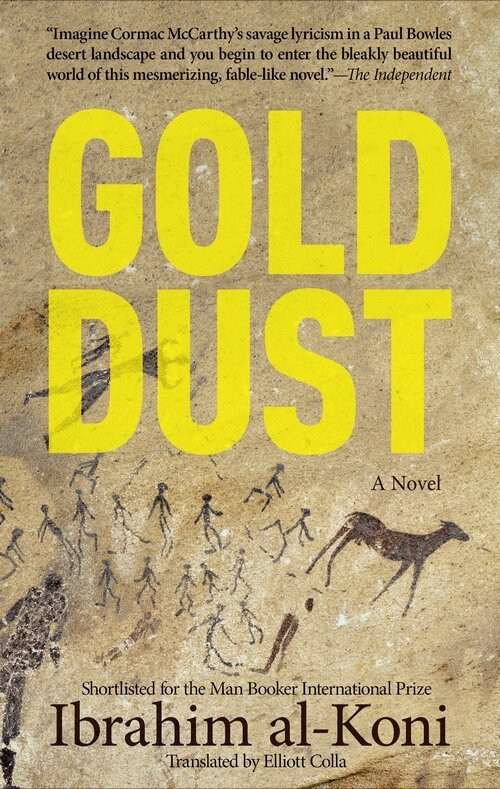
Rejected by his tribe and hunted by the kin of the man he killed, Ukhayyad and his thoroughbred camel flee across the desolate Tuareg deserts of the Libyan Sahara. Between bloody wars against the Italians in the north and famine raging in the south, Ukhayyad rides for the remote rock caves of Jebel Hasawna. There, he says farewell to the mount who has been his companion through thirst, disease, lust, and loneliness. Alone in the desert, haunted by the prophetic cave paintings of ancient hunting scenes and the cries of jinn in the night, Ukhayyad awaits the arrival of his pursuers and their insatiable hunger for blood and gold. Gold Dust is a classic story of the brotherhood between man and beast, the thread of companionship that is all the difference between life and death in the desert. It is a story of the fight to endure in a world of limitless and waterless wastes, and a parable of the struggle to survive in the most dangerous landscape of all: human society.
269 kr
Slutsåld
Rejected by his tribe and hunted by the kin of the man he killed, Ukhayyad and his thoroughbred camel flee across the desolate Tuareg deserts of the Sahara. Between bloody wars against the Italians in the north and famine raging in the south, Ukhayyad rides for the remote rock caves of Jebel Hasawna. There, he says farewell to the mount who has been his companion through thirst, disease, lust and loneliness. Alone in the desert, haunted by the prophetic cave paintings of ancient hunting scenes and the cries of jinn in the night, Ukhayyad awaits the arrival of his pursuers and their insatiable hunger for blood and gold. Gold Dust is a classic story of the brotherhood between man and beast, the thread of companionship that is all the difference between life and death in the desert. It is a story of the fight to endure in a world of limitless and waterless wastes, and a parable of the struggle to survive in the most dangerous landscape of all: human society.