Irina Metzler – författare
Visar alla böcker från författaren Irina Metzler. Handla med fri frakt och snabb leverans.
11 produkter
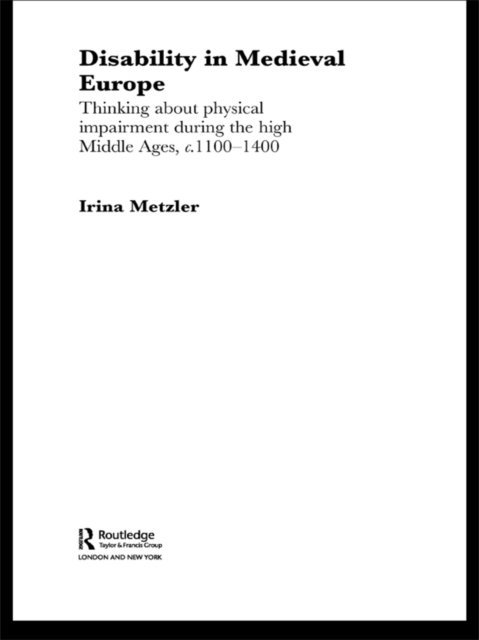
Disability in Medieval Europe
Thinking about Physical Impairment in the High Middle Ages, c.1100–c.1400
Inbunden, 2005
2324 kr
Lägg i varukorg
This impressive volume presents a thorough examination of all aspects of physical impairment and disability in medieval Europe. Examining a popular era that is of great interest to many historians and researchers, Irene Metzler presents a theoretical framework of disability and explores key areas …
Disability in Medieval Europe
Thinking about Physical Impairment in the High Middle Ages, c.1100–c.1400
Häftad, 2010
740 kr
Lägg i varukorg
This impressive volume presents a thorough examination of all aspects of physical impairment and disability in medieval Europe. Examining a popular era that is of great interest to many historians and researchers, Irene Metzler presents a theoretical framework of disability and explores key areas …
Social History of Disability in the Middle Ages
Cultural Considerations of Physical Impairment
Inbunden, 2013
2586 kr
Lägg i varukorg
What was it like to be disabled in the Middle Ages? How did people become disabled? Did welfare support exist? This book discusses social and cultural factors affecting the lives of medieval crippled, deaf, mute and blind people, those nowadays collectively called "disabled." Although the word did …
Fools and Idiots?
Intellectual Disability in the Middle Ages
Inbunden, 2016
1263 kr
Lägg i varukorg
This is the first book devoted to the cultural history in the pre-modern period of people we now describe as having learning disabilities. Using an interdisciplinary approach, including historical semantics, medicine, natural philosophy and law, it considers a neglected field of social and medical …
Fools and Idiots?
Intellectual Disability in the Middle Ages
Häftad, 2018
456 kr
Lägg i varukorg
This is the first book devoted to the cultural history in the pre-modern period of people we now describe as having learning disabilities. Using an interdisciplinary approach, including historical semantics, medicine, natural philosophy and law, it considers a neglected field of social and medical …
Disability in Medieval Europe
Thinking about Physical Impairment in the High Middle Ages, c.1100-c.1400
E-bok, 2006
955 kr
Lägg i varukorg
This impressive volume presents a thorough examination of all aspects of physical impairment and disability in medieval Europe. Examining a popular era that is of great interest to many historians and researchers, Irene Metzler presents a theoretical framework of disability and explores key areas …
Disability in Medieval Europe
Thinking about Physical Impairment in the High Middle Ages, c.1100-c.1400
E-bok, 2006
955 kr
Lägg i varukorg
This impressive volume presents a thorough examination of all aspects of physical impairment and disability in medieval Europe. Examining a popular era that is of great interest to many historians and researchers, Irene Metzler presents a theoretical framework of disability and explores key areas …
Social History of Disability in the Middle Ages
Cultural Considerations of Physical Impairment
E-bok, 2013
898 kr
Lägg i varukorg
What was it like to be disabled in the Middle Ages? How did people become disabled? Did welfare support exist? This book discusses social and cultural factors affecting the lives of medieval crippled, deaf, mute and blind people, those nowadays collectively called "disabled." Although the word did …
Social History of Disability in the Middle Ages
Cultural Considerations of Physical Impairment
E-bok, 2013
907 kr
Lägg i varukorg
What was it like to be disabled in the Middle Ages? How did people become disabled? Did welfare support exist? This book discusses social and cultural factors affecting the lives of medieval crippled, deaf, mute and blind people, those nowadays collectively called "disabled." Although the word did …
Social History of Disability in the Middle Ages
Cultural Considerations of Physical Impairment
Häftad, 2015
787 kr
Lägg i varukorg
What was it like to be disabled in the Middle Ages? How did people become disabled? Did welfare support exist? This book discusses social and cultural factors affecting the lives of medieval crippled, deaf, mute and blind people, those nowadays collectively called "disabled." Although the word did …
'Madness' in the Ancient World: Innate or Acquired?: From Theoretical Concepts to Daily Life
Av Christian Laes, Irina Metzler
Häftad
1606 kr
Lägg i varukorg