
Irma McClaurin – författare
Visar alla böcker från författaren Irma McClaurin. Handla med fri frakt och snabb leverans.
4 produkter
4 produkter
Häftad, Engelska, 1996
358 kr
Skickas inom 5-8 vardagar
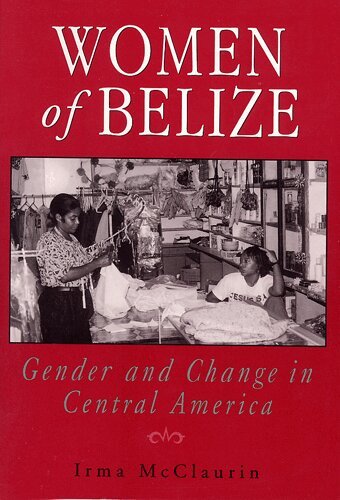
This engaging ethnography is set in the remote district of Toledo in Belize, Central America, where three women weave personal stories about the events in their lives. Each describes her experiences of motherhood, marriage, family illness, emigration, separation, work, or domestic violence that led her to recognize gender inequality and then to do something about it. All three challenge the culture of gender at home and in the larger community.Zola, an East Indian woman without primary school education, invents her own escape from a life of subordination by securing land, then marries the man she's lived with since the age of fourteen--but on her terms. Once she needed permission to buy a dress, now she advocates against domestic violence. Evelyn, a thirty-nine-year old Creole woman, has raised eight children virtually alone, yet she remains married "out of habit." A keen entrepreneur, she has run a restaurant, a store, and a sewing business, and she now owns a mini-mart attached to her home. Rose, a Garifuna woman, is a mother of two whose husband left when she would not accept his extra-marital affairs. While she ekes out a survival in the informal economy by making tamales, she gets spiritual comfort from her religious beliefs, love of music, and two children.The voices of these ordinary Belizean women fill the pages of this book. Irma McClaurin reveals the historical circumstances, cultural beliefs, and institutional structures that have rendered women in Belize politically and socially disenfranchised and economically dependent upon men. She shows how some ordinary women, through their participation in women's grassroots groups, have found the courage to change their lives. Drawing upon her own experiences as a black woman in the United States, and relying upon cross-cultural data about the Caribbean and Latin America, she explains the specific way gender is constructed in Belize.
Häftad, Engelska, 2024
314 kr
Skickas inom 5-8 vardagar
Black Feminist Anthropology: Theory, Politics, Praxis and Poetics is a groundbreaking collection that centers the imaginative intellectual perspectives, voices, and experiences of Black American feminist anthropologists. Twenty-five years ago, as the Foreword states, this book dared to put three words together in the title-Black. Feminist. Anthropology- “that have not always kept company with each other-and in the minds of many both in and outside of the academy, they should remain separate.” Standing the test of time, it is still a bold reimagining of anthropology, and all social sciences, as inclusive and decolonized, while establishing a new Black feminist anthropology canon that decades later is too often taken for granted as normative. Black Feminist Anthropology is filled with a message of theoretical possibilities that anyone who enters its pages will find “healing,” “life-saving,” and an affirmation that Black women anthropologists have contributed much to the theory, politics, praxis and poetics of anthropology, gender and women’s studies, masculinity studies, queer studies, the social sciences generally, and any other discipline that seeks transformation from the inside out. It is both an archive and a legacy for the next generation.
Inbunden, Engelska, 2024
1 607 kr
Skickas inom 5-8 vardagar
Black Feminist Anthropology: Theory, Politics, Praxis and Poetics is a groundbreaking collection that centers the imaginative intellectual perspectives, voices, and experiences of Black American feminist anthropologists. Twenty-five years ago, as the Foreword states, this book dared to put three words together in the title—Black. Feminist. Anthropology— “that have not always kept company with each other—and in the minds of many both in and outside of the academy, they should remain separate.” Standing the test of time, it is still a bold reimagining of anthropology, and all social sciences, as inclusive and decolonized, while establishing a new Black feminist anthropology canon that decades later is too often taken for granted as normative. Black Feminist Anthropology is filled with a message of theoretical possibilities that anyone who enters its pages will find “healing,” “life-saving,” and an affirmation that Black women anthropologists have contributed much to the theory, politics, praxis and poetics of anthropology, gender and women’s studies, masculinity studies, queer studies, the social sciences generally, and any other discipline that seeks transformation from the inside out. It is both an archive and a legacy for the next generation.
Häftad, Engelska, 2001
368 kr
Tillfälligt slut
In the discipline's early days, anthropologists by definition were assumed to be white and male. Women and black scholars were relegated to the field's periphery. From this marginal place, white feminist anthropologists have successfully carved out an acknowledged intellectual space, identified as feminist anthropology. Unfortunately, the works of black and non-western feminist anthropologists are rarely cited, and they have yet to be respected as significant shapers of the direction and transformation of feminist anthropology.In this volume, Irma McClaurin has collected-for the first time-essays that explore the role and contributions of black feminist anthropologists. She has asked her contributors to disclose how their experiences as black women have influenced their anthropological practice in Africa, the Caribbean, and the United States, and how anthropology has influenced their development as black feminists. Every chapter is a unique journey that enables the reader to see how scholars are made. The writers present material from their own fieldwork to demonstrate how these experiences were shaped by their identities. Finally, each essay suggests how the author's field experiences have influenced the theoretical and methodological choices she has made throughout her career.Not since Diane Wolf's Feminist Dilemmas in the Field or Hortense Powdermaker's Stranger and Friend have we had such a breadth of women anthropologists discussing the critical (and personal) issues that emerge when doing ethnographic research.