Isabel Fernandes – författare
Visar alla böcker från författaren Isabel Fernandes. Handla med fri frakt och snabb leverans.
4 produkter
4 produkter
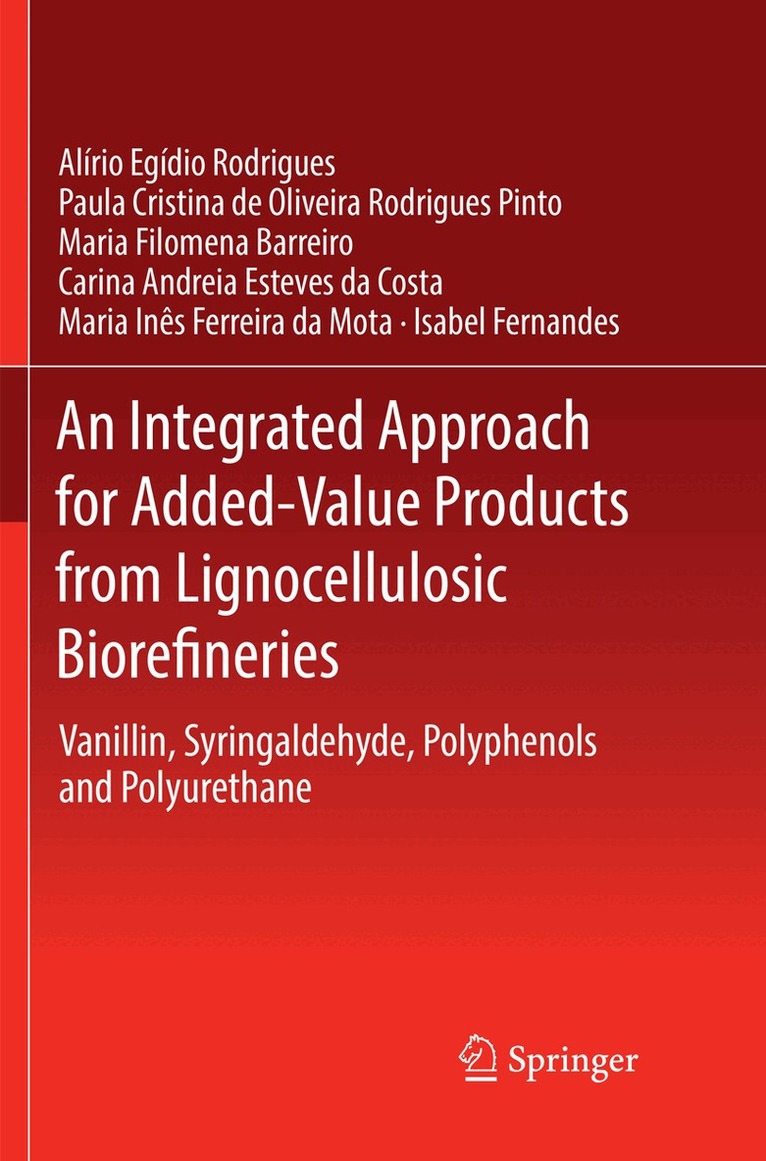
Integrated Approach for Added-Value Products from Lignocellulosic Biorefineries
Vanillin, Syringaldehyde, Polyphenols and Polyurethane
Häftad, Engelska, 2019
1 062 kr
Skickas inom 10-15 vardagar
This book offers the state of the art on the progress and accomplishments of 25 years of research at the Associate Laboratory LSRE-LCM - Laboratory of Separation and Reaction Engineering - Laboratory of Catalysis and Materials on lignin conversion to value-added products and their downstream separation. The first valorisation pathway presented for lignin is its partial depolymerisation by oxidation for the production of low molecular weight phenolic compounds, such as vanillin and syringaldehyde, and the second one is the lignin application as macromonomer for polyurethane synthesis. In this book, the authors present the integration of these two valorisation pathways as an exclusive vision of LSRE-LCM resulting from hands-on experience on reaction and separation processes: the integrated process for lignin valorisation. In this perspective, the lignin is oxidized to simultaneously produce syringaldehyde and vanillin, and the obtained by-products to produce a polyolfor lignin-based polyurethanes, completing the lignin value chain. On the perspective of pulp mill-related biorefineries, a valorisation route for eucalyptus bark is also presented, focusing on LSRE-LCM experience on extraction and separation of bioactive polyphenols, giving some insights about further integration of extracted bark on biorefining operations.
Integrated Approach for Added-Value Products from Lignocellulosic Biorefineries
Vanillin, Syringaldehyde, Polyphenols and Polyurethane
Inbunden, Engelska, 2018
1 062 kr
Skickas inom 10-15 vardagar
This book offers the state of the art on the progress and accomplishments of 25 years of research at the Associate Laboratory LSRE-LCM - Laboratory of Separation and Reaction Engineering - Laboratory of Catalysis and Materials on lignin conversion to value-added products and their downstream separation. The first valorisation pathway presented for lignin is its partial depolymerisation by oxidation for the production of low molecular weight phenolic compounds, such as vanillin and syringaldehyde, and the second one is the lignin application as macromonomer for polyurethane synthesis. In this book, the authors present the integration of these two valorisation pathways as an exclusive vision of LSRE-LCM resulting from hands-on experience on reaction and separation processes: the integrated process for lignin valorisation. In this perspective, the lignin is oxidized to simultaneously produce syringaldehyde and vanillin, and the obtained by-products to produce a polyolfor lignin-based polyurethanes, completing the lignin value chain. On the perspective of pulp mill-related biorefineries, a valorisation route for eucalyptus bark is also presented, focusing on LSRE-LCM experience on extraction and separation of bioactive polyphenols, giving some insights about further integration of extracted bark on biorefining operations.
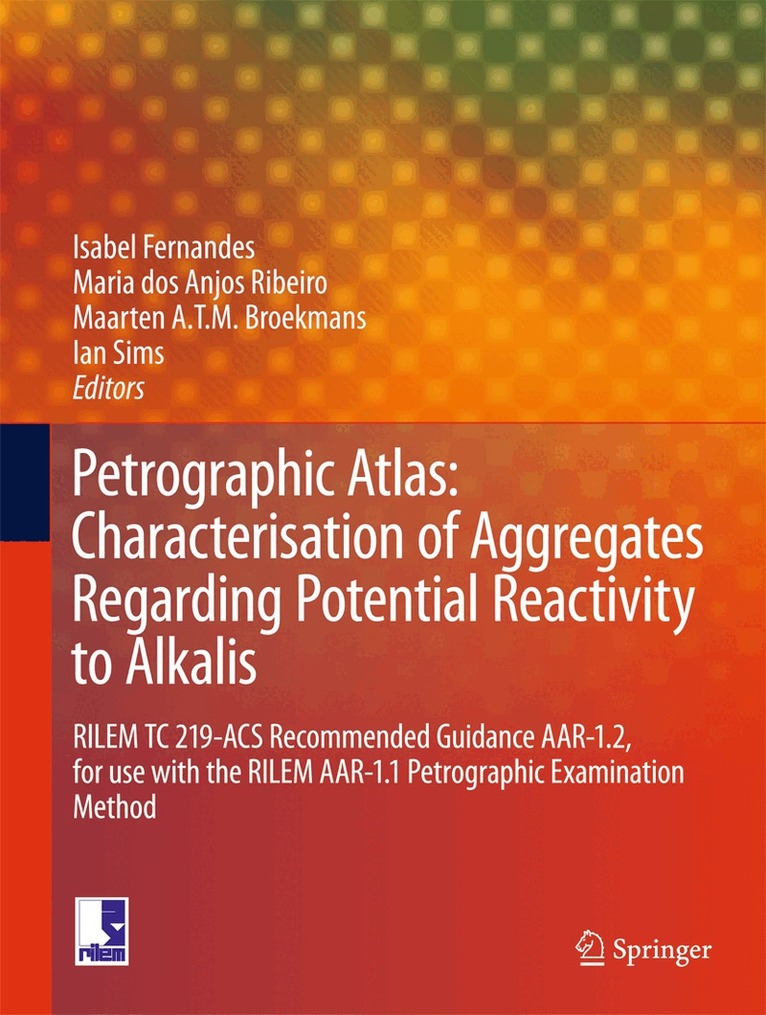
Petrographic Atlas: Characterisation of Aggregates Regarding Potential Reactivity to Alkalis
RILEM TC 219-ACS Recommended Guidance AAR-1.2, for Use with the RILEM AAR-1.1 Petrographic Examination Method
Inbunden, Engelska, 2016
1 800 kr
Skickas inom 10-15 vardagar
This RILEM AAR 1.2 Atlas is complementary to the petrographic method described in RILEM AAR 1.1. It is designed and intended to assist in the identification of alkali-reactive rock types in concrete aggregate by thin-section petrography. Additional issues include: • optical thin-section petrography conforming to RILEM AAR 1.1 is considered the prime assessment method for aggregate materials, being effective regarding cost and time. Unequivocal identification of minerals in very-fine grained rock types may however require use of supplementary methods.• the atlas adheres to internationally adopted schemes for rock classification and nomenclature, as recommended in AAR 1.1. Thus, rock types are classified as igneous, sedimentary or metamorphic based upon mineral content, microstructure and texture/fabric.• in addition, the atlas identifies known alkali-reactive silica types in each rock type presented. It also identifies consistent coincidence between certain lithologies and silica types; however, it refrains from attributing alkali-reactivity to a specific silica property or quality.• operator skill and experience remain essential for reliable assessment by thin-section petrography. • aggregate materials must be classified according to local criteria, based on regional experiences with ASR-damaged field structures and geology. Access to additional data may be relevant for the assessment of imported materials.• mere application of rock nomenclature does not provide any sort of warranty to the development of deleterious alkali-reaction. Such may result in either rejection of a suitable aggregate material, thus wasting a valuable resource, or acceptance of an unsuitable material leading to concrete damage, both of which are undesirable.
1 800 kr
Skickas inom 10-15 vardagar
This RILEM AAR 1.2 Atlas is complementary to the petrographic method described in RILEM AAR 1.1. It is designed and intended to assist in the identification of alkali-reactive rock types in concrete aggregate by thin-section petrography. Additional issues include: • optical thin-section petrography conforming to RILEM AAR 1.1 is considered the prime assessment method for aggregate materials, being effective regarding cost and time. Unequivocal identification of minerals in very-fine grained rock types may however require use of supplementary methods.• the atlas adheres to internationally adopted schemes for rock classification and nomenclature, as recommended in AAR 1.1. Thus, rock types are classified as igneous, sedimentary or metamorphic based upon mineral content, microstructure and texture/fabric.• in addition, the atlas identifies known alkali-reactive silica types in each rock type presented. It also identifies consistent coincidence between certain lithologies and silica types; however, it refrains from attributing alkali-reactivity to a specific silica property or quality.• operator skill and experience remain essential for reliable assessment by thin-section petrography. • aggregate materials must be classified according to local criteria, based on regional experiences with ASR-damaged field structures and geology. Access to additional data may be relevant for the assessment of imported materials.• mere application of rock nomenclature does not provide any sort of warranty to the development of deleterious alkali-reaction. Such may result in either rejection of a suitable aggregate material, thus wasting a valuable resource, or acceptance of an unsuitable material leading to concrete damage, both of which are undesirable.