Itamar Pitowsky - Böcker
Visar alla böcker från författaren Itamar Pitowsky. Handla med fri frakt och snabb leverans.
4 produkter
4 produkter
1 073 kr
Skickas inom 10-15 vardagar
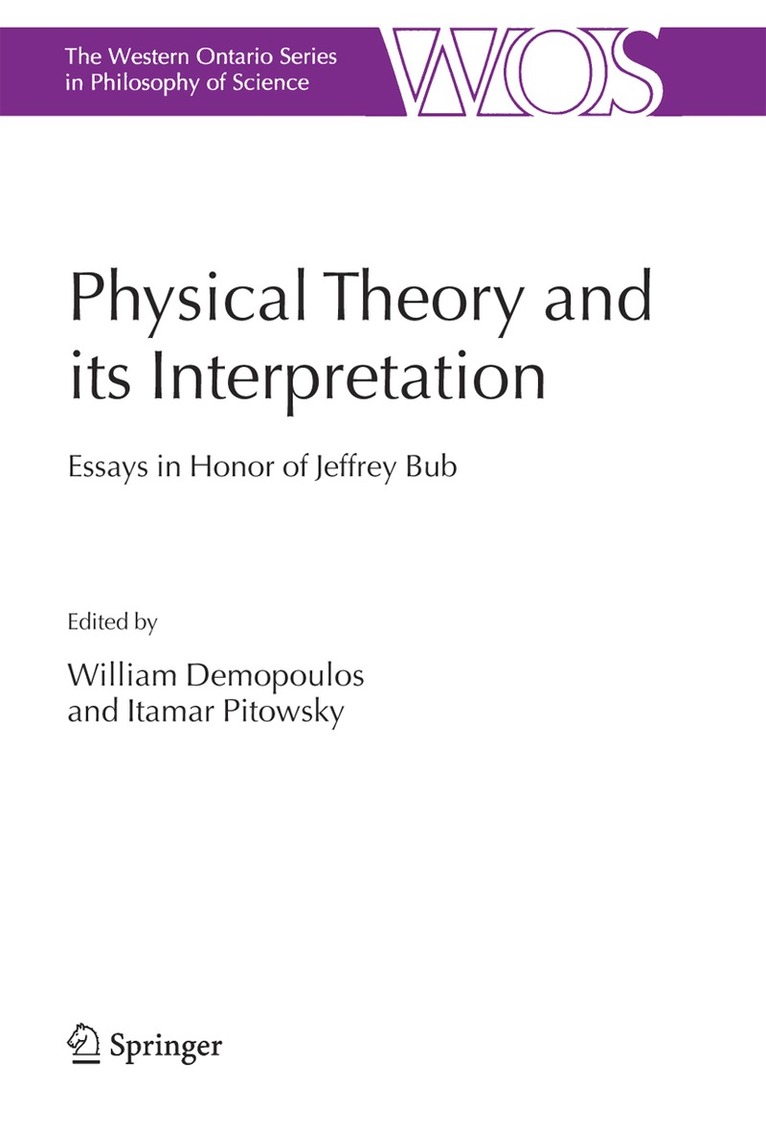
JeffandImetwhenIwasagraduatestudentattheUniversityofMinnesotaandhewas a post doctoral fellow, first in the Chemistry Department, and then in the Center for Philosophy of Science. Later we were colleagues atWestern Ontario. Our friendship and collaboration owe a great deal to both these institutions. In the mid-1960s the Center enjoyed great success under Feigl’s directorship. The history of the Center has been only very partially documented. Feyerabend’s recollections,reportedinhisAutobiography,andsomeyearsearlierinhisremarksfor Feigl’s Festschrift, possess an immediacy that makes them particularly noteworthy, even if all too brief. The Center was the first American institution of its kind and a bastion of positivist and neo-positivist thought. At the time Jeff and I were there, the staff included, in addition to Feigl and Maxwell, Paul Meehl, Roger Steuwer and Keith Gunderson. There were many enthusiastic graduate students, and there was participation, on occasion, from the members of the Philosophy Department, as well as the departments of physics, psychology, mathematics and chemistry. The extent to which this (to us ideal) environment was held together by the force of Feigl’s personality became evident only many years later. The political liberalism of the Viennese Positivists was very much reflected in the philosophicalatmosphereFeiglcreated,anatmospherethatwasmarkedbyopenness, collegiality and intellectual freedom. Combined with its excellent permanent faculty and steady stream of distinguished visitors, the Center was especially well-suited to Jeff’s and my early friendship, our analytic and speculative interests, and our early collaboration.This collaboration was continued when we were members of the Philosophy Department at Western Ontario.
634 kr
Skickas inom 5-8 vardagar
540 kr
Skickas inom 10-15 vardagar
This book compares various approaches to the interpretation of quantum mechanics, in particular those which are related to the key words "the Copenhagen interpretation", "the antirealist view", "quantum logic" and "hidden variable theory". Using the concept of "correlation" carefully analyzed in the context of classical probability and in quantum theory, the author provides a framework to compare these approaches. He also develops an extension of probability theory to construct a local hidden variable theory. The book should be of interest for physicists and philosophers of science interested in the foundations of quantum theory.
1 073 kr
Skickas inom 10-15 vardagar
JeffandImetwhenIwasagraduatestudentattheUniversityofMinnesotaandhewas a post doctoral fellow, first in the Chemistry Department, and then in the Center for Philosophy of Science. Later we were colleagues atWestern Ontario. Our friendship and collaboration owe a great deal to both these institutions. In the mid-1960s the Center enjoyed great success under Feigl’s directorship. The history of the Center has been only very partially documented. Feyerabend’s recollections,reportedinhisAutobiography,andsomeyearsearlierinhisremarksfor Feigl’s Festschrift, possess an immediacy that makes them particularly noteworthy, even if all too brief. The Center was the first American institution of its kind and a bastion of positivist and neo-positivist thought. At the time Jeff and I were there, the staff included, in addition to Feigl and Maxwell, Paul Meehl, Roger Steuwer and Keith Gunderson. There were many enthusiastic graduate students, and there was participation, on occasion, from the members of the Philosophy Department, as well as the departments of physics, psychology, mathematics and chemistry. The extent to which this (to us ideal) environment was held together by the force of Feigl’s personality became evident only many years later. The political liberalism of the Viennese Positivists was very much reflected in the philosophicalatmosphereFeiglcreated,anatmospherethatwasmarkedbyopenness, collegiality and intellectual freedom. Combined with its excellent permanent faculty and steady stream of distinguished visitors, the Center was especially well-suited to Jeff’s and my early friendship, our analytic and speculative interests, and our early collaboration.This collaboration was continued when we were members of the Philosophy Department at Western Ontario.