J. Barrow – författare
Visar alla böcker från författaren J. Barrow. Handla med fri frakt och snabb leverans.
3 produkter
3 produkter
6 228 kr
Skickas inom 10-15 vardagar
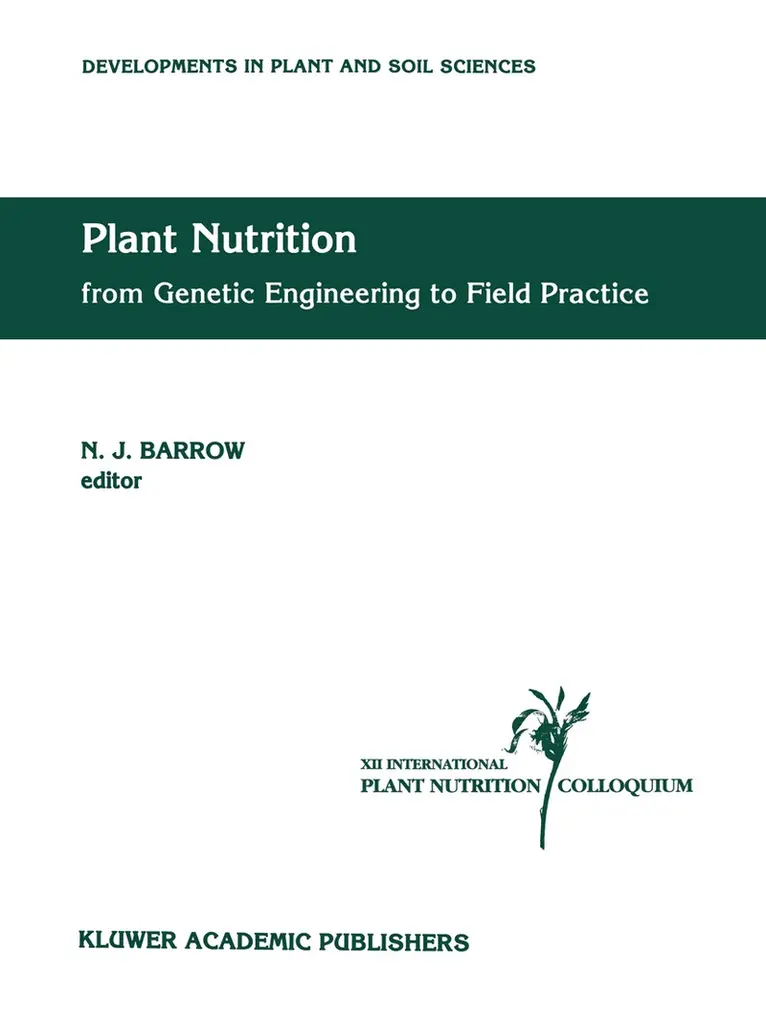
"Plant Nutrition - From Genetic Engineering to Field Practice", the 12th International Colloquium on Plant Nutrition, is part of a series which began in 1954. Early meetings were mainly concerned with the practical problems of soil fertility, with soil assessment, fertilizer requirements and methods of analysis. As the colloquia have progressed, the emphasis has slowly changed. The practical problems are still important, but there is increasing emphasis on plant physiology, plant biochemistry, membrane biochemistry, and on the chemistry of genes which control the proteins in order to transfer nutrient ions to the inside of cells. The meetings therefore provide a useful opportunity for each half of the science of plant nutrition to interact with, and learn from the other half. This volume begins with five papers which review current knowledge in important fields: the rhizosphere, molecular biology, electron microscopy, location and function of elements, and modelling nutrient responses in the field. These themes are continued in groups of shorter papers which follow.In addition, there are sections on nutrient dynamics and partitioning, diagnostic techniques, plant survival strategies, mycorrhizas, and on nutrients such as P, N, S, K, Ca, Mg, and micronutrients. A large section is devoted specifically to boron - reflecting the considerable current interest in this element. In total there are 177 refeered papers providing both a broad overview and a detailed picture of the latest developments in pure and applied plant nutrition.
Plant Nutrition — from Genetic Engineering to Field Practice
Proceedings of the Twelfth International Plant Nutrition Colloquium, 21–26 September 1993, Perth, Western Australia
Häftad, Engelska, 2014
5 281 kr
Skickas inom 10-15 vardagar
Plant Nutrition - From Genetic Engineering to Field Practice, the 12th International Colloquium on Plant Nutrition, is the latest in a series which began in 1954. Early meetings were mainly concerned with the practical problems of soil fertility, with soil assessment, fertilizer requirements and methods of analysis. As the colloquia have progressed, the emphasis has slowly changed. The practical problems are still important, but there is increasing emphasis on plant physiology, plant biochemistry, membrane biochemistry, and even on the chemistry of genes which control the proteins which transfer nutrient ions to the inside of cells. The meetings therefore provide a valuable opportunity for each half of the science of plant nutrition to interact with, and learn from the other half.This volume begins with five papers which review current knowledge in important fields: the rhizosphere, molecular biology, electron microscopy, location and function of elements in vivo, and modelling nutrient responses in the field. These themes are continued in groups of shorter papers which follow. In addition, there are sections on nutrient dynamics and partitioning, diagnostic techniques, plant survival strategies, mycorrhizas, and on nutrients such as P, N, S, K, Ca, Mg, and micronutrients. A large section is devoted specifically to boron - reflecting the considerable current interest in this element. In total there are 177 refereed papers providing both a broad overview and a detailed picture of the latest developments in pure and applied plant nutrition.
Del 31 - Developments in Plant and Soil Sciences
Reactions with Variable-Charge Soils
Häftad, Engelska, 2011
534 kr
Skickas inom 10-15 vardagar
Thisbook isabout ions,about variable-chargesurfacesand about models. Jti~about ions because most of the substances in which soil scientists are interested occur in the soil solution as ions. This applies to both plant nutrients and pollutants. Thus the,reilction between soil and say phosphate does not involve a substance called "phosphate"; it involves phosphate ions. Ions are charged particles. When these charged particles react with charged surfaces, the outcome of the reaction is affected by both the charge on the particles and the charge on the surfaces. Hence we also need to understand the charge on the surfaces. If our understanding is adequate, we should be able to express our ideas precisely - ideally bywritingequations. Unfortunatelytheequationsturnoutto bequite complex and to interrelate with each other in a complex way. Ifwe want to envisage the effect of varying some of the conditions we have to include the equations in,computer programs. Because these programs describe physical systems, they are called models. Aword aboutthe roleand function ofmodels is in order. Acomputermodel is no more than a precisely expressed hypothesis.Like all hypotheses, it can be used to make predictions. The predictions from some hypotheses turn out to be better than those of others and we are to prefer the one that makes the best predictions. However, in practice, old ideasarenotabandoned readily. We clingtothem untilthe new ideas becomefamiliar. Forexample,someofthemodelsthat have been used to describe ionreaction with surfaces have a pleasing familiarity about them.