J. Delery – författare
Visar alla böcker från författaren J. Delery. Handla med fri frakt och snabb leverans.
5 produkter
5 produkter
Inbunden, Engelska, 2002
2 160 kr
Skickas inom 10-15 vardagar
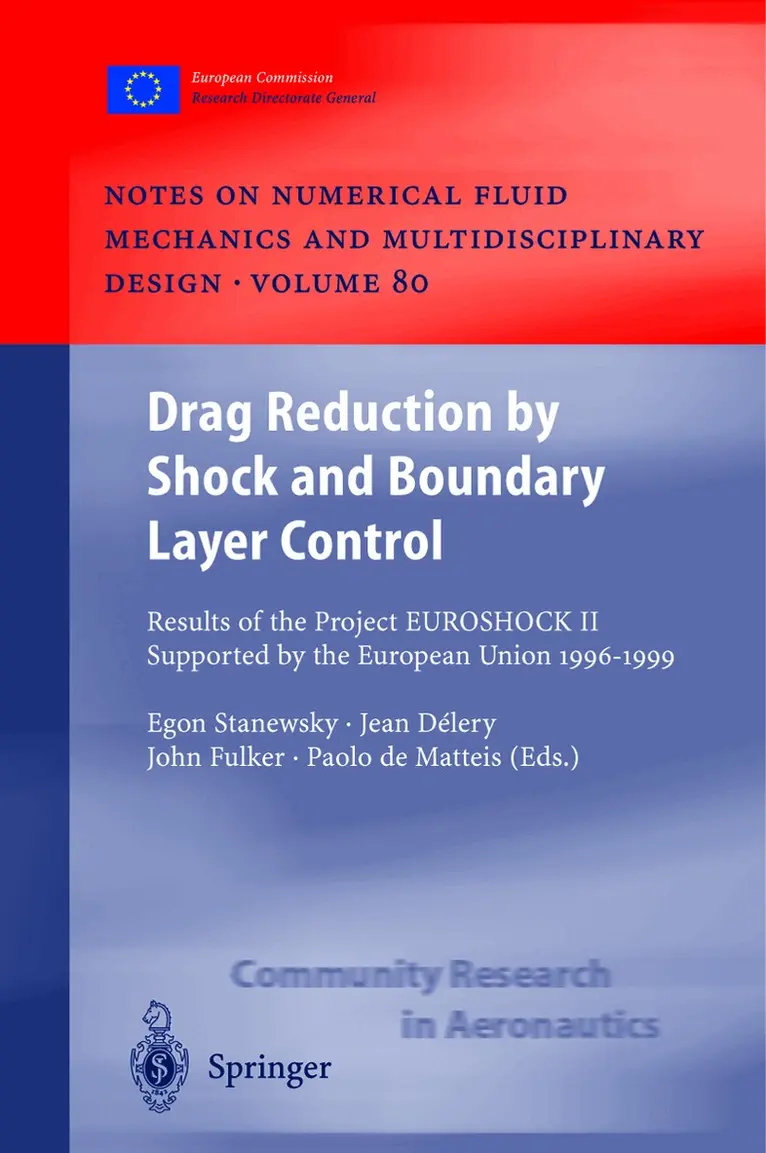
The survival of the Aeronautical Industries of Europe in the highly competitive World Aviation Market is strongly dependent on such factors as time-to-market of a new or derivative aircraft and on its manufacturing costs but also on the achievement of a competitive technological advantage by which an increased market share can be gained. Recognizing this, cooperative research is continuously encouraged and co-financed by the European Union in order to strengthen the scientific and technological base of the Aeronautical Industries thus providing - among others - the technological edge needed for survival. Corresponding targets of research within Area 3, Technologies for Transport Means, and here in particular Area 3A, Aeronautics Technologies, of the Industrial and Materials Technologies Program ( Brite -EuRam III, 1994 -1998) have been identified to be aircraft efficiency, cost effectiveness and environmental impact. Concerning aircraft efficiency - relevant to the present research - a reduction in aircraft drag of 10%, a reduction in aircraft fuel consumption of 30%, and a reduction in airframe, engine and system weight of 20% are envisaged. Meeting these objectives has, of course, also a strong positive impact on the environment.
E-bok
PDF, Engelska, 20132 741 kr
Läs direkt efter köp
The survival of the Aeronautical Industries of Europe in the highly competitive World Aviation Market is strongly dependent on such factors as time-to-market of a new or derivative aircraft and on its manufacturing costs but also on the achievement of a competitive technological advantage by which an increased market share can be gained. Recognizing this, cooperative research is continuously encouraged and co-financed by the European Union in order to strengthen the scientific and technological base of the Aeronautical Industries thus providing - among others - the technological edge needed for survival. Corresponding targets of research within Area 3, Technologies for Transport Means, and here in particular Area 3A, Aeronautics Technologies, of the Industrial and Materials Technologies Program ( Brite -EuRam III, 1994 -1998) have been identified to be aircraft efficiency, cost effectiveness and environmental impact. Concerning aircraft efficiency - relevant to the present research - a reduction in aircraft drag of 10%, a reduction in aircraft fuel consumption of 30%, and a reduction in airframe, engine and system weight of 20% are envisaged. Meeting these objectives has, of course, also a strong positive impact on the environment.
Del 80 - Notes on Numerical Fluid Mechanics and Multidisciplinary Design
Drag Reduction by Shock and Boundary Layer Control
Results of the Project EUROSHOCK II. Supported by the European Union 1996–1999
Häftad, Engelska, 2010
2 160 kr
Skickas inom 10-15 vardagar
The survival of the Aeronautical Industries of Europe in the highly competitive World Aviation Market is strongly dependent on such factors as time-to-market of a new or derivative aircraft and on its manufacturing costs but also on the achievement of a competitive technological advantage by which an increased market share can be gained. Recognizing this, cooperative research is continuously encouraged and co-financed by the European Union in order to strengthen the scientific and technological base of the Aeronautical Industries thus providing - among others - the technological edge needed for survival. Corresponding targets of research within Area 3, Technologies for Transport Means, and here in particular Area 3A, Aeronautics Technologies, of the Industrial and Materials Technologies Program ( Brite -EuRam III, 1994 -1998) have been identified to be aircraft efficiency, cost effectiveness and environmental impact. Concerning aircraft efficiency - relevant to the present research - a reduction in aircraft drag of 10%, a reduction in aircraft fuel consumption of 30%, and a reduction in airframe, engine and system weight of 20% are envisaged. Meeting these objectives has, of course, also a strong positive impact on the environment.
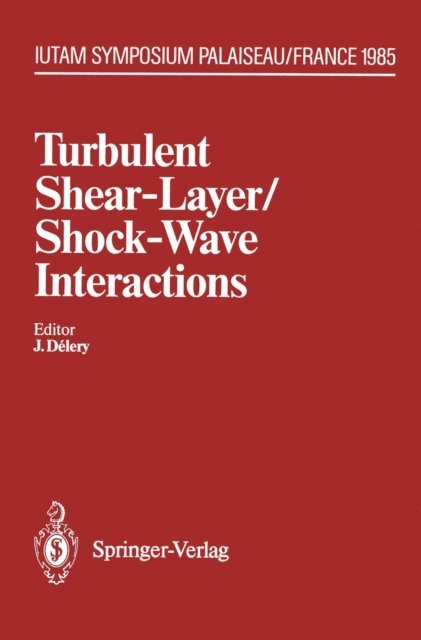
Turbulent Shear-Layer/Shock-Wave Interactions
IUTAM Symposium, Palaiseau, France September 9–12, 1985
E-bok
PDF, Engelska, 20131 416 kr
Läs direkt efter köp
It was on a proposal of the late Professor Maurice Roy, member of the French Academy of Sciences, that in 1982, the General Assembly of the International Union of Theoretical and Applied Mechanics decided to sponsor a symposium on Turbulent Shear-Layer/Shock-Wave Interactions. This sympo sium might be arranged in Paris -or in its immediate vicinity-during the year 1985. Upon request of Professor Robert Legendre, member of the French Academy of Sciences, the organization of the symposium might be provided by the Office National d''Etudes et de Recherches Aerospatiales (ONERA). The request was very favorably received by Monsieur l''Ingenieur General Andre Auriol, then General Director of ONERA. The subject of interactions between shock-waves and turbulent dissipative layers is of considerable importance for many practical devices and has a wide range of engineering applications. Such phenomena occur almost inevitably in any transonic or supersonic flow and the subject has given rise to an important research effort since the advent of high speed fluid mechanics, more than forty years ago. However, with the coming of age of modern computers and the development of new sophisticated measurement techniques, considerable progress has been made in the field over the past fifteen years. The aim of the symposium was to provide an updated status of the research effort devoted to shear layer/shock-wave interactions and to present the most significant results obtained recently.
Turbulent Shear-Layer/Shock-Wave Interactions
IUTAM Symposium, Palaiseau, France September 9–12, 1985
Häftad, Engelska, 2011
1 084 kr
Skickas inom 10-15 vardagar
It was on a proposal of the late Professor Maurice Roy, member of the French Academy of Sciences, that in 1982, the General Assembly of the International Union of Theoretical and Applied Mechanics decided to sponsor a symposium on Turbulent Shear-Layer/Shock-Wave Interactions. This sympo sium might be arranged in Paris -or in its immediate vicinity-during the year 1985. Upon request of Professor Robert Legendre, member of the French Academy of Sciences, the organization of the symposium might be provided by the Office National d'Etudes et de Recherches Aerospatiales (ONERA). The request was very favorably received by Monsieur l'Ingenieur General Andre Auriol, then General Director of ONERA. The subject of interactions between shock-waves and turbulent dissipative layers is of considerable importance for many practical devices and has a wide range of engineering applications. Such phenomena occur almost inevitably in any transonic or supersonic flow and the subject has given rise to an important research effort since the advent of high speed fluid mechanics, more than forty years ago. However, with the coming of age of modern computers and the development of new sophisticated measurement techniques, considerable progress has been made in the field over the past fifteen years. The aim of the symposium was to provide an updated status of the research effort devoted to shear layer/shock-wave interactions and to present the most significant results obtained recently.