John Fulker – författare
Visar alla böcker från författaren John Fulker. Handla med fri frakt och snabb leverans.
5 produkter
5 produkter
E-bok
PDF, Engelska, 2013693 kr
Läs direkt efter köp
It has been recognized by the European Union (EU) that the survival of the Aeronautical Industries of Europe in the highly competitive World Aviation Market is strongly dependent on such factors as time-to-market of a new or derivative aircraft and on its manufacturing costs but also on the achievement of a competitive technological advantage by which an increased market share can be gained. Cooperative research is therefore continuously encouraged and co-financed by the European Union in order to strengthen the scientific and technological base of the Aeronautical Industries thus facilitating the future design and manufacture of civil air craft products and providing the technological edge needed for survival. Targets of research within Area 3, Aeronautics, of the Industrial and Materials Technology Programme (1991 - 1993) have been identified to be aircraft efficiency, cost effectiveness and environmental im pact. Concerning aircraft efficiency - relevant to the present research - a reduction in aircraft drag of 10010, a reduction in aircraft fuel consumption of 30010 and a reduction in airframe, en gine and system weight of 20% are envisaged. Meeting these objectives has, of course, also a strong positive impact on the environment. In order to further technology, the philosophy is to avoid spreading the available resources too thinly and rather concentrate on the feasibility demonstration of a limited number of tech nologies of high economic and industrial impact.
Del 56 - Notes on Numerical Fluid Mechanics
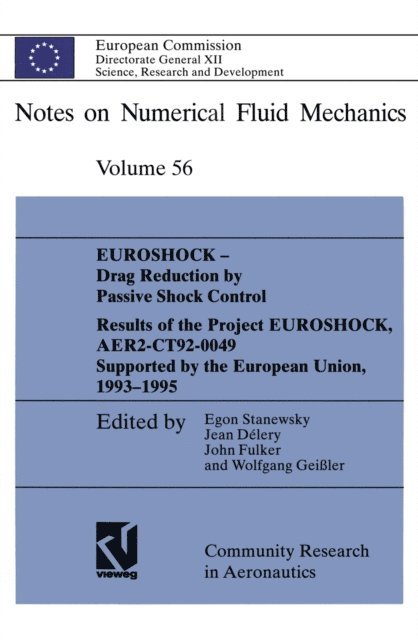
EUROSHOCK - Drag Reduction by Passive Shock Control
Results of the Project EUROSHOCK, AER2-CT92-0049 Supported by the European Union, 1993 – 1995
Häftad, Engelska, 2012
544 kr
Skickas inom 10-15 vardagar
It has been recognized by the European Union (EU) that the survival of the Aeronautical Industries of Europe in the highly competitive World Aviation Market is strongly dependent on such factors as time-to-market of a new or derivative aircraft and on its manufacturing costs but also on the achievement of a competitive technological advantage by which an increased market share can be gained. Cooperative research is therefore continuously encouraged and co-financed by the European Union in order to strengthen the scientific and technological base of the Aeronautical Industries thus facilitating the future design and manufacture of civil air craft products and providing the technological edge needed for survival. Targets of research within Area 3, Aeronautics, of the Industrial and Materials Technology Programme (1991 - 1993) have been identified to be aircraft efficiency, cost effectiveness and environmental im pact. Concerning aircraft efficiency - relevant to the present research - a reduction in aircraft drag of 10010, a reduction in aircraft fuel consumption of 30010 and a reduction in airframe, en gine and system weight of 20% are envisaged. Meeting these objectives has, of course, also a strong positive impact on the environment. In order to further technology, the philosophy is to avoid spreading the available resources too thinly and rather concentrate on the feasibility demonstration of a limited number of tech nologies of high economic and industrial impact.
Inbunden, Engelska, 2002
2 156 kr
Skickas inom 10-15 vardagar
This volume contains a thorough description of the EU-supported project EUROSHOCK II concerned with the investigation of active shock and boundary layer control to improve aircraft performance. Discussed are basic experiments, supplemented by Navier-Stokes computations, to improve and validate physical models relevant to control and the extension, validation and application of various computational methods to airfoil and wing flows with control. Furthermore described are experiments on airfoils and wings carried out to assess the aerodynamic benefits of control and to provide data for validation purposes. Finally, control applications to real aircraft and the corresponding installation penalties and mission benefits are addressed. This volume is a sequel to Vol. 56 on passive shock control.
E-bok
PDF, Engelska, 20132 741 kr
Läs direkt efter köp
The survival of the Aeronautical Industries of Europe in the highly competitive World Aviation Market is strongly dependent on such factors as time-to-market of a new or derivative aircraft and on its manufacturing costs but also on the achievement of a competitive technological advantage by which an increased market share can be gained. Recognizing this, cooperative research is continuously encouraged and co-financed by the European Union in order to strengthen the scientific and technological base of the Aeronautical Industries thus providing - among others - the technological edge needed for survival. Corresponding targets of research within Area 3, Technologies for Transport Means, and here in particular Area 3A, Aeronautics Technologies, of the Industrial and Materials Technologies Program ( Brite -EuRam III, 1994 -1998) have been identified to be aircraft efficiency, cost effectiveness and environmental impact. Concerning aircraft efficiency - relevant to the present research - a reduction in aircraft drag of 10%, a reduction in aircraft fuel consumption of 30%, and a reduction in airframe, engine and system weight of 20% are envisaged. Meeting these objectives has, of course, also a strong positive impact on the environment.
Del 80 - Notes on Numerical Fluid Mechanics and Multidisciplinary Design
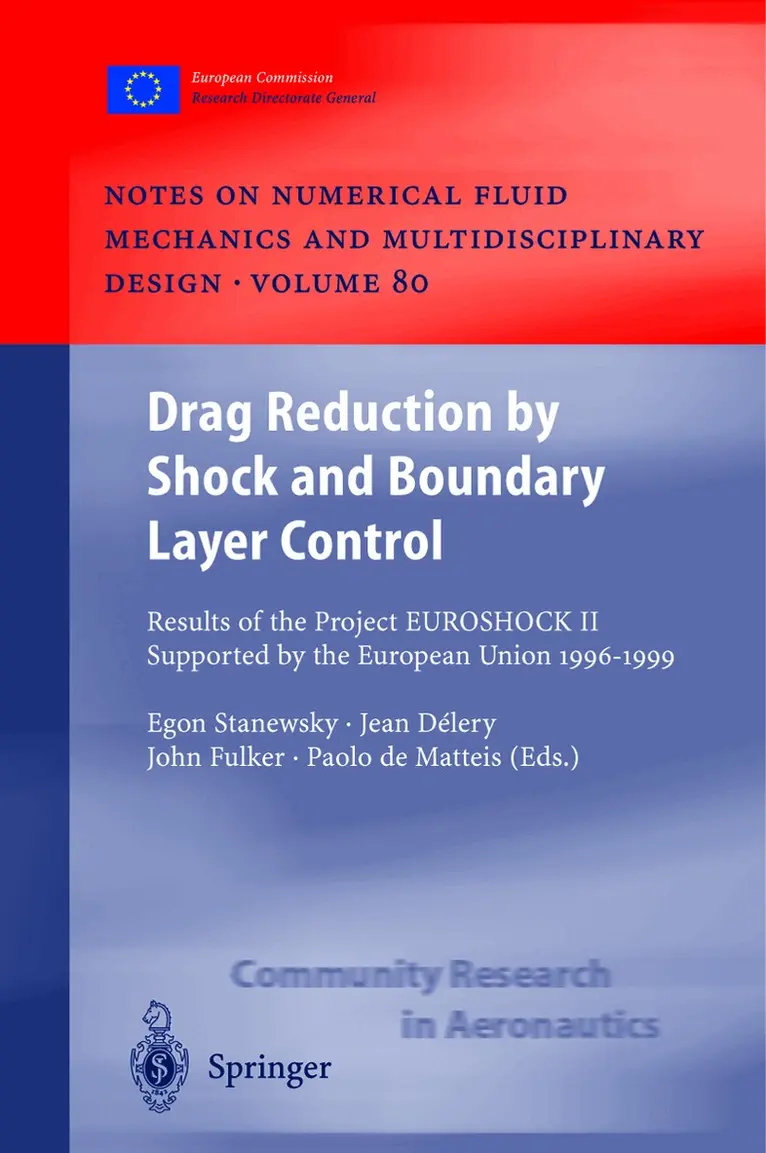
Drag Reduction by Shock and Boundary Layer Control
Results of the Project EUROSHOCK II. Supported by the European Union 1996–1999
Häftad, Engelska, 2010
2 156 kr
Skickas inom 10-15 vardagar
This volume contains a thorough description of the EU-supported project EUROSHOCK II concerned with the investigation of active shock and boundary layer control to improve aircraft performance. Discussed are basic experiments, supplemented by Navier-Stokes computations, to improve and validate physical models relevant to control and the extension, validation and application of various computational methods to airfoil and wing flows with control. Furthermore described are experiments on airfoils and wings carried out to assess the aerodynamic benefits of control and to provide data for validation purposes. Finally, control applications to real aircraft and the corresponding installation penalties and mission benefits are addressed. This volume is a sequel to Vol. 56 on passive shock control.