J. Gerald Kennedy - Böcker
Visar alla böcker från författaren J. Gerald Kennedy. Handla med fri frakt och snabb leverans.
14 produkter
14 produkter
205 kr
Skickas
The Portable Poe compiles Poe's greatest writings: tales of fantasy, terror, death, revenge, murder, and mystery, including "The Pit and the Pendulum," "The Fall of the House of Usher," "The Cask of Amontillado," and "The Murders in the Rue Morgue," the world's first detective story. In addition, this volume offers letters, articles, criticism, visionary poetry, and a selection of random "opinions" on fancy and the imagination, music and poetry, intuition and sundry other topics.
2 522 kr
Skickas inom 5-8 vardagar
No American author of the early 19th century enjoys a larger international audience than Edgar Allan Poe. Widely translated, read, and studied, he occupies an iconic place in global culture. Such acclaim would have gratified Poe, who deliberately wrote for "the world at large" and mocked the provincialism of strictly nationalistic themes. Partly for this reason, early literary historians cast Poe as an outsider, regarding his dark fantasies as extraneous to American life and experience. Only in the 20th century did Poe finally gain a prominent place in the national canon. Changing critical approaches have deepened our understanding of Poe's complexity and revealed an author who defies easy classification. New models of interpretation have excited fresh debates about his essential genius, his subversive imagination, his cultural insight, and his ultimate impact, urging an expansive reconsideration of his literary achievement. Edited by leading experts J. Gerald Kennedy and Scott Peeples, this volume presents a sweeping reexamination of Poe's work. Forty-five distinguished scholars address Poe's troubled life and checkered career as a "magazinist," his poetry and prose, and his reviews, essays, opinions, and marginalia. The chapters provide fresh insights into Poe's lasting impact on subsequent literature, music, art, comics, and film and illuminate his radical conception of the universe, science, and the human mind. Wide-ranging and thought-provoking, this Handbook reveals a thoroughly modern Poe, whose timeless fables of peril and loss will continue to attract new generations of readers and scholars.
899 kr
Skickas inom 5-8 vardagar
Edgar Allan Poe (1809-1849), son of itinerant actors, holds a secure place in the firmament of history as America's first master of suspense. Displaying scant interest in native scenes or materials, Edgar Allan Poe seems the most un-American of American writers during the era of literary nationalism; yet he was at the same time a pragmatic magazinist, fully engaged in popular culture and intensely concerned with the "republic of letters" in the United States. This Historical Guide contains an introduction that considers the tensions between Poe's "otherwordly" settings and his historically marked representations of violence, as well as a capsule biography situating Poe in his historical context. The subsequent essays in this book cover such topics as Poe and the American Publishing Industry, Poe's Sensationalism, his relationships to gender constructions, and Poe and American Privacy. The volume also includes a bibliographic essay, a chronology of Poe's life, a bibliography, illustrations, and an index.
373 kr
Skickas inom 5-8 vardagar
Edgar Allan Poe (1809-1849), son of itinerant actors, holds a secure place in the firmament of history as America's first master of suspense. Displaying scant interest in native scenes or materials, Edgar Allan Poe seems the most un-American of American writers during the era of literary nationalism; yet he was at the same time a pragmatic magazinist, fully engaged in popular culture and intensely concerned with the "republic of letters" in the United States. This Historical Guide contains an introduction that considers the tensions between Poe's "otherwordly" settings and his historically marked representations of violence, as well as a capsule biography situating Poe in his historical context. The subsequent essays in this book cover such topics as Poe and the American Publishing Industry, Poe's Sensationalism, his relationships to gender constructions, and Poe and American Privacy. The volume also includes a bibliographic essay, a chronology of Poe's life, a bibliography, illustrations, and an index.
2 171 kr
Skickas inom 5-8 vardagar
Edgar Allen Poe's strength as a writer lay in fabricating fantisies in settings far removed from his own place and time. This dislocation renders the attitudes embedded in his fiction open to interpretation, and over the years some readers have found Poe to be virulently racist, while others found him morally conflicted, and still others detected a subversion of racism in his works' subtle sympathies for non-white characters. As a nineteenth-century Southerner, Poe was a deeply ambiguous figure, evading race issues while living among them, and traversing the North-South border with little sensitivity to its political implications. In this tightly organized volume, a handful of leading Americanists revisit the Poe issue, re-examining what it means to speak of an author and his work as racist, and where the critic's responsibility lies.
462 kr
Skickas inom 5-8 vardagar
Edgar Allen Poe's strength as a writer lay in fabricating fantisies in settings far removed from his own place and time. This dislocation renders the attitudes embedded in his fiction open to interpretation, and over the years some readers have found Poe to be virulently racist, while others found him morally conflicted, and still others detected a subversion of racism in his works' subtle sympathies for non-white characters. As a nineteenth-century Southerner, Poe was a deeply ambiguous figure, evading race issues while living among them, and traversing the North-South border with little sensitivity to its political implications. In this tightly organized volume, a handful of leading Americanists revisit the Poe issue, re-examining what it means to speak of an author and his work as racist, and where the critic's responsibility lies.
The Oxford History of the Novel in English
Volume 5: The American Novel from Its Beginnings to 1870
Inbunden, Engelska, 2014
3 023 kr
Skickas inom 5-8 vardagar
The American Revolution and the Civil War bracket roughly eight decades of formative change in a republic created in 1776 by a gesture that was both rhetorical and performative. The subsequent construction of U.S. national identity influenced virtually all art forms, especially prose fiction, until internal conflict disrupted the project of nation-building. This volume reassesses, in an authoritative way, the principal forms and features of the emerging American novel. It will include chapters on: the beginnings of the novel in the US; the novel and nation-building; the publishing industry; leading novelists of Antebellum America; eminent early American novels; cultural influences on the novel; and subgenres within the novel form during this period. This book is the first of the three proposed US volumes that will make up Oxford's ambitious new eleven-volume literary resource, The Oxford History of the Novel in English (OHONE), a venture being commissioned and administered on both sides of the Atlantic
2 522 kr
Skickas inom 5-8 vardagar
After the War of 1812, Americans belatedly realized that they lacked national identity. The subsequent campaign to articulate nationality transformed every facet of culture from architecture to painting, and in the realm of letters, literary jingoism embroiled American authors in the heated politics of nationalism. The age demanded stirring images of U.S. virtue, often achieved by contriving myths and obscuring brutalities. Between these sanitized narratives of the nation and U.S. social reality lay a grotesque discontinuity: vehement conflicts over slavery, Indian removal, immigration, and territorial expansion divided the country. Authors such as Washington Irving, James Fenimore Cooper, Catharine M. Sedgwick, William Gilmore Simms, Nathaniel Hawthorne, and Lydia Maria Child wrestled uneasily with the imperative to revise history to produce national fable. Counter-narratives by fugitive slaves, Native Americans, and defiant women subverted literary nationalism by exposing the plight of the unfree and dispossessed. And with them all, Edgar Allan Poe openly mocked literary nationalism and deplored the celebration of "stupid" books appealing to provincial self-congratulation. More than any other author, he personifies the contrary, alien perspective that discerns the weird operations at work behind the facade of American nation-building.
618 kr
Skickas inom 5-8 vardagar
After the War of 1812, Americans belatedly realized that they lacked national identity. The subsequent campaign to articulate nationality transformed every facet of culture from architecture to painting, and in the realm of letters, literary jingoism embroiled American authors in the heated politics of nationalism. The age demanded stirring images of U.S. virtue, often achieved by contriving myths and obscuring brutalities. Between these sanitized narratives of the nation and U.S. social reality lay a grotesque discontinuity: vehement conflicts over slavery, Indian removal, immigration, and territorial expansion divided the country. Authors such as Washington Irving, James Fenimore Cooper, Catharine M. Sedgwick, William Gilmore Simms, Nathaniel Hawthorne, and Lydia Maria Child wrestled uneasily with the imperative to revise history to produce national fable. Counter-narratives by fugitive slaves, Native Americans, and defiant women subverted literary nationalism by exposing the plight of the unfree and dispossessed. And with them all, Edgar Allan Poe openly mocked literary nationalism and deplored the celebration of "stupid" books appealing to provincial self-congratulation. More than any other author, he personifies the contrary, alien perspective that discerns the weird operations at work behind the facade of American nation-building.
114 kr
Skickas inom 5-8 vardagar
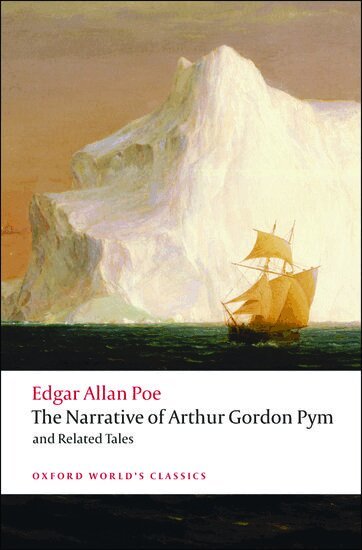
And now I found these fancies creating their own realities, and all imagined horrors crowding upon me in fact'.The Narrative of Arthur Gordon Pym is an archetypal American story of escape from home and family which traces a young man's rite of passage through a series of terrible brushes with death during a fateful sea voyage. But it also goes much deeper, as Pym encounters various interpretative dilemmas, at last leaving the reader with a broken-off ending that defies solution.Apart from its violence and mystery, the tale calls attention to the act of writing and to the problem of representing truth. Layer upon layer of elaborate hoaxes include its author's own role of posing as ghost-writer of the narrative; Pym - his only novel - has become the key text for our understanding of Poe.This edition offers eight short tales which are linked to Pym by their treatment of persistent themes - fantastic voyages, gigantic whirlpools, and premature burials - or by their ironic commentary on Poe's mystification of his readers. ABOUT THE SERIES: For over 100 years Oxford World's Classics has made available the widest range of literature from around the globe. Each affordable volume reflects Oxford's commitment to scholarship, providing the most accurate text plus a wealth of other valuable features, including expert introductions by leading authorities, helpful notes to clarify the text, up-to-date bibliographies for further study, and much more.
538 kr
Skickas inom 5-8 vardagar
Between 1900 and 1940, Paris was the capital of high modernism and the center of artistic experimentation—Paris was "where the twentieth century was," claimed Gertrude Stein. In this book, J. Gerald Kennedy explores how living in Paris shaped the careers and literary works of five expatriate Americans: Gertrude Stein, Ernest Hemingway, Henry Miller, F. Scott Fitzgerald, and Djuna Barnes. Kennedy shows that the writings of these authors reveal their various struggles to accommodate themselves to a complex, foreign scene, to construct an expatriate self, or to understand the contradictions of American identity. He treats these figures and their narratives as instances of the profound effect of place on writing and on the formation of the self.According to Kennedy, Stein's Paris, France presents an abstraction, a series of random and discontinuous images refracted into a theory of the French way of life. Her self- portrait in The Autobiography of Alice B. Toklas, however, hinges on a contrast between the outside world of galleries, studios, and exhibitions and her inner domain at 27, rue de Fleurus. Hemingway's conflict with Paris, says Kennedy, betrays both an attraction to its danger and a disgust with its profligacy, as seen in the ambivalent imagery of The Sun Also Rises. Miller's Paris emerges in his Letters to Emil and Tropic of Cancer as a tormenting world of alleyways, sewers, and flophouses that nevertheless becomes a site of deliverance where Miller discovers himself as a literary subject. The nocturnal, unreal Paris of Fitzgerald's Tender Is the Night and Barnes's Nightwood reflects the disorientation of modernism, which parallel and intensify the estrangement of exile.
Modern American Short Story Sequences
Composite Fictions and Fictive Communities
Häftad, Engelska, 2011
644 kr
Skickas inom 7-10 vardagar
Originally published in 1995, this book gathers together eleven full-length essays on important American short story sequences of the twentieth century. The introduction by J. Gerald Kennedy elucidates problems of defining the genre, cites notable instances of the form (such as Sherwood Anderson's Winesburg, Ohio), and explores the implications of its modern emergence and popularity. Subsequent essays discuss illustrative works by such figures as Henry James, Jean Toomer, Ernest Hemingway, Richard Wright, William Faulkner, Eudora Welty, J. D. Salinger, John Cheever, John Updike, Louise Erdrich, and Raymond Carver. While examining distinctive thematic concerns, each essay also considers implications of form and arrangement in the construction of composite fictions that often produce the illusion of a fictive community.
Modern American Short Story Sequences
Composite Fictions and Fictive Communities
Inbunden, Engelska, 1995
1 431 kr
Skickas inom 7-10 vardagar
Originally published in 1995, this book gathers together eleven full-length essays on important American short story sequences of the twentieth century. The introduction by J. Gerald Kennedy elucidates problems of defining the genre, cites notable instances of the form (such as Sherwood Anderson's Winesburg, Ohio), and explores the implications of its modern emergence and popularity. Subsequent essays discuss illustrative works by such figures as Henry James, Jean Toomer, Ernest Hemingway, Richard Wright, William Faulkner, Eudora Welty, J. D. Salinger, John Cheever, John Updike, Louise Erdrich, and Raymond Carver. While examining distinctive thematic concerns, each essay also considers implications of form and arrangement in the construction of composite fictions that often produce the illusion of a fictive community.
556 kr
Skickas inom 7-10 vardagar
Edgar Allan Poe (1809--1849) has long occupied the position of literary outsider. Dismissed as unrepresentative of the main currents of antebellum culture, Poe commented incisively -- in fiction and nonfiction -- on nationalism, science, materialism, popular taste, and cultural ideology. Opposing the pressure to write nationalistic ""American"" tales or from a restricted New England perspective, he produced a body of work held in greater international esteem than that of any of his U.S. contemporaries.In Poe and the Remapping of Antebellum Print Culture, scholars explore Poe's anti-nationalistic Americanism as they redefine the outlines of antebellum print culture and challenge ideas that situate Poe at the margins of national thought and cultural activity.The contributors offer fresh perspectives on an often-maligned author, including essays on Poe's preoccupation with celebrity, his fascination with metropolitan crime and mystery, his impact as an observer of racial fear, his role as an eccentric cultural icon, and his fluctuating reputation in our own era. They also argue for new digital approaches that facilitate remapping of print culture.Contributors: Anna Brickhouse, Betsy Erkkila, Jennifer Rae Greeson, Leon Jackson, J. Gerald Kennedy, Maurice S. Lee, Jerome McGann, Scott Peeples, Leland S. Person, and Eliza Richards