J. Goossens - Böcker
Visar alla böcker från författaren J. Goossens. Handla med fri frakt och snabb leverans.
3 produkter
3 produkter
Dutch Studies
An annual review of the language, literature and life of the Low Countries
Häftad, Engelska, 1974
552 kr
Skickas inom 10-15 vardagar
The language of some eighteen million people living at the junction of the two great cultures of western Europe, Romance and Germanic, is now taught by some 262 teachers at I43 universities outside the Netherlands, ineluding Finland, Hungary, Poland, Russia, Czecho slovakia, Portugal, Japan, Malaysia and South Korea. These teachers obviously need to keep in regular and elose touch with the two countries whose culturallife forms the subject of their courses. Yet the first international congress of Dutch teachers abroad did not take place until the early sixties, since when the Colloquium Neerlandicum has become a triennial event, meeting alternately in the Netherlands and Belgium, in The Hague (I96I and I967), Brussels (I964) Ghent (I970) with the fifth Colloquium planned for Leiden in I973. Financial support from the Dutch and Belgian governments enables the majority of European colleagues, and a number of those from other continents, to attend a conference lasting for four or five days and ineluding discussions of the problems involved in teaching Dutch abroad and papers on various aspects of current Dutch studies of interest to those who are working in a certain degree of isolation abroad. At the first Colloquium a Working Committee of Professors and Lecturers in Dutch studies at Universities abroad was set up.
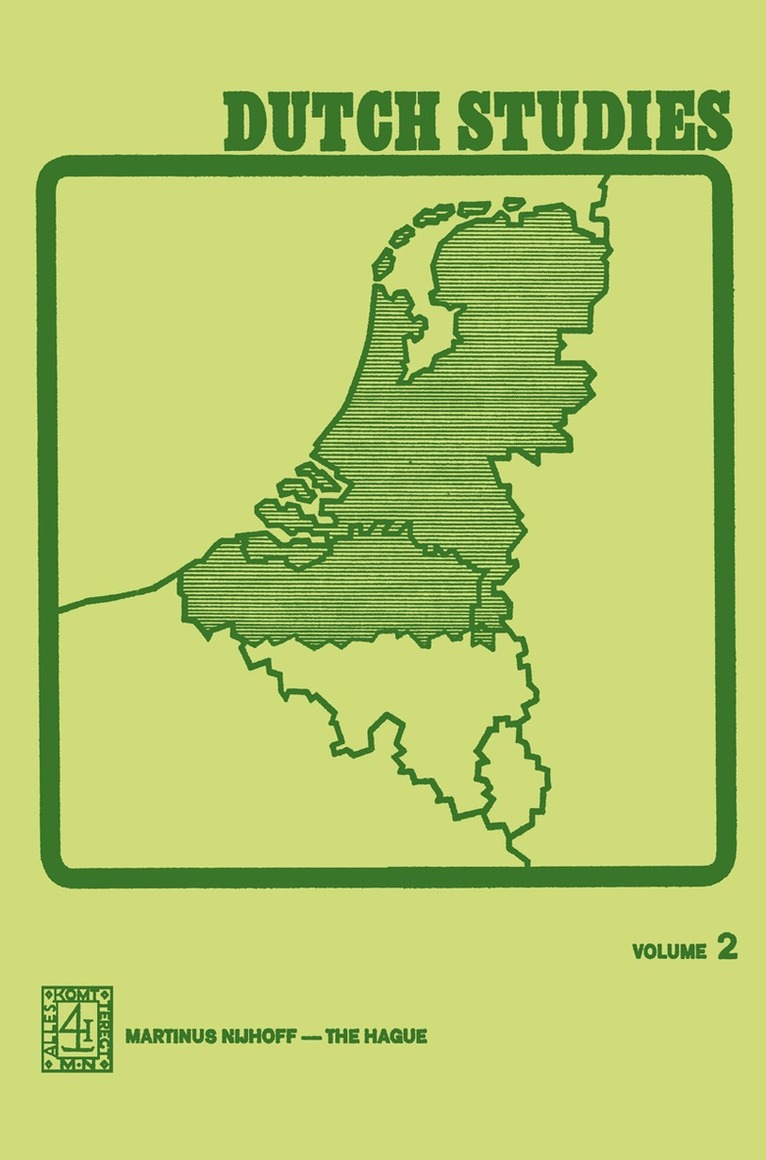
Dutch Studies
An annual review of the language, literature and life of the Low Countries Volume 2
Häftad, Engelska, 1976
552 kr
Skickas inom 10-15 vardagar
1. Areas 2. Language 3. "Pertaining 4. Inhabitants to the area" and variants a. The Dutch language area (de Nederlanden); a. (Nederlands); a. (Nederlands); a. (Nederlander(s)!Vlaming(en": the Netherlands Dutch Netherlandish Netherlander(s) b. The country whose capital is Amsterdam b. (Noordnederlands); b. "Noord)nederlands); b. (Nederlander(s"; (Nederland); Northern Dutch Northern; Northern Netherlander(s); the Northern Netherlands; Holland Dutch Dutch(man) c. The Dutch speaking part of Belgium c. (Zuidnederlands); c. (Vlaams); c. (Vlaming(en"; (V laanderen); Southern Dutch Southern Netherlander(s); Southern; the Southern Netherlands; Flanders Flemish Fleming(s) d. The western provinces of Holland d. (Hollands); d. (Hollands); d. (Hollander(s": (Holland = Noord-Holland and Hollands Hollander(s) Hollands Zuid-Holland); the provinces of Holland e. The western provinces of Flanders e. (Vlaams); e. (Vlaams); e. (Vlaming(en": (Vlaanderen ('de Vlaanders') = West- Vlaams Vlaams Vlaming(en) Vlaanderen and Oost-Vlaanderen); the provinces of Flanders The Dutch terms are italicized.LINGUISTICS APPLIED LINGUISTICS IN THE SEVENTEENTH CENTURY, AND THE DUTCH GRAMMAR OF WILLEM BEYER, 1661, 1681 JOHN GLEDHILL In the flourishing culture of the Northern Netherlands in the early seventeenth century, a proportionate amount of attention was paid to the state of the language. Between 1623 and 1625 several of the leading literary figures, including Hooft and Vondel, had joined in a series of meetings to discuss many aspects of linguistic usage in literature. In this atmosphere it is to be expected that several grammars of the language would appear, and this is indeed the case.
271 kr
Skickas inom 5-8 vardagar
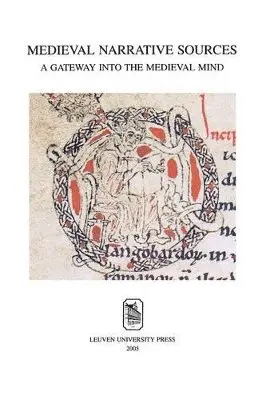
Reduced Price!Now only € 15,00 instead of € 51,50More than ten years ago, some mediaevalists of the K.U.Leuven and the University of Ghent joined together to create a repertory of medieval narrative sources focusing on the southern Low Countries. A pre-print was published in a paper version and was soon followed by the electronic database entitled "Narrative Sources" which is available through the Internet. Since 1996, "Narrative Sources" has been adapted, supplemented and rearranged every year and over the years the number of inventoried items has been increased to far more than 2150 titles. The information present thus far in "Narrative Sources" already allows and facilitates the study of the sources as such, individually or collectively, qualitatively or quantitatively.In a next step the goal would be the exploitation of the contents, with a specific focus on monastic historiography, its social setting, and self-image. In this proceeding some of the scholars working on this project present their work, their methodology and their results to-date.