J Hoberman - Böcker
Visar alla böcker från författaren J Hoberman. Handla med fri frakt och snabb leverans.
7 produkter
7 produkter
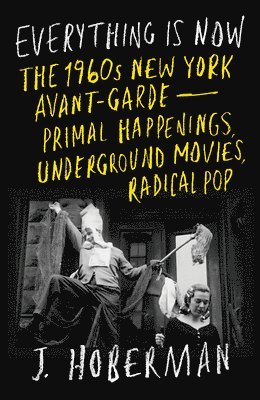
Everything Is Now
The 1960s New York Avant-Garde—Primal Happenings, Underground Movies, Radical Pop
Inbunden, Engelska, 2025
297 kr
Skickas inom 7-10 vardagar
Like Paris in the 1920s, New York City in the 1960s was a cauldron of avant-garde ferment and artistic innovation. Boundaries were transgressed and new forms created. Drawing on interviews, memoirs, and the alternative press, Everything Is Now chronicles this collective drama as it was played out in coffeehouses, bars, lofts, storefront theaters, and, ultimately, the streets.The principals here are penniless filmmakers, jazz musicians, and performing poets, as well as less classifiable artists. Most were outsiders at the time. They include Amiri Baraka, Bob Dylan, Allen Ginsberg, Yayoi Kusama, Yoko Ono, Nam June Paik, Carolee Schneemann, Jack Smith, Andy Warhol, and many more. Some were associated with specific movements (Avant Rock, Destruction Art, Fluxus, Free Jazz, Guerrilla Theater, Happenings, Mimeographed Zines, Pop Art, Protest-Folk, Ridiculous Theater, Stand-Up Poetry, Underground Comix, and Underground Movies). But there were also movements of one. Their art, rooted in the detritus and excitement of urban life, was taboo-breaking and confrontational.As J. Hoberman shows in this riveting history, these subcultures coalesced into a counterculture that changed the city, the country, and the world.
338 kr
Skickas inom 3-6 vardagar
In what the New York Times’s A.O. Scott called a “suave, scholarly tour de force,” J. Hoberman delivers a brilliant and witty look at the decade when politics and pop culture became one.This was the era of the Missile Gap and the Space Race, the Black and Sexual Revolutions, the Vietnam War and Watergate—as well as the tele-saturation of the American market and the advent of Pop art. In “elegant, epigrammatic prose,” as Scott put it, Hoberman moves from the political histories of movies to the theater of wars, national political campaigns, and pop culture events.With entertaining reinterpretations of key Hollywood movies (such as Bonnie and Clyde, The Wild Bunch, and Shampoo), and meditations on personages from Che Guevara, John Wayne, and Patty Hearst to Jane Fonda, Ronald Reagan, and Dirty Harry, Hoberman reconstructs the hidden political history of 1960s cinema and the formation of America’s mass-mediated politics.
400 kr
Skickas inom 7-10 vardagar
A new anthology from one of America's foremost critics of movies and culture
259 kr
Skickas
353 kr
Skickas inom 3-6 vardagar
One of the world's most erudite and entertaining film critics on the state of cinema in the post-digital-and post-9/11-age. This witty and allusive book, in the style of classic film theorists/critics like André Bazin and Siegfried Kracauer, includes considerations of global cinema's most important figures and films, from Lars von Trier and Jia Zhangke to WALL-E, Avatar and Inception.
Everything Is Now
The 1960s New York Avant-Garde—Primal Happenings, Underground Movies, Radical Pop
Häftad, Engelska, 2026
211 kr
Kommande
Like Paris in the 1920s, New York City in the 1960s was a cauldron of avant-garde ferment and artistic innovation. Boundaries were transgressed and new forms created. Drawing on interviews, memoirs, and the alternative press, Everything Is Now chronicles this collective drama as it was played out in coffeehouses, bars, lofts, storefront theaters, and, ultimately, the streets. The principals here include Amiri Baraka, Bob Dylan, Allen Ginsberg, Yoko Ono, Nam June Paik, Carolee Schneemann, Andy Warhol, and many more. Their art, rooted in the detritus and excitement of urban life, was taboo breaking and confrontational. As J. Hoberman shows in this riveting history, these subcultures coalesced into a counterculture that changed the city, the country, and the world.
181 kr
Skickas
The Marx Brothers are universally considered to be classic Hollywood’s preeminent comedy team and Duck Soup is generally regarded as their quintessential film. A topical satire of dictatorship and government in general, the movie was a critical failure and box-office let-down on its initial release in 1933.J. Hoberman's study of the film traces its reputation history, from the initial disappointment of its release, to its rise to cult status in the 1960s when the Marx’s anarchic, anti-establishment humor seemed again timely. Hoberman places Duck Soup, alongside analogous comedies—Dr. Strangelove (1964), the Beatles films, Morgan! (1966), The President’s Analyst (1967) and The Producers (1968). It attained canonical stature as a touchstone for Woody Allen and would be recognized by the Library of Congress in the 1990s.Hoberman's analysis provides a historical and political context as well as an in-depth production history, drawing on primary sources and emphasizing director McCarey’s prior work along with the Marx Brothers as well as the situation at Paramount, a substantial synopsis, and an account of the movie’s initial reception, concluding with its subsequent elevation to comic masterpiece.