J. Ian Richards - Böcker
Visar alla böcker från författaren J. Ian Richards. Handla med fri frakt och snabb leverans.
2 produkter
2 produkter
573 kr
Skickas inom 7-10 vardagar
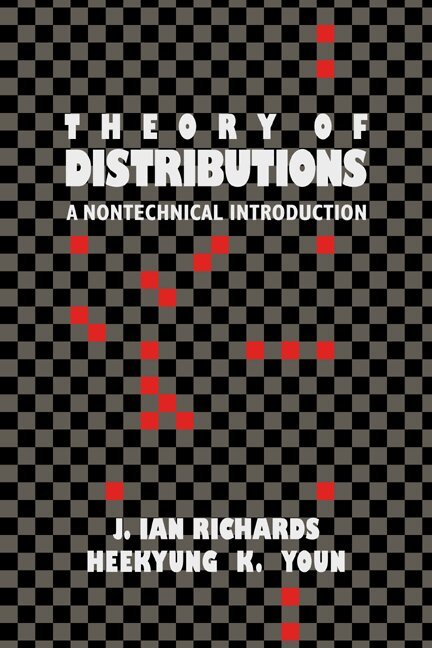
This book is a self-contained introduction to the theory of distributions, sometimes called generalized functions. Most books on this subject are either intuitive or else rigorous but technically demanding. Here, by concentrating on the essential results, the authors have introduced the subject in a way that will most appeal to non-specialists, yet is still mathematically correct. Topics covered include: the Dirac delta function, generalized functions, dipoles, quadrupoles, pseudofunctions and Fourier transforms. The self-contained treatment does not require any knowledge of functional analysis or topological vector spaces; even measure theory is not needed for most of the book. The book, which can be used either to accompany a course or for self-study, is liberally supplied with exercises. It will be a valuable introduction to the theory of distributions and their applications for students or professionals in statistics, physics, engineering and economics.
1 521 kr
Skickas inom 7-10 vardagar
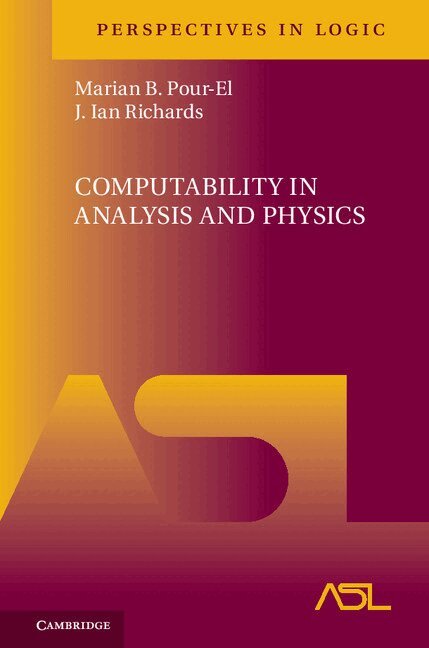
Since their inception, the Perspectives in Logic and Lecture Notes in Logic series have published seminal works by leading logicians. Many of the original books in the series have been unavailable for years, but they are now in print once again. In this volume, the first publication in the Perspectives in Logic series, Pour-El and Richards present the first graduate-level treatment of computable analysis within the tradition of classical mathematical reasoning. The book focuses on the computability or noncomputability of standard processes in analysis and physics. Topics include classical analysis, Hilbert and Banach spaces, bounded and unbounded linear operators, eigenvalues, eigenvectors, and equations of mathematical physics. The work is self-contained, and although it is intended primarily for logicians and analysts, it should also be of interest to researchers and graduate students in physics and computer science.