J. Strother Moore – författare
Visar alla böcker från författaren J. Strother Moore. Handla med fri frakt och snabb leverans.
9 produkter
9 produkter
E-bok
PDF, Engelska, 20141 335 kr
Läs direkt efter köp
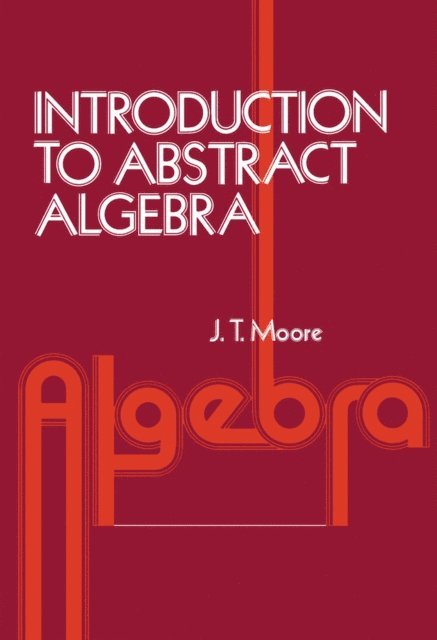
Introduction to Abstract Algebra provides insight into the methods of abstract algebra. This book provides information pertinent to the fundamental concepts of abstract algebra. Organized into five chapters, this book begins with an overview of the study of natural numbers that are used historically for the purpose of counting the objects in different assemblages. This text then examines the concepts of set and elements of a set. Other chapters contain an intuitive survey of the different kinds of real numbers, with the inclusion of many very important results on integers. This book presents as well a brief survey of algebraic systems from the trivial sets to the more highly structures groups, with emphasis on the elementary properties of groups. The final chapter deals with the simple development of complex numbers. This book is intended to be suitable for students in abstract algebra.
E-bok
PDF, Engelska, 2007712 kr
Läs direkt efter köp
Mountaineers use pitons to protect themselves from falls. The lead climber wears a harness to which a rope is tied. As the climber ascends, the rope is paid out by a partner on the ground. As described thus far, the climber receives no protection from the rope or the partner. However, the climber generally carries several spike-like pitons and stops when possible to drive one into a small crack or crevice in the rock face. After climbing just above the piton, the climber clips the rope to the piton, using slings and carabiners. A subsequent fall would result in the climber hanging from the piton—if the piton stays in the rock, the slings and carabiners do not fail, the rope does not break, the partner is holding the rope taut and secure, and the climber had not climbed too high above the piton before falling. The climber''s safety clearly depends on all of the components of the system. But the piton is distinguished because it connects the natural to the artificial. In 1987 I designed an assembly-level language for Warren Hunt''s FM8501 verified microprocessor. I wanted the language to be conveniently used as the object code produced by verified compilers. Thus, I envisioned the language as the first software link in a trusted chain from verified hardware to verified applications programs. Thinking of the hardware as the "rock" I named the language "Piton.
Inbunden, Engelska, 2000
2 225 kr
Skickas inom 10-15 vardagar
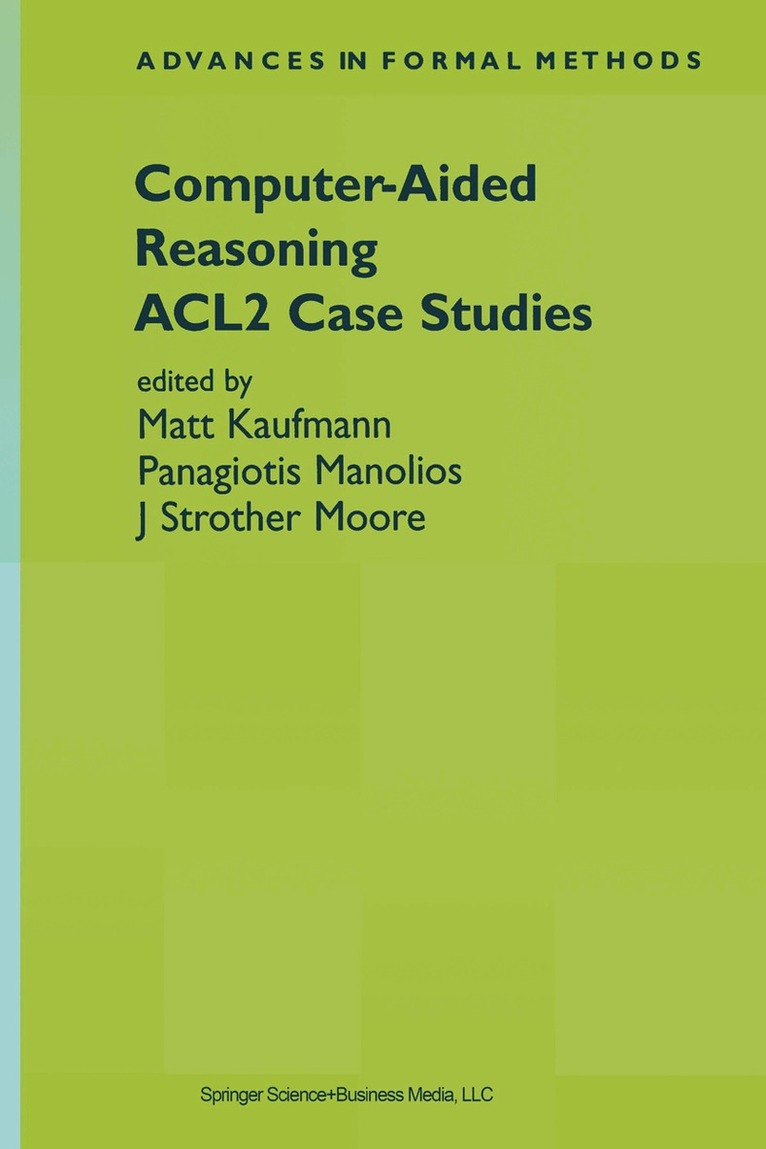
Computer-Aided Reasoning: ACL2 Case Studies illustrates how the computer-aided reasoning system ACL2 can be used in productive and innovative ways to design, build, and maintain hardware and software systems. Included here are technical papers written by twenty-one contributors that report on self-contained case studies, some of which are sanitized industrial projects. The papers deal with a wide variety of ideas, including floating-point arithmetic, microprocessor simulation, model checking, symbolic trajectory evaluation, compilation, proof checking, real analysis, and several others. Computer-Aided Reasoning: ACL2 Case Studies is meant for two audiences: those looking for innovative ways to design, build, and maintain hardware and software systems faster and more reliably, and those wishing to learn how to do this. The former audience includes project managers and students in survey-oriented courses. The latter audience includes students and professionals pursuing rigorous approaches to hardware and software engineering or formal methods. Computer-Aided Reasoning: ACL2 Case Studies can be used in graduate and upper-division undergraduate courses on Software Engineering, Formal Methods, Hardware Design, Theory of Computation, Artificial Intelligence, and Automated Reasoning. The book is divided into two parts. Part I begins with a discussion of the effort involved in using ACL2. It also contains a brief introduction to the ACL2 logic and its mechanization, which is intended to give the reader sufficient background to read the case studies. A more thorough, textbook introduction to ACL2 may be found in the companion book, Computer-Aided Reasoning: An Approach. The heart of the book is Part II, where the case studies are presented. The case studies contain exercises whose solutions are on the Web. In addition, the complete ACL2 scripts necessary to formalize the models and prove all the properties discussed are on the Web. For example, when we say that one of the case studies formalizes a floating-point multiplier and proves it correct, we mean that not only can you read an English description of the model and how it was proved correct, but you can obtain the entire formal content of the project and replay the proofs, if you wish, with your copy of ACL2. ACL2 may be obtained from its home page. The results reported in each case study, as ACL2 input scripts, as well as exercise solutions for both books, are available from this page.
Häftad, Engelska, 2010
2 222 kr
Skickas inom 10-15 vardagar
Computer-Aided Reasoning: ACL2 Case Studies illustrates how the computer-aided reasoning system ACL2 can be used in productive and innovative ways to design, build, and maintain hardware and software systems. Included here are technical papers written by twenty-one contributors that report on self-contained case studies, some of which are sanitized industrial projects. The papers deal with a wide variety of ideas, including floating-point arithmetic, microprocessor simulation, model checking, symbolic trajectory evaluation, compilation, proof checking, real analysis, and several others. Computer-Aided Reasoning: ACL2 Case Studies is meant for two audiences: those looking for innovative ways to design, build, and maintain hardware and software systems faster and more reliably, and those wishing to learn how to do this. The former audience includes project managers and students in survey-oriented courses. The latter audience includes students and professionals pursuing rigorous approaches to hardware and software engineering or formal methods. Computer-Aided Reasoning: ACL2 Case Studies can be used in graduate and upper-division undergraduate courses on Software Engineering, Formal Methods, Hardware Design, Theory of Computation, Artificial Intelligence, and Automated Reasoning. The book is divided into two parts. Part I begins with a discussion of the effort involved in using ACL2. It also contains a brief introduction to the ACL2 logic and its mechanization, which is intended to give the reader sufficient background to read the case studies. A more thorough, textbook introduction to ACL2 may be found in the companion book, Computer-Aided Reasoning: An Approach. The heart of the book is Part II, where the case studies are presented. The case studies contain exercises whose solutions are on the Web. In addition, the complete ACL2 scripts necessary to formalize the models and prove all the properties discussed are on the Web. For example, when we say that one of the case studies formalizes a floating-point multiplier and proves it correct, we mean that not only can you read an English description of the model and how it was proved correct, but you can obtain the entire formal content of the project and replay the proofs, if you wish, with your copy of ACL2. ACL2 may be obtained from its home page. The results reported in each case study, as ACL2 input scripts, as well as exercise solutions for both books, are available from this page.
E-bok
PDF, Engelska, 20123 530 kr
Läs direkt efter köp
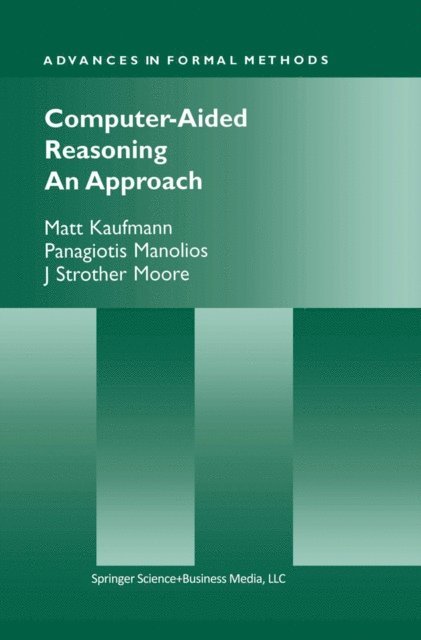
Computer-Aided Reasoning: An Approach is a textbook introduction to computer-aided reasoning. It can be used in graduate and upper-division undergraduate courses on software engineering or formal methods. It is also suitable in conjunction with other books in courses on hardware design, discrete mathematics, or theory, especially courses stressing formalism, rigor, or mechanized support. It is also appropriate for courses on artificial intelligence or automated reasoning and as a reference for business and industry. Current hardware and software systems are often very complex and the trend is towards increased complexity. Many of these systems are of critical importance; therefore making sure that they behave as expected is also of critical importance. By modeling computing systems mathematically, we obtain models that we can prove behave correctly. The complexity of computing systems makes such proofs very long, complicated, and error-prone. To further increase confidence in our reasoning, we can use a computer program to check our proofs and even to automate some of their construction. In this book we present: A practical functional programming language closely related to Common Lisp which is used to define functions (which can model computing systems) and to make assertions about defined functions; A formal logic in which defined functions correspond to axioms; the logic is first-order, includes induction, and allows us to prove theorems about the functions; The computer-aided reasoning system ACL2, which includes the programming language, the logic, and mechanical support for the proof process. The ACL2 system has been successfully applied to projects of commercial interest, including microprocessor, modeling, hardware verification, microcode verification, and software verification. This book gives a methodology for modeling computing systems formally and for reasoning about those models with mechanized assistance. The practicality of computer-aided reasoning is further demonstrated in the companion book, Computer-Aided Reasoning: ACL2 Case Studies. Approximately 140 exercises are distributed throughout the book. Additional material is freely available from the ACL2 home page on the Web, including solutions to the exercises, additional exercises, case studies from the companion book, research papers, and the ACL2 system with detailed documentation.
E-bok
PDF, Engelska, 20132 925 kr
Läs direkt efter köp
Computer-Aided Reasoning: ACL2 Case Studies illustrates how the computer-aided reasoning system ACL2 can be used in productive and innovative ways to design, build, and maintain hardware and software systems. Included here are technical papers written by twenty-one contributors that report on self-contained case studies, some of which are sanitized industrial projects. The papers deal with a wide variety of ideas, including floating-point arithmetic, microprocessor simulation, model checking, symbolic trajectory evaluation, compilation, proof checking, real analysis, and several others. Computer-Aided Reasoning: ACL2 Case Studies is meant for two audiences: those looking for innovative ways to design, build, and maintain hardware and software systems faster and more reliably, and those wishing to learn how to do this. The former audience includes project managers and students in survey-oriented courses. The latter audience includes students and professionals pursuing rigorous approaches to hardware and software engineering or formal methods. Computer-Aided Reasoning: ACL2 Case Studies can be used in graduate and upper-division undergraduate courses on Software Engineering, Formal Methods, Hardware Design, Theory of Computation, Artificial Intelligence, and Automated Reasoning. The book is divided into two parts. Part I begins with a discussion of the effort involved in using ACL2. It also contains a brief introduction to the ACL2 logic and its mechanization, which is intended to give the reader sufficient background to read the case studies. A more thorough, textbook introduction to ACL2 may be found in the companion book, Computer-Aided Reasoning: An Approach. The heart of the book is Part II, where the case studies are presented. The case studies contain exercises whose solutions are on the Web. In addition, the complete ACL2 scripts necessary to formalize the models and prove all the properties discussed are on the Web. For example, when we say that one of the case studies formalizes a floating-point multiplier and proves it correct, we mean that not only can you read an English description of the model and how it was proved correct, but you can obtain the entire formal content of the project and replay the proofs, if you wish, with your copy of ACL2. ACL2 may be obtained from its home page. The results reported in each case study, as ACL2 input scripts, as well as exercise solutions for both books, are available from this page.
E-bok
PDF, Engelska, 2014756 kr
Läs direkt efter köp
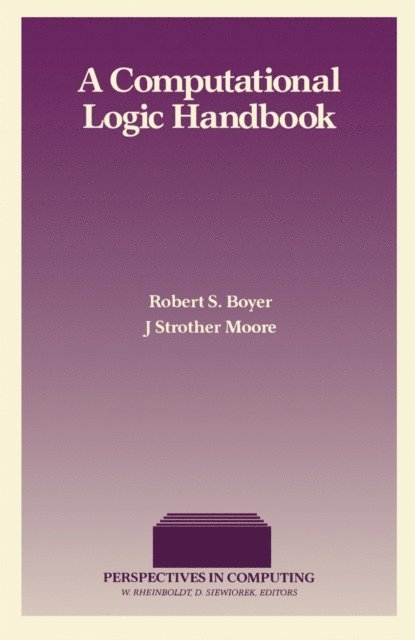
Perspectives in Computing: A Computational Logic Handbook contains a precise description of the logic and a detailed reference guide to the associated mechanical theorem proving system, including a primer for the logic as a functional programming language, an introduction to proofs in the logic, and a primer for the mechanical theorem. The publication first offers information on a primer for the logic, formalization within the logic, and a precise description of the logic. Discussions focus on induction and recursion, quantification, explicit value terms, dealing with features and omissions, elementary mathematical relationships, Boolean operators, and conventional data structures. The text then takes a look at proving theorems in the logic, mechanized proofs in the logic, and an introduction to the system. The text examines the processes involved in using the theorem prover, four classes of rules generated from lemmas, and aborting or interrupting commands. Topics include executable counterparts, toggle, elimination of irrelevancy, heuristic use of equalities, representation of formulas, type sets, and the crucial check points in a proof attempt. The publication is a vital reference for researchers interested in computational logic.
E-bok
PDF, Engelska, 2014783 kr
Läs direkt efter köp
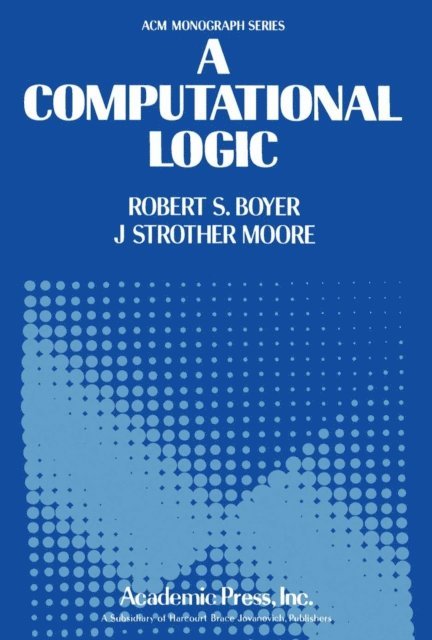
ACM Monograph Series: A Computational Logic focuses on the use of induction in proving theorems, including the use of lemmas and axioms, free variables, equalities, and generalization. The publication first elaborates on a sketch of the theory and two simple examples, a precise definition of the theory, and correctness of a tautology-checker. Topics include mechanical proofs, informal development, formal specification of the problem, well-founded relations, natural numbers, and literal atoms. The book then examines the use of type information to simplify formulas, use of axioms and lemmas as rewrite rules, and the use of definitions. Topics include nonrecursive functions, computing values, free variables in hypothesis, infinite backwards chaining, infinite looping, computing type sets, and type prescriptions. The manuscript takes a look at rewriting terms and simplifying clauses, eliminating destructors and irrelevance, using equalities, and generalization. Concerns include reasons for eliminating isolated hypotheses, precise statement of the generalization heuristic, restricting generalizations, precise use of equalities, and multiple destructors and infinite looping. The publication is a vital source of data for researchers interested in computational logic.
Del 3 - Automated Reasoning Series
Piton
A Mechanically Verified Assembly-Level Language
Häftad, Engelska, 2013
545 kr
Skickas inom 10-15 vardagar
Mountaineers use pitons to protect themselves from falls. The lead climber wears a harness to which a rope is tied. As the climber ascends, the rope is paid out by a partner on the ground. As described thus far, the climber receives no protection from the rope or the partner. However, the climber generally carries several spike-like pitons and stops when possible to drive one into a small crack or crevice in the rock face. After climbing just above the piton, the climber clips the rope to the piton, using slings and carabiners. A subsequent fall would result in the climber hanging from the piton—if the piton stays in the rock, the slings and carabiners do not fail, the rope does not break, the partner is holding the rope taut and secure, and the climber had not climbed too high above the piton before falling. The climber's safety clearly depends on all of the components of the system. But the piton is distinguished because it connects the natural to the artificial. In 1987 I designed an assembly-level language for Warren Hunt's FM8501 verified microprocessor. I wanted the language to be conveniently used as the object code produced by verified compilers. Thus, I envisioned the language as the first software link in a trusted chain from verified hardware to verified applications programs. Thinking of the hardware as the "rock" I named the language "Piton.