Matt Kaufmann - Böcker
Visar alla böcker från författaren Matt Kaufmann. Handla med fri frakt och snabb leverans.
3 produkter
3 produkter
2 163 kr
Skickas inom 10-15 vardagar
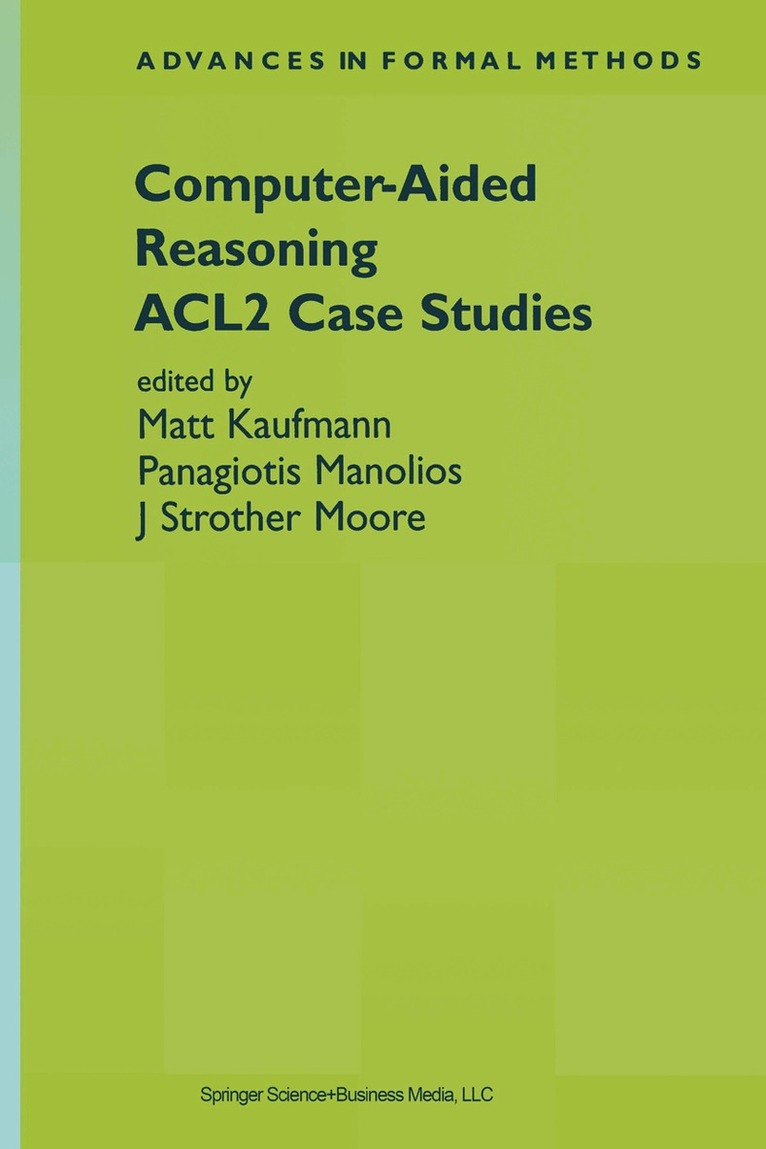
This title illustrates how the computer-aided reasoning system ACL2 can be used in productive and innovative ways to design, build, and maintain hardware and software systems. Included here are technical papers written by 21 contributors that report on self-contained case studies, some of which are sanitized industrial projects. The papers deal with a wide variety of ideas, including floating-point arithmetic, microprocessor simulation, model checking, symbolic trajectory evaluation, compilation, proof checking, real analysis, and several others. The book is divided into two parts. Part I begins with a discussion of the effort involved in using ACL2. It also contains a brief introduction to the ACL2 logic and its mechanization, which is intended to give the reader sufficient background to read the case studies. A more thorough, textbook introduction to ACL2 may be found in the companion book, "Computer-Aided Reasoning: An Approach". The heart of the book is Part II, where the case studies are presented. The case studies contain exercises whose solutions are on the Web.In addition, the complete ACL2 scripts necessary to formalize the models and prove all the properties discussed are on the Web.
2 163 kr
Skickas inom 10-15 vardagar
Computer-Aided Reasoning: ACL2 Case Studies illustrates how the computer-aided reasoning system ACL2 can be used in productive and innovative ways to design, build, and maintain hardware and software systems. Included here are technical papers written by twenty-one contributors that report on self-contained case studies, some of which are sanitized industrial projects. The papers deal with a wide variety of ideas, including floating-point arithmetic, microprocessor simulation, model checking, symbolic trajectory evaluation, compilation, proof checking, real analysis, and several others. Computer-Aided Reasoning: ACL2 Case Studies is meant for two audiences: those looking for innovative ways to design, build, and maintain hardware and software systems faster and more reliably, and those wishing to learn how to do this. The former audience includes project managers and students in survey-oriented courses. The latter audience includes students and professionals pursuing rigorous approaches to hardware and software engineering or formal methods.Computer-Aided Reasoning: ACL2 Case Studies can be used in graduate and upper-division undergraduate courses on Software Engineering, Formal Methods, Hardware Design, Theory of Computation, Artificial Intelligence, and Automated Reasoning. The book is divided into two parts. Part I begins with a discussion of the effort involved in using ACL2. It also contains a brief introduction to the ACL2 logic and its mechanization, which is intended to give the reader sufficient background to read the case studies. A more thorough, textbook introduction to ACL2 may be found in the companion book, Computer-Aided Reasoning: An Approach. The heart of the book is Part II, where the case studies are presented. The case studies contain exercises whose solutions are on the Web. In addition, the complete ACL2 scripts necessary to formalize the models and prove all the properties discussed are on the Web.For example, when we say that one of the case studies formalizes a floating-point multiplier and proves it correct, we mean that not only can you read an English description of the model and how it was proved correct, but you can obtain the entire formal content of the project and replay the proofs, if you wish, with your copy of ACL2. ACL2 may be obtained from its home page. The results reported in each case study, as ACL2 input scripts, as well as exercise solutions for both books, are available from this page.
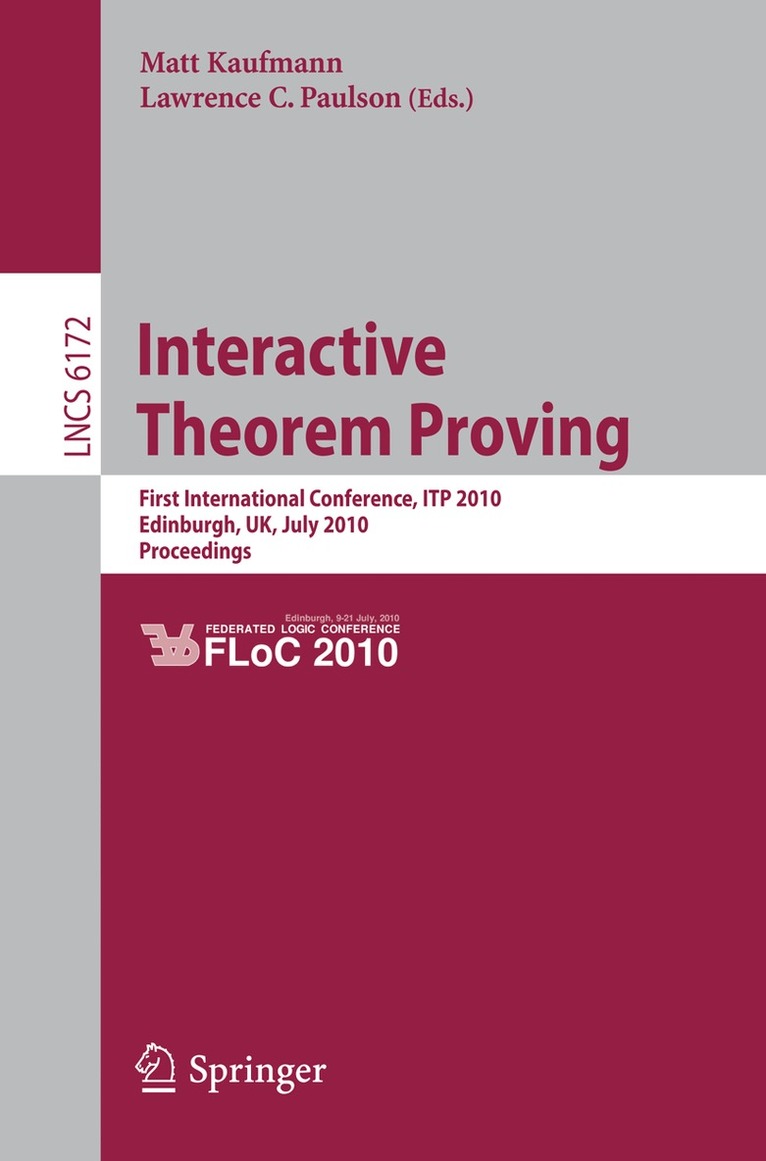
Interactive Theorem Proving
First International Conference, ITP 2010 Edinburgh, UK, July 11-14, 2010, Proceedings
Häftad, Engelska, 2010
1 095 kr
Skickas inom 10-15 vardagar
This volume contains the papers presented at ITP 2010: the First International ConferenceonInteractiveTheoremProving. It washeldduring July11-14,2010 in Edinburgh, Scotland as part of the Federated Logic Conference (FLoC, July 9-21, 2010) alongside the other FLoC conferences and workshops. ITP combines the communities of two venerable meetings: the TPHOLs c- ference and the ACL2 workshop. The former conference originated in 1988 as a workshop for users of the HOL proof assistant. The ?rst two meetings were at the University of Cambridge, but afterwards they were held in a variety of venues. By 1992, the workshop acquired the name Higher-Order Logic Theorem Proving and Its Applications. In 1996, it was christened anew as Theorem Pr- ing in Higher-Order Logics, TPHOLs for short, and was henceforth organizedas a conference. Each of these transitions broadened the meeting's scope from the original HOL system to include other proof assistants based on forms of high- order logic, including Coq, Isabelle and PVS.TPHOLs has regularly published research done using ACL2 (the modern version of the well-known Boyer-Moore theorem prover), even though ACL2 implements a unique computational form of ?rst-order logic. The ACL2 community has run its own series of workshops since1999. BymergingTPHOLswith the ACL2workshop,weinclude a broader community of researchers who work with interactive proof tools. With our enlarged community, it was not surprising that ITP attracted a record-breaking 74 submissions, each of which was reviewed by at least three Programme Committee members.