Häftad, Engelska, 2010
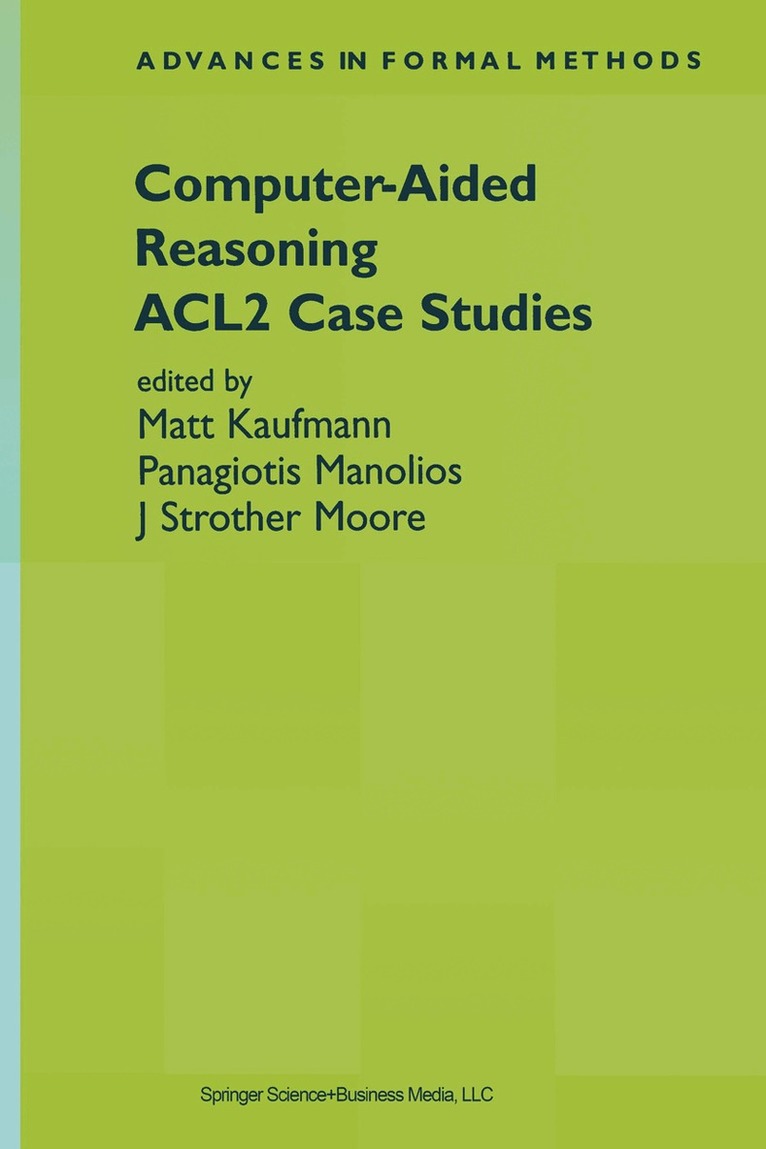
Computer-Aided Reasoning
Av Matt Kaufmann, Panagiotis Manolios, J Strother Moore
2273 kr
Skickas inom 10-15 vardagar
Beskrivning
Computer-Aided Reasoning: ACL2 Case Studies illustrates how the computer-aided reasoning system ACL2 can be used in productive and innovative ways to design, build, and maintain hardware and software systems. Included here are technical papers written by twenty-one contributors that report on self-contained case studies, some of which are sanitized industrial projects. The papers deal with a wide variety of ideas, including floating-point arithmetic, microprocessor simulation, model checking, symbolic trajectory evaluation, compilation, proof checking, real analysis, and several others. Computer-Aided Reasoning: ACL2 Case Studies is meant for two audiences: those looking for innovative ways to design, build, and maintain hardware and software systems faster and more reliably, and those wishing to learn how to do this. The former audience includes project managers and students in survey-oriented courses. The latter audience includes students and professionals pursuing rigorous approaches to hardware and software engineering or formal methods. Computer-Aided Reasoning: ACL2 Case Studies can be used in graduate and upper-division undergraduate courses on Software Engineering, Formal Methods, Hardware Design, Theory of Computation, Artificial Intelligence, and Automated Reasoning. The book is divided into two parts. Part I begins with a discussion of the effort involved in using ACL2. It also contains a brief introduction to the ACL2 logic and its mechanization, which is intended to give the reader sufficient background to read the case studies. A more thorough, textbook introduction to ACL2 may be found in the companion book, Computer-Aided Reasoning: An Approach. The heart of the book is Part II, where the case studies are presented. The case studies contain exercises whose solutions are on the Web. In addition, the complete ACL2 scripts necessary to formalize the models and prove all the properties discussed are on the Web. For example, when we say that one of the case studies formalizes a floating-point multiplier and proves it correct, we mean that not only can you read an English description of the model and how it was proved correct, but you can obtain the entire formal content of the project and replay the proofs, if you wish, with your copy of ACL2. ACL2 may be obtained from its home page. The results reported in each case study, as ACL2 input scripts, as well as exercise solutions for both books, are available from this page.
Produktinformation
- Utgivningsdatum: 2010-12-08
- Mått: 155 x 235 x 20 mm
- Vikt: 540 g
- Format: Häftad
- Språk: Engelska
- Antal sidor: 337
- Förlag: Springer-Verlag New York Inc.
- Serie: Advances in Formal Methods
- ISBN: 9781441949813
Utforska kategorier
Betyg & recensioner
0 recensioner
Inga recensioner tillgängliga.