Jacek Mańdziuk - Böcker
Visar alla böcker från författaren Jacek Mańdziuk. Handla med fri frakt och snabb leverans.
5 produkter
5 produkter
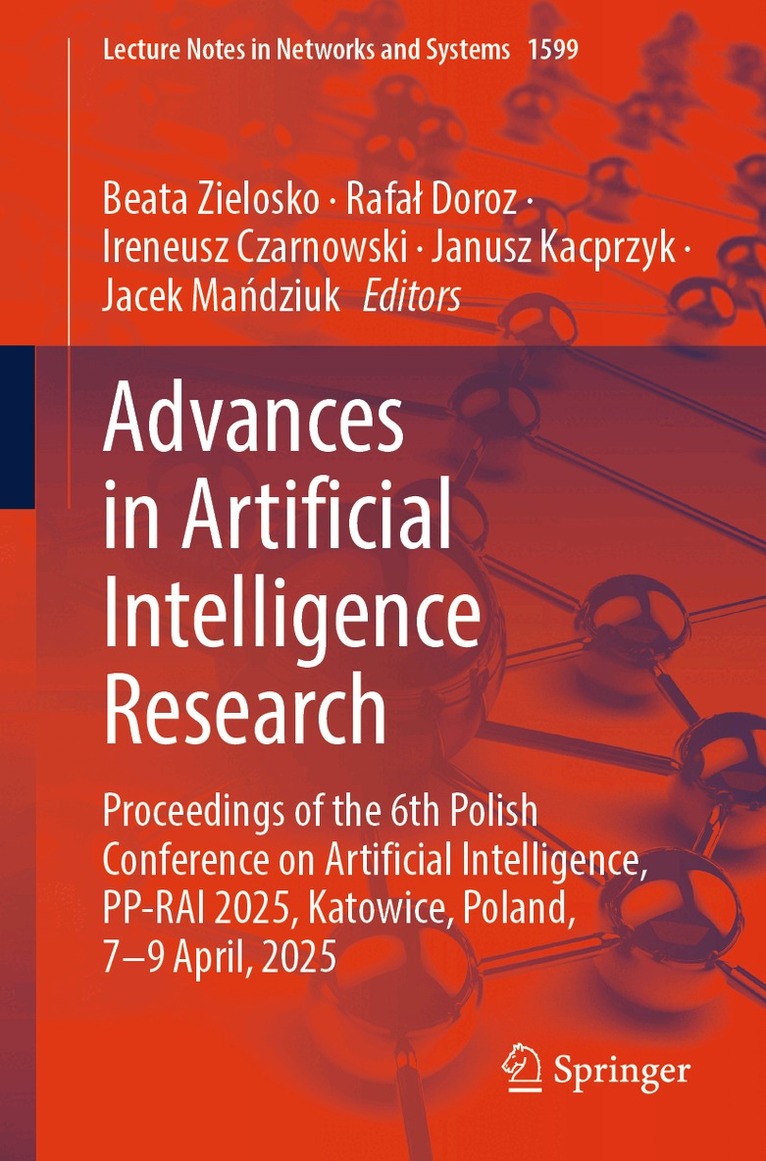
Advances in Artificial Intelligence Research
Proceedings of the 6th Polish Conference on Artificial Intelligence, PP-RAI 2025, Katowice, Poland, 7-9 April, 2025
Häftad, Engelska, 2026
2 163 kr
Skickas inom 10-15 vardagar
This book is a collection of papers related to the latest achievements and development trends in the field of artificial intelligence. This compilation of peer-reviewed articles presents both theoretical foundations and innovative algorithms, as well as interdisciplinary applications that shape modern intelligent technologies. It serves as a platform for critical academic discussion, integrating methodological foundations with the analysis of contemporary AI issues. This book points to many advances topically subdivided into parts related to data mining and machine learning, medical, interdisciplinary and human behaviour applications, neural network and deep learning systems, computer vision, uncertainty in AI, robotics and autonomous systems, problem solving and optimisation, generative AI, decision-making and classification in complex systems, and research of young scientist in field of AI. By addressing innovative approaches, implementation efficiency, and responsibility in applications, this book is a valuable source of knowledge for researchers, practitioners, and students in technical disciplines.
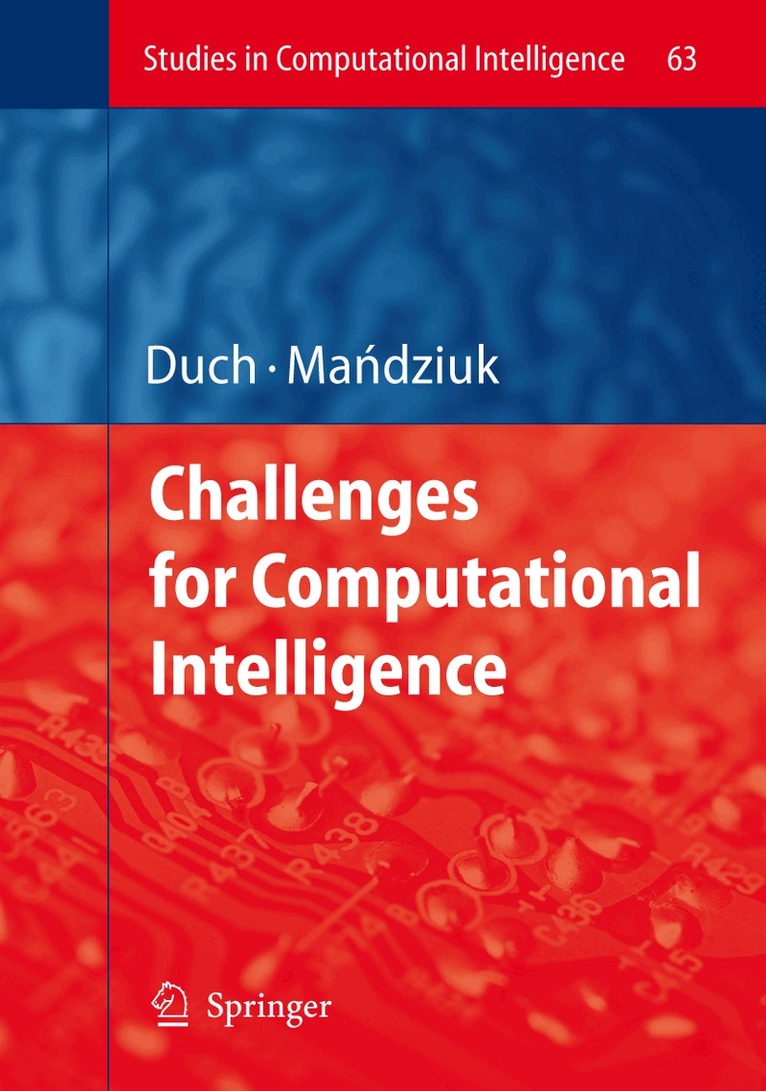
Del 63 - Studies in Computational Intelligence
Challenges for Computational Intelligence
Inbunden, Engelska, 2007
1 590 kr
Skickas inom 10-15 vardagar
In the year 1900 at the International Congress of Mathematicians in Paris David Hilbert delivered what is now considered the most important talk ever given in the history of mathematics, proposing 23 major problems worth working at in the future. One hundred years later the impact of this talk is still strong: some problems have been solved, new problems have been added, but the direction once set - identify the most important problems and focus on them - is still actual.Computational Intelligence (CI) is used as a name to cover many existing branches of science, with artificial neural networks, fuzzy systems and evolutionary computation forming its core. In recent years CI has been extended by adding many other subdisciplines and it became quite obvious that this new field also requires a series of challenging problems that will give it a sense of direction. Without setting up clear goals and yardsticks to measure progress on the way many research efforts are wasted.The book written by top experts in CI provides such clear directions and the much-needed focus on the most important and challenging research issues, showing a roadmap how to achieve ambitious goals.
Del 63 - Studies in Computational Intelligence
Challenges for Computational Intelligence
Häftad, Engelska, 2010
1 590 kr
Skickas inom 10-15 vardagar
In the year 1900 at the International Congress of Mathematicians in Paris David Hilbert delivered what is now considered the most important talk ever given in the history of mathematics, proposing 23 major problems worth working at in the future. One hundred years later the impact of this talk is still strong: some problems have been solved, new problems have been added, but the direction once set - identify the most important problems and focus on them - is still actual.Computational Intelligence (CI) is used as a name to cover many existing branches of science, with artificial neural networks, fuzzy systems and evolutionary computation forming its core. In recent years CI has been extended by adding many other subdisciplines and it became quite obvious that this new field also requires a series of challenging problems that will give it a sense of direction. Without setting up clear goals and yardsticks to measure progress on the way many research efforts are wasted.The book written by top experts in CI provides such clear directions and the much-needed focus on the most important and challenging research issues, showing a roadmap how to achieve ambitious goals.
1 105 kr
Skickas inom 10-15 vardagar
Humans and machines are very di?erent in their approaches to game pl- ing. Humans use intuition, perception mechanisms, selective search, creat- ity, abstraction, heuristic abilities and other cognitive skills to compensate their (comparably) slow information processing speed, relatively low m- ory capacity, and limited search abilities. Machines, on the other hand, are extremely fast and infallible in calculations, capable of e?ective brute-for- type search, use “unlimited” memory resources, but at the same time are poor at using reasoning-based approaches and abstraction-based methods. The above major discrepancies in the human and machine problem solving methods underlined the development of traditional machine game playing as being focused mainly on engineering advances rather than cognitive or psychological developments. In other words, as described by Winkler and F¨ urnkranz [347, 348] with respect to chess, human and machine axes of game playing development are perpendicular, but the most interesting, most promising, and probably also most di?cult research area lies on the junction between human-compatible knowledge and machine compatible processing.I undoubtedly share this point of view and strongly believe that the future of machine game playing lies in implementation of human-type abilities (- straction,intuition,creativity,selectiveattention,andother)whilestilltaking advantage of intrinsic machine skills. Thebookisfocusedonthedevelopmentsandprospectivechallengingpr- lems in the area of mind gameplaying (i.e. playinggames that require mental skills) using Computational Intelligence (CI) methods, mainly neural n- works, genetic/evolutionary programming and reinforcement learning.
Del 276 - Studies in Computational Intelligence
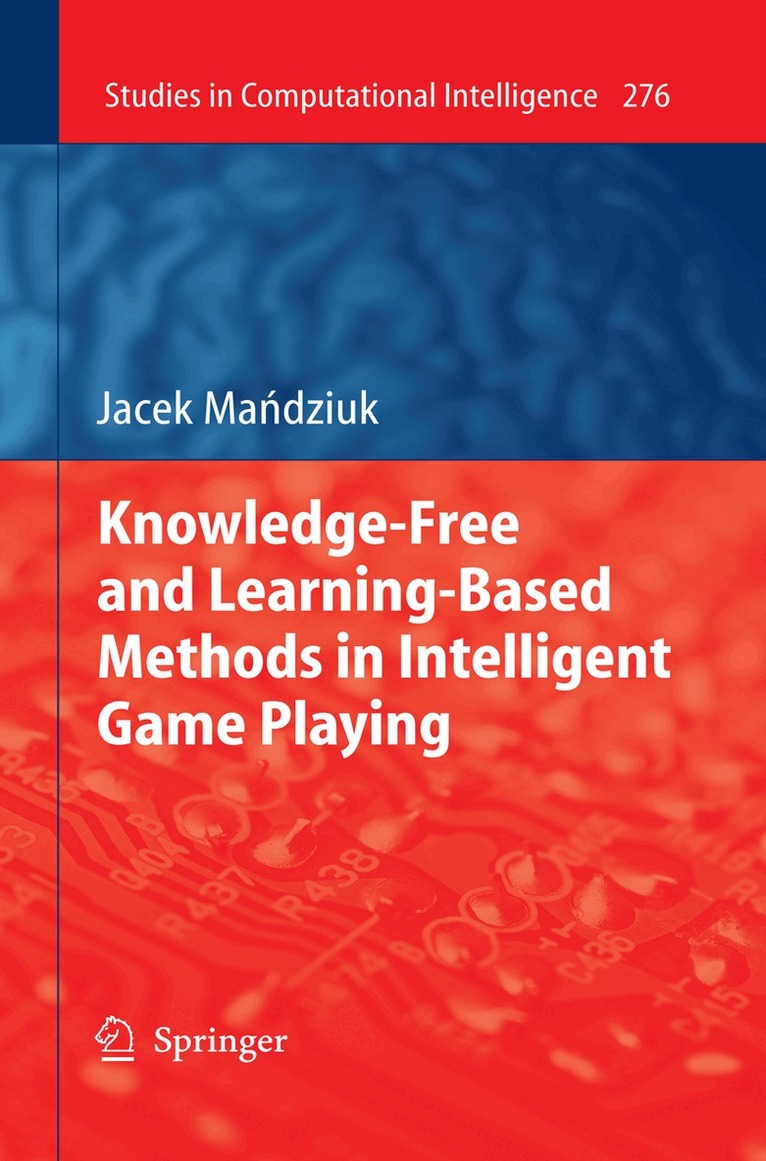
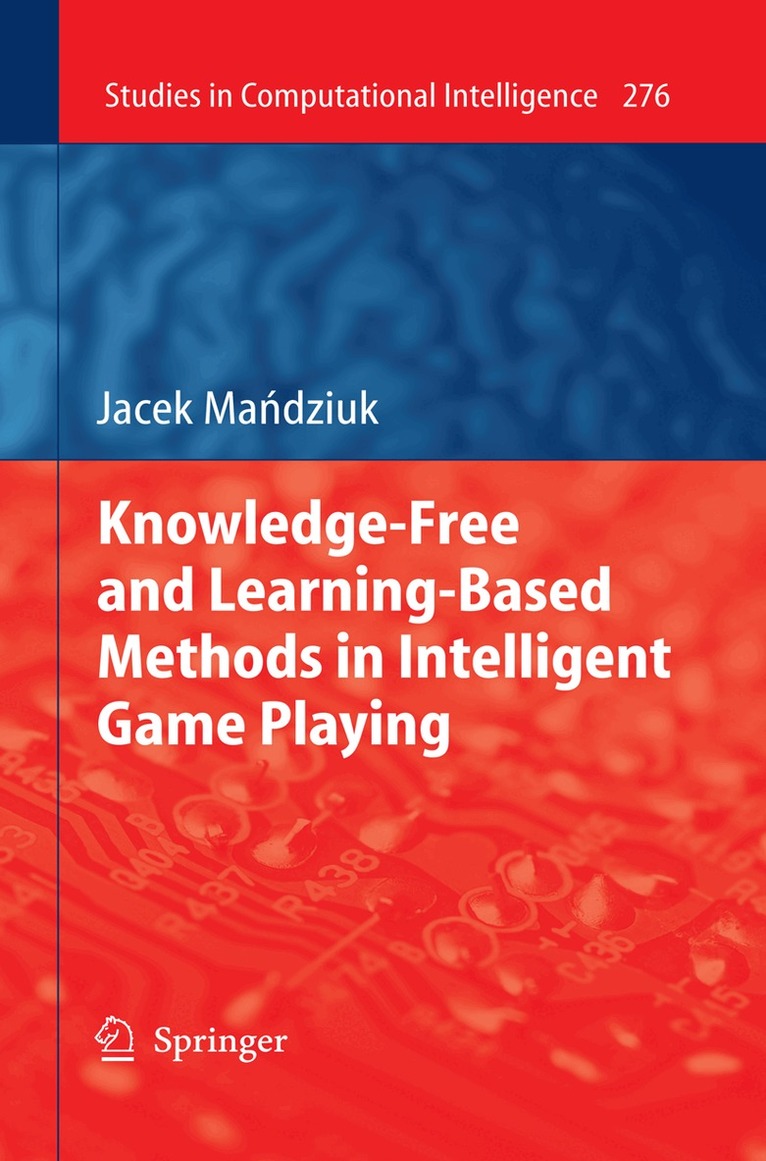
Knowledge-Free and Learning-Based Methods in Intelligent Game Playing
Häftad, Engelska, 2012
1 105 kr
Skickas inom 10-15 vardagar
Humans and machines are very di?erent in their approaches to game pl- ing. Humans use intuition, perception mechanisms, selective search, creat- ity, abstraction, heuristic abilities and other cognitive skills to compensate their (comparably) slow information processing speed, relatively low m- ory capacity, and limited search abilities. Machines, on the other hand, are extremely fast and infallible in calculations, capable of e?ective brute-for- type search, use “unlimited” memory resources, but at the same time are poor at using reasoning-based approaches and abstraction-based methods. The above major discrepancies in the human and machine problem solving methods underlined the development of traditional machine game playing as being focused mainly on engineering advances rather than cognitive or psychological developments. In other words, as described by Winkler and F¨ urnkranz [347, 348] with respect to chess, human and machine axes of game playing development are perpendicular, but the most interesting, most promising, and probably also most di?cult research area lies on the junction between human-compatible knowledge and machine compatible processing.I undoubtedly share this point of view and strongly believe that the future of machine game playing lies in implementation of human-type abilities (- straction,intuition,creativity,selectiveattention,andother)whilestilltaking advantage of intrinsic machine skills. Thebookisfocusedonthedevelopmentsandprospectivechallengingpr- lems in the area of mind gameplaying (i.e. playinggames that require mental skills) using Computational Intelligence (CI) methods, mainly neural n- works, genetic/evolutionary programming and reinforcement learning.