Jack Gillon - Böcker
Visar alla böcker från författaren Jack Gillon. Handla med fri frakt och snabb leverans.
27 produkter
27 produkter
111 kr
Skickas inom 11-20 vardagar
Perth History Tour provides a fascinating glimpse into the past of ‘The Fair City’. It was once the capital of Scotland, was given Royal Burgh status in the early twelfth century under King David I and developed as one of the most affluent towns in Scotland. Perth’s position on the River Tay ensured that it became a busy trading port, exporting salmon and wool and importing claret from Bordeaux.In this pocket-sized guide, Jack Gillon offers a tour around Perth’s streets and buildings, showing how its famous landmarks used to look and how they have changed over the years, as well as exploring some of its lesser-known sights and hidden corners. With the help of a handy location map, readers are invited to discover for themselves the history and the changing face of Perth.
178 kr
Skickas
The ‘Fair City of Perth’ is aptly named. Situated on the banks of the Tay, Scotland’s longest river, Perth and its surrounding area boast some of the most beautiful scenery in the country. The city’s position on the River Tay ensured that it became a busy trading port, exporting salmon and wool and importing claret from Bordeaux. Its bustling harbour remains in use, the only inland harbour in Britain. Perth was once the capital of Scotland and there are many interesting historical sights to visit. The jewel in the crown is undoubtedly Scone Palace on the outskirts of town. Scone was the home of the Stone of Destiny for nearly 500 years, and the site where every Scottish king was crowned. Today, Perth is a major tourist centre and important staging post on the route north to the Highlands of Scotland. As such, it boasts many shops, bars and restaurants, as well as a thriving arts and cultural scene.In this book, author Jack Gillon takes the reader on an evocative journey into Perth’s past through a superb selection of old postcards. This fascinating window into the city’s history will appeal to residents and visitors alike.
178 kr
Skickas
In 1560, Mary of Guise moved the Scottish Court to Leith, a site that is now Parliament Street, off Coalhill. Serving Edinburgh’s shipbuilding and repair facilities, in subsequent centuries Leith’s port saw the opening of a new Wet Dock, the first of its kind in Scotland. Leith has played a long and prominent role in Scottish history. As the major port serving Edinburgh, it has been the stage on which many significant events have taken place. From housing the Scottish Court to seeing civil war, being the port of call for royal arrivals and becoming its own burgh, Leith has seen it all.Leith Reflections features an exciting collection of historic and modern pictures that are individually merged to reveal how the area has changed over the decades. Each of the 180 pictures in this book combines a recent colour view of Leith with the matching sepia archive scene. Through the split-image effect, readers can see how streets, buildings, the docks and everyday life have transformed with the passing of time. Local authors Jack Gillon and Fraser Parkinson present this fascinating visual chronicle that ingeniously reflects past and present glimpses of Leith.This book will be of interest to residents, visitors, local historians and all those with links to the area.
178 kr
Skickas
Having been granted city status during the Golden Jubilee celebrations in 2002, Stirling is Scotland’s smallest city, but has an enthralling wealth of architectural and historic heritage that would be the envy of much larger places in the country. Stirling’s heritage dates from the thirteenth century, when it was granted a royal charter and became a significant medieval settlement. Its strategic importance as the ‘Gateway to the Highlands’ also made it the much-fought over ‘Cockpit of Scotland’ and it has been witness to many of the most significant battles in Scottish history.Today, Stirling is a bustling and charming historic city that retains much of its ancient character and architectural quality. Using old postcards, Stirling The Postcard Collection shows how the city has changed and evolved over the years. These postcards are an invaluable visual record of a place’s past and provide a fascinating insight into the world of our ancestors. The old postcards of Stirling celebrate the town’s civic achievements and distinctive character in the form of public buildings, principal streets, parks, railway stations and historic landmarks.
178 kr
Tillfälligt slut
Edinburgh, the capital of Scotland, has been central to Scottish life and its history over the centuries. It is the seat of the Scottish government, the Scottish parliament, the supreme courts of Scotland, many national institutions, and a major educational, medical and financial centre. The Palace of Holyroodhouse is the official residence of the monarch in Scotland.The Old Town retains much of its medieval character and the Georgian New Town, with its regular facades and major neoclassical buildings by architects of the stature of Robert Adam, is one of the world’s most extensive examples of neoclassical towns. Numerous festivals attract visitors from all over the world and its eminent scientists, engineers, philosophers and writers are internationally renowned.In this book, author Jack Gillon brings together a superbly evocative collection of old postcards of Edinburgh. The 180 featured postcards celebrate the city’s achievements and distinctive character in the form of its public buildings, principal streets, and historic landmarks. Edinburgh: The Postcard Collection provides an invaluable visual record of the city’s past and a fascinating insight into the world of our ancestors.
178 kr
Skickas inom 11-20 vardagar
Stirlingshire is central to Scotland and its history. Spanning the boundary between the Highlands and Lowlands, and standing at the heart of Scotland, the town of Stirling was ‘the key of the Highlands’. Granted city status in 2002 as part of the Queen’s Jubilee celebrations, it is a thriving city with a proud and distinctive identity, which retains much of its ancient character and a wealth of fine heritage buildings. Cattle were driven from all over Scotland to the great trysts at Falkirk and local foundries fuelled the Industrial Revolution. The military heritage of Stirlingshire is also in evidence in the numerous battlefields and memorials in the area. The greater part of the western section of the area includes vast swathes of great natural beauty, which are most clearly represented by the outstanding scenery of the Trossachs and Loch Lomond. The Millennium Link project and the monumental Kelpie statues are two of the more recent additions to the gems of the area.50 Gems of Stirling District explores the many places and their history that make this part of Scotland so special, including natural features, towns and villages, buildings, and places of historical interest. The selection includes some of the major landmarks in the area and several possibly lesser-known and more uncommon places.
181 kr
Skickas
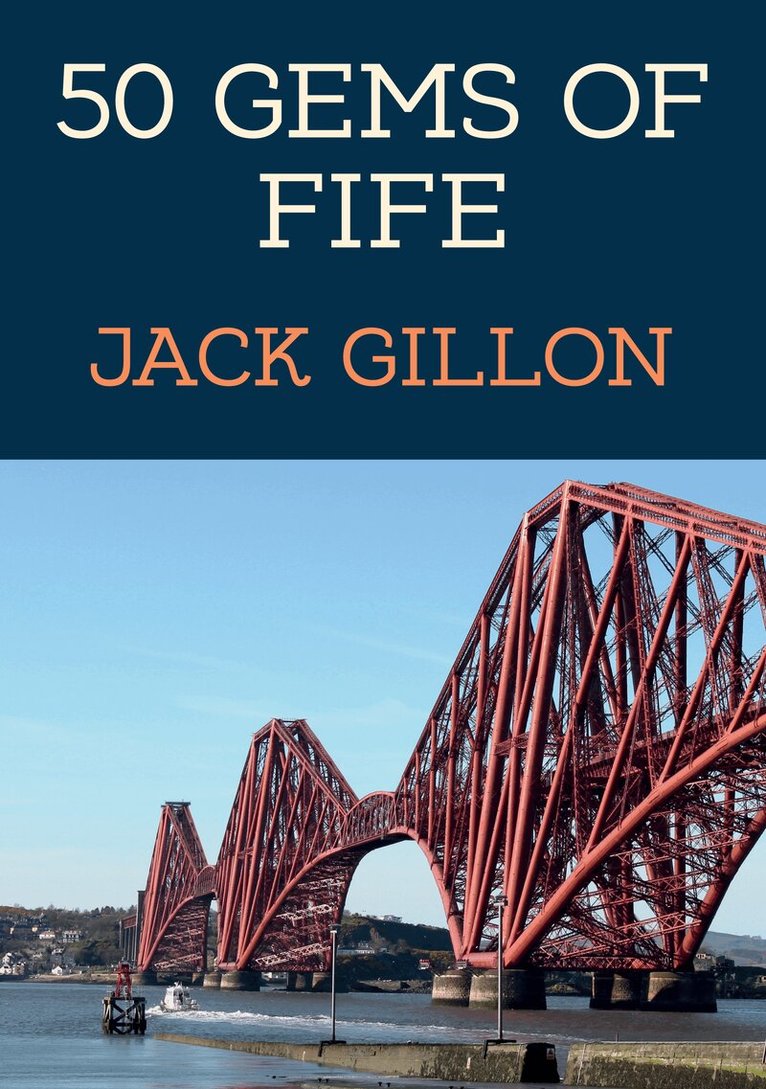
The historic county of Fife is a natural peninsula on the east coast of Scotland, bordered by the Firth of Forth and the Firth of Tay. Alongside its three largest settlements of Dunfermline, Kirkcaldy and Glenrothes it is also home to the ancient city of St Andrews, with its world-famous golf course and university. The often turbulent history of Fife is reflected in its royal palaces, castles and other ruins, such as Ravenscraig Castle and Dunfermline Abbey.Fife’s picturesque coast draws visitors to places like Crail Harbour and Pittenweem. Fife’s cultural and industrial heritage are also celebrated, including the Fife Folk Museum, the Anstruther Fisheries Museum and the Fife Heritage Railway.50 Gems of Fife explores the many places and their history that make this part of Scotland so special, including natural features, towns and villages, buildings and places of historical interest. Alongside justly famous attractions, others will be relatively unknown, but all have an interesting story to tell.
178 kr
Skickas
Edinburgh, Scotland’s capital city, has a dramatic cityscape and its wealth of historic streets and buildings make up the UNESCO Old and New Towns World Heritage Site. The city has also been subject to a myriad of changes through the years. This book features several landmark buildings but concentrates attention on areas which have been subject to change through redevelopment.Edinburgh Reflections features a collection of historic and modern pictures that are individually merged to reveal how the area has changed over the decades. Each of the 180 pictures in this book combines a recent colour view of Edinburgh with the matching sepia archive scene. Through the split-image effect, readers can see how streets, buildings and everyday life have been transformed with the passing of time.This book will be of interest to residents, visitors, local historians, and all those with links to Edinburgh.
178 kr
Skickas
The 1960s, 1970s and 1980s were decades of great change. Many towns and cities were redeveloped with projects that dramatically affected the character of the place. People’s shopping habits were altered as supermarkets took over from traditional stores and corner shops. Leisure habits were changing too, as cheap air travel led to the arrival of the foreign package holiday and a new range of leisure facilities were developed at home. Fashions, as ever, were changing in this period, reflecting radical changes in society and the ways in which we viewed ourselves. Transport also evolved, with a move away from the railway and buses, creating a strain on the roads and leading to new road schemes.These changes in people’s habits and lifestyles were keenly felt in Scotland’s capital as the city grew in size. Old and dilapidated housing was demolished, to be replaced by new housing estates; other areas were redeveloped and new shopping centres were built, universities were expanding and many long-established pastimes and activities, cultural centres and places of leisure were evolving. Local author Jack Gillon recaptures it all in this fascinating portrayal of the city and its people over the course of these most nostalgic decades.
173 kr
Skickas
Edinburgh has always been a city of unusual characters and has its own distinct, often peculiar, history. Quirky Edinburgh delves into lesser-known but fascinating tales from Edinburgh’s past. Readers will discover stories of the sedan chairs that transported the gentry around the city in the eighteenth century, horse racing on Leith Sands, the open-air Royal Patent Gymnasium that delighted its Victorian visitors with rides on the Great Sea Serpent and Giant See-Saw, an exploding postbox, the 80-foot spiral of kinetic art placed on a roundabout, the original Mrs Doubtfire and much, much more.Quirky Edinburgh celebrates the unusual and often strange history of Edinburgh and its characters over the years. This fascinating insight into Edinburgh will be of interest to all those who want to know more about the city’s quirky history.
172 kr
Skickas inom 11-20 vardagar
EDINBURGH in the 1950s was a very different place. After the ravages of war, the International Festival and Military Tattoo was introduced as an antidote to post-war austerity, the new Civic Survey and Plan put forward grandiose recommendations for change, and a new young Queen visited the city. This was a time when slum housing was a blight on many people's lives, but there was a real sense of community that was ultimately lost in the move to sparkling, modern homes in the new housing estates. People continued to use the trams to travel to work in the many factories or make trips to Portobello for a day of fun, but they were slowly usurped by the car. It was a glory period for the local football teams, and nights spent dancing or at the pictures were a weekly event. There was still the horse-drawn milk float and children played in streets that were lit by gas. Beautifully illustrated with many previously unpublished photographs, Edinburgh in the 1950s provides an exceptional insight into a time now acknowledged as the end of an era in Edinburgh - for good and for bad.
178 kr
Skickas inom 11-20 vardagar
Not all of Edinburgh’s history is well known; some of it has remained a secret, lost behind the façades of the familiar and hidden from view … until now. Fascinated by Edinburgh’s hidden history, author Jack Gillon has plundered the records in a quest for the lesser-known side of Scotland’s capital city.Secret Edinburgh tells the tales of the Arthur’s Seat coffins, the Great Lafayette and his dog Beauty, the Six Foot High Club, the first balloon ascent, a Patent Rotary Boat, bizarre performers, Bum the dog, and much more to intrigue and amuse Edinburgh’s friends old and new.
178 kr
Skickas inom 11-20 vardagar
In 1560, when Mary of Guise ran Scotland and Mary, Queen of Scots, remained in France, Mary of Guise moved the Scottish Court to Leith, a site that is now Parliament Street, off Coalhill. Serving Edinburgh’s shipbuilding and repair facilities, Leith’s port saw the opening of a new Wet Dock, the first of its kind in Scotland. Today, Leith is, again, part of Edinburgh, and recent regeneration has helped improve its poorer areas.Leith has played a long and prominent role in Scottish history. As the major port serving Edinburgh, it has been the stage on which many significant events in Scottish history have taken place. From housing the Scottish Court to seeing civil war, being the port of call for royal arrivals and becoming its own burgh, Leith has seen it all. Leith Through Time takes you on this journey, with old and new images to illustrate how Leith has changed over the years.
168 kr
Tillfälligt slut
Nestled under the Garleton Hills on the banks of the River Tyne, the Royal Burgh of Haddington, East Lothian, was established in the twelfth century to provide trade and industry in one of Scotland’s richest agricultural counties. It was upon the strength of its agricultural industry that Haddington prospered, and the town was at the heart of Scotland’s agricultural revolution in the mid-eighteenth century. Although relatively small today, Haddington was once the fourth largest town in Scotland, after Aberdeen, Roxburgh and Edinburgh.Haddington suffered significantly in the wake of English invasions and disastrous floods, and it was also burned to the ground a number of times over the centuries. Despite this, the town continued to grow and prosper, as can be seen in its striking architecture. Today, Haddington’s rich history is evident with its wide streets and grand buildings, including St Mary’s kirk, the Town House and Lennoxlove Castle.
178 kr
Skickas inom 11-20 vardagar
Falkirk’s strategic location, midway between Edinburgh and Glasgow at the crossroads of lowland Scotland, has been the main influence on the town’s development and has contributed to its key role in Scotland’s history. The Romans were the first to make a significant mark on the district, William Wallace and Bonnie Prince Charlie fought the English nearby, cattle were driven from all over Scotland to the great trysts in the area, central Scotland’s canals came together at Camelon, and local foundries fuelled the Industrial Revolution.Using old images juxtaposed with modern photography, in Falkirk Through Time author Jack Gillon explores how the town has changed and developed over the years. Today Falkirk has a bustling town centre focused on its pedestrianised High Street and boasts popular tourist attractions such as the new Helix Park, Falkirk Wheel and the breathtaking Kelpie statues, all of which complement and build upon its industrial heritage.
168 kr
Skickas inom 11-20 vardagar
The Midlothian town of Dalkeith has had an eventful history. Cromwell’s officer, General Monck, was Commander in Scotland, and the government of the country was based out of Dalkeith Castle. In the seventeenth century, Dalkeith had one of Scotland’s largest markets in its exceptionally broad High Street. In 1831 Dalkeith was linked to Edinburgh by a railway line that transported coal, minerals and agricultural produce. Two decades later, in 1853, a corn exchange, at the time the largest indoor grain market in Scotland, was built, and in 1879 Dalkeith was where Gladstone first started his campaign to become British prime minister.The surrounding villages also have their fair share of historical significance: Newtongrange was Scotland’s largest mining village in the 1890s and today houses the National Mining Museum; Bonnyrigg was a mining village until the 1920s; Lasswade was a popular holiday resort in the nineteenth century for wealthy Edinburgh residents; and in nearby Roslin is Rosslyn Chapel, famous for its connections to the Knights Templar and the Holy Grail and which featured in The Da Vinci Code.
178 kr
Skickas
The teeming nature of life in eighteenth-century Edinburgh elevated the Old Town’s taverns to a critical role in the city’s social life, and there was ‘no superabundance of sobriety in the town’. Much of the business life of the city was carried out in taverns where it was even normal for doctors to consult their patients.The Edinburgh taverns of the eighteenth century are described as having ‘a coarse and darksome snugness which was courted by their worshippers’. These earlier basic hostelries were swept away during the period 1880–1910, which is recognised as the golden age of pub design. These new pubs were decorated with an abundance of spectacular ornaments to attract customers into their shining interiors.This book won’t tell you how many real ales or malts the pubs stock or whether the burgers are worth popping in for. What it does provide is a record of Edinburgh Pubs that are architectural gems of exceptional quality or which have a particularly interesting historical association.
172 kr
Skickas
Neuk is the Scots word for nook or corner, and the delightful East Neuk, with its string of picturesque fishing and farming villages, is one of the most attractive parts of the country to investigate. Few regions present a greater number of attractions than the East Neuk with its sandy beaches, wild and precipitous cliffs, remarkable caves, celebrated golf links, notable churches, historic castles and historical associations.These villages, running from from Crail to Largo, are quite distinct from those of any other part of Scotland and have stood almost unchanged for centuries and thus present, in their uneven, angular streets, red-tiled roofs and crow-stepped gables, an accurate representation of the ancient burghs of our past.
163 kr
Skickas inom 11-20 vardagar
The Festival and King’s Theatres are two of Scotland’s most historic theatrical venues and both have their own engrossing stories to tell. This book highlights their milestone moments and recollects the innumerable celebrated performers that created the legacies of the theatres. The King’s Theatre, the ‘Grand Old Lady of Leven Street’, first opened its magnificent art nouveau doors to welcome the public into its sumptuously decorated auditorium in December 1906. The opening-night show was a festive production of the pantomime Cinderella, and the panto tradition has continued at the King’s ever since.The glass frontage of the Festival Theatre forms a glowing night-time landmark on Nicolson Street, and encloses a magnificent auditorium which dates back to 1928. It stands on Edinburgh’s longest continuous theatre site, dating as far back as 1830. This book traces the history of the site from its earliest days, through its time as the Empire Palace, its reconstruction as the Empire and its final transformation into the Festival Theatre.
178 kr
Skickas
Having been granted city status during the Golden Jubilee celebrations in 2002, Stirling is Scotland’s smallest city. Despite this, it has an enthralling wealth of architectural and historic heritage that would be the envy of much larger places in the country. Stirling’s origins can be dated to the thirteenth century, when it was granted a royal charter and became a significant medieval settlement.Its strategic importance as the ‘Gateway to the Highlands’ also made it the much fought-over ‘Cockpit of Scotland’, making it witness to many of the most significant battles in Scottish history. Today, Stirling is a bustling and charming historic city that retains much of its ancient character and architectural quality. Using a beautiful collection of old and new images, Stirling Through Time explores how Stirling has transformed and evolved over the years.
173 kr
Skickas inom 11-20 vardagar
From its founding as a Royal Burgh in the twelfth century and through its growth and development as an internationally renowned hotbed of science, education, literature and culture, to its current status as home of the Scottish Parliament and the largest financial centre in the UK outside London, Edinburgh has a proud and distinctive identity. This extraordinary history is embodied in the many fine buildings that have shaped the ‘Athens of the North’.Edinburgh in 50 Buildings explores the history of this rich and vibrant city through a selection of its greatest architectural treasures. From the elegance of the neoclassical and Georgian New Town to the controversial Parliament building, this unique study celebrates the city’s architectural heritage in a new and accessible way. Local author Jack Gillon guides the reader on a tour of the city’s historic buildings and modern architectural marvels.
178 kr
Skickas inom 11-20 vardagar
‘The Fair City’ of Perth is aptly named. Situated on the banks of Scotland’s longest river, the Tay, Perth and its surrounding area boast some of the most beautiful scenery in the country. Perth was once the capital of Scotland and there are many interesting historical sights to visit. The jewel in the crown, though, is undoubtedly Scone Palace on the outskirts of town. Scone was the home of the Stone of Destiny for nearly 500 years, and the site where every Scottish king was crowned. Its position on the River Tay ensured that Perth became a busy trading port, exporting salmon and wool and importing claret from Bordeaux. Its bustling harbour remains in use, the only inland harbour in Britain.Today, Perth is a major tourist centre and important staging post on the route north to the Highlands of Scotland. As such, it boasts many shops, bars and restaurants as well as a thriving arts and cultural scene. Join author Jack Gillon as he shows how the city has changed and how much of its proud heritage remains.
168 kr
Skickas inom 11-20 vardagar
Selkirk obtained its original charter in the twelfth century from David I and it is one of the oldest burghs in Scotland. The town’s development was based around the woollen industry. Statues in the town celebrate its association with the explorer Mungo Park and Sir Walter Scott, who was sheriff-deputy of the county of Selkirk and based at Selkirk’s courthouse in the town square. The Selkirk Common Riding in June is a celebration of the town’s traditions and links to the Battle of Flodden.The picturesque town of Melrose is the location of Melrose Abbey, one of the most beautiful monastic ruins in Britain. It is also the site of the burial of the heart of Scottish King Robert the Bruce. Sir Walter Scott also has close associations with the Melrose area and his home at Abbotsford is a much-visited tourist attraction.
173 kr
Skickas inom 11-20 vardagar
Aberdeen, Scotland's third largest city, has been a place of economic importance since the development of the shipbuilding and fishing industries, and has been synonymous with oil ever since the discovery of North Sea reserves in the 1970s. Nicknamed the 'Granite City' due to the locally quarried grey granite that was used in many of the city's most important buildings, Aberdeen has a proud and distinctive identity with an extraordinary history embodied in the many fine buildings that have shaped the city. Aberdeen in 50 Buildings explores the history of this rich and vibrant city through a selection of its greatest architectural assets, from notable buildings such as the Music Hall, the Trinity Hall, the new Town House and, of course, Alexander Marshall Mackenzie's extension to Marischal College, the second largest granite building in the world, to more recent additions such as the Maggie’s Centre and the Sir Duncan Rice Library. Aberdeen in 50 Buildingsguides the reader on a tour of Aberdeen’s historic buildings and modern architectural marvels to celebrate the city's architectural heritage in a new and accessible way.
178 kr
Skickas
Falkirk is a small town with a big history. Its strategic location, at the crossroads of lowland Scotland, contributed to its key role in Scotland’s history. The Romans were the first to make a significant mark on the district, William Wallace and Bonnie Prince Charlie fought the English nearby, cattle were driven from all over Scotland to the great trysts in the area, central Scotland’s canals came together at Camelon, and local foundries fuelled the Industrial Revolution. Secret Falkirk delves into the town’s past and offers an insight into aspects of its fascinating history that may not be familiar to many Falkirk Bairns.
178 kr
Skickas
Leith has played a long and prominent role in Scottish history. As the major port serving Edinburgh, it has been the stage on which many significant events in the nation’s past have taken place, from housing the Scottish court to witnessing civil war, acting as the port of call for royal arrivals and becoming its own burgh until the amalgamation with Edinburgh in 1920. The 1950s brought the final days of the old and ancient thoroughfares in the heart of Leith: the Kirkgate, St Andrew Street, Tolbooth Wynd, Bridge Street and many more would disappear in the coming decade. However, the town retains a passionate sense of individuality and its people a proud sense of identity. Leith has seen it all. In Secret Leith, local author and historian Jack Gillon delves into the town’s past and offers an insight into some of the lesser-known aspects of its long and distinguished history.
168 kr
Tillfälligt slut
The historic county of Lothian lies along the south side of the broad estuary of the Forth. Its strategic location and political and economic importance, with Edinburgh at its centre, has made the county witness to some of the most significant events in Scottish history. This is reflected in the remarkable wealth of architectural heritage spanning thousands of years. Castles, royal palaces, churches and industrial buildings of national importance abound in the county.Author Jack Gillon seeks out some of the favourite landmarks, lesser-known locations and hidden treasures of the region. He takes the reader from Edinburgh, with its castle, the Scottish Parliament and the Palace of Holyrood House, to the East Lothian village of Athelstaneford, the birthplace of the Saltire, Traprain Law and the historic Hailes Castle.Among the gems of Midlothian are the glorious Rosslyn Chapel, which was the setting for the finale of The Da Vinci Code and described by its author, Dan Brown, as ‘the most mysterious and magical chapel on earth’. This book also explores the highlights of West Lothian including the Bo’ness &Kinneil Railway, Linlithgow Palace (birthplace of Mary, Queen of Scots) and the impressive Hopetoun House, near Queensferry. 50 Gems of The Lothians will appeal to residents as well as visitors to the area.