Jack L. Amoureux - Böcker
Visar alla böcker från författaren Jack L. Amoureux. Handla med fri frakt och snabb leverans.
4 produkter
4 produkter
2 289 kr
Skickas inom 10-15 vardagar
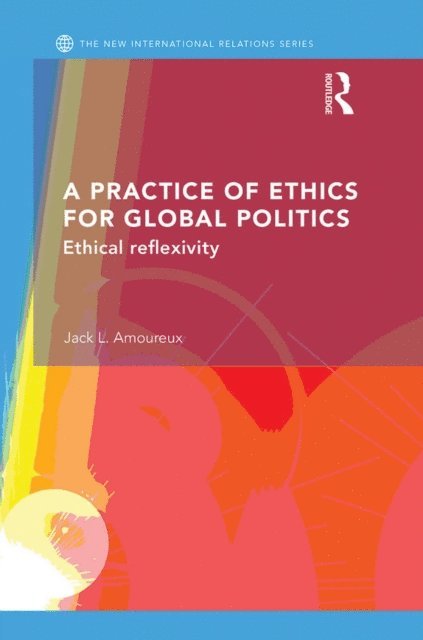
What kind of ethics in world politics is possible if there is no foundation for moral knowledge or global reality is at least complex and contingent? Furthermore, how can an ethics grapple with difference, a persistent and confounding feature for global politics? This book responds to the call for a bold and creative approach to ethics that avoids assuming or aspiring to universality, and instead prioritizes difference, complexity and uncertainty by turning to reflexivity, not as method or methodology, but as a practice of ethics for politics. This practice, ‘ethical reflexivity’, offers individuals, organizations and communities tools to recognize, interrogate and potentially change the stories they tell about politics—about constraints, notions of responsibility and visions of desirability. The benefits and limits of ethical reflexivity are investigated by the author, who engages writing on critique, rhetoric, affect and relationality, and carefully considers dominant and alternative framings of difficult issues in International Relations (IR)—the 1994 genocide in Rwanda, and the US policies of ‘enhanced interrogation’ and drone strikes. This path-breaking study provokes new possibilities for agency and action and contributes to a growing literature in IR on reflexivity by uniquely elaborating its promise as an ethics for politics, and by drawing on thinkers less utilized in discussions of reflexivity such as Hannah Arendt, Michel Foucault and Aristotle.This book will appeal to scholars and upper-level graduates in several sub-fields of IR, including international/global ethics, IR theory, global governance, international organizations, non-governmental organizations, foreign policy analysis and US foreign policy.

644 kr
Skickas inom 10-15 vardagar
What kind of ethics in world politics is possible if there is no foundation for moral knowledge or global reality is at least complex and contingent? Furthermore, how can an ethics grapple with difference, a persistent and confounding feature for global politics? This book responds to the call for a bold and creative approach to ethics that avoids assuming or aspiring to universality, and instead prioritizes difference, complexity and uncertainty by turning to reflexivity, not as method or methodology, but as a practice of ethics for politics. This practice, ‘ethical reflexivity’, offers individuals, organizations and communities tools to recognize, interrogate and potentially change the stories they tell about politics—about constraints, notions of responsibility and visions of desirability. The benefits and limits of ethical reflexivity are investigated by the author, who engages writing on critique, rhetoric, affect and relationality, and carefully considers dominant and alternative framings of difficult issues in International Relations (IR)—the 1994 genocide in Rwanda, and the US policies of ‘enhanced interrogation’ and drone strikes. This path-breaking study provokes new possibilities for agency and action and contributes to a growing literature in IR on reflexivity by uniquely elaborating its promise as an ethics for politics, and by drawing on thinkers less utilized in discussions of reflexivity such as Hannah Arendt, Michel Foucault and Aristotle.This book will appeal to scholars and upper-level graduates in several sub-fields of IR, including international/global ethics, IR theory, global governance, international organizations, non-governmental organizations, foreign policy analysis and US foreign policy.
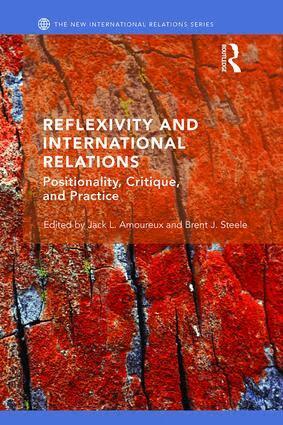
Reflexivity and International Relations
Positionality, Critique, and Practice
Inbunden, Engelska, 2015
2 088 kr
Skickas inom 10-15 vardagar
Reflexivity has become a common term in IR scholarship with a variety of uses and meanings. Yet for such an important concept and referent, understandings of reflexivity have been more assumed rather than developed by those who use it, from realists and constructivists to feminists and post-structuralists. This volume seeks to provide the first overview of reflexivity in international relations theory, offering students and scholars a text that :provides a comprehensive and systematic overview of the current reflexivity literature develops important insights into how reflexivity can play a broader role in IR theorypushes reflexivity in new, productive directions, and offers more nuanced and concrete specifications of reflexivitymoves reflexivity beyond the scholar and the scholarly field to political practice Formulates practices of reflexivityDrawing together the work of many of the key scholars in the field into one volume, this work will be essential reading for all students of international relations theory.
725 kr
Skickas inom 10-15 vardagar
Reflexivity has become a common term in IR scholarship with a variety of uses and meanings. Yet for such an important concept and referent, understandings of reflexivity have been more assumed rather than developed by those who use it, from realists and constructivists to feminists and post-structuralists. This volume seeks to provide the first overview of reflexivity in international relations theory, offering students and scholars a text that :provides a comprehensive and systematic overview of the current reflexivity literature develops important insights into how reflexivity can play a broader role in IR theorypushes reflexivity in new, productive directions, and offers more nuanced and concrete specifications of reflexivitymoves reflexivity beyond the scholar and the scholarly field to political practice Formulates practices of reflexivityDrawing together the work of many of the key scholars in the field into one volume, this work will be essential reading for all students of international relations theory.