Jacqueline Arthur-Montagne - Böcker
Visar alla böcker från författaren Jacqueline Arthur-Montagne. Handla med fri frakt och snabb leverans.
6 produkter
6 produkter
1 728 kr
Kommande
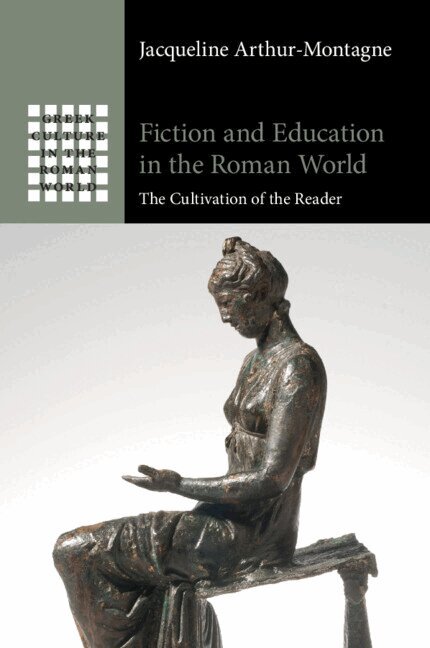
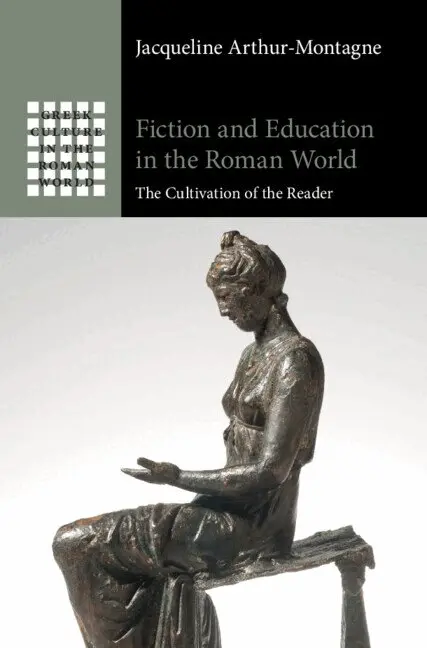
What was fiction in the Roman world - and how did ancient readers learn to make sense of it? This book redefines ancient fiction not as a genre but as a sociocultural practice, governed by the institutions of Greco-Roman education. Drawing on modern fiction theory, it uncovers how fables, epic, and rhetorical training cultivated "fiction competence" in readers from childhood through advanced studies. But it also reveals how the ancient novels - including Greek romance, fictional biography, and the fragmentary novels - subverted the very rules of fiction pedagogy they inherited. Through incisive close readings of a wide array of canonical and paraliterary texts, this book reframes the classical curriculum as the engine of literary imagination in antiquity. For classicists, literary theorists, and anyone interested in ancient education, it offers a provocative reassessment of fiction's place in cultural history - and of how readers learned to believe, disbelieve, and decode narrative meaning.
613 kr
Kommande
What was fiction in the Roman world - and how did ancient readers learn to make sense of it? This book redefines ancient fiction not as a genre but as a sociocultural practice, governed by the institutions of Greco-Roman education. Drawing on modern fiction theory, it uncovers how fables, epic, and rhetorical training cultivated "fiction competence" in readers from childhood through advanced studies. But it also reveals how the ancient novels - including Greek romance, fictional biography, and the fragmentary novels - subverted the very rules of fiction pedagogy they inherited. Through incisive close readings of a wide array of canonical and paraliterary texts, this book reframes the classical curriculum as the engine of literary imagination in antiquity. For classicists, literary theorists, and anyone interested in ancient education, it offers a provocative reassessment of fiction's place in cultural history - and of how readers learned to believe, disbelieve, and decode narrative meaning.
1 590 kr
Skickas inom 7-10 vardagar
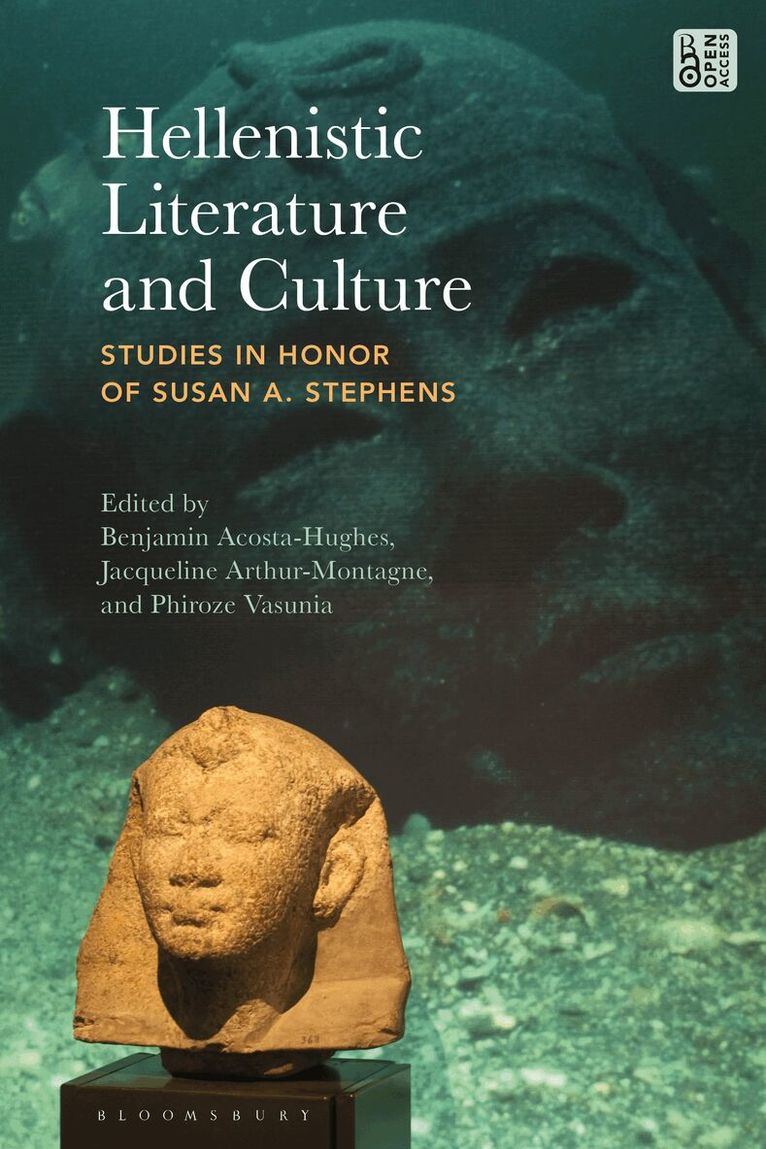
In this open access book, leading Greek scholars explore the rich and diverse poetry and prose of the long Hellenistic period. Chapters focus on the poets of Alexandria such as Callimachus, Theocritus, Apollonius, and Posidippus and on prose texts written in Greek in the Roman Empire. This volume demonstrates the versatility of this literature and examines its multiple cultural affiliations. The Hellenistic writers emerge from this volume as complex, playful, and politically engaged figures, interested in the relationship between culture and society, and far removed from the stereotype of them as distant or elitist. This book makes a major contribution to the study of Hellenistic Greek culture.Susan Stephens is the Sarah Hart Kimball Emerita Professor in the Humanities at Stanford University, USA. Her contributions to the study of Hellenistic literature and culture are immense. She is the author of over fifty articles and the author or editor of ten books. Many of these publications have made a significant impact on the study of the ancient world. Her research on the poets of Alexandria and on ancient Greek prose fiction is widely regarded as path-breaking. She is an inspiring and influential teacher who guided and mentored generations of students and is closely associated with Stanford, where she obtained her undergraduate and doctoral degrees and where she taught from 1978 until her retirement.The eBook editions of this book are available open access under a CC BY-NC-ND 4.0 licence on bloomsburycollections.com. Open access was funded by Stanford University.
453 kr
Skickas inom 10-15 vardagar
In this open access book, leading Greek scholars explore the rich and diverse poetry and prose of the long Hellenistic period. Chapters focus on the poets of Alexandria such as Callimachus, Theocritus, Apollonius, and Posidippus and on prose texts written in Greek in the Roman Empire. This volume demonstrates the versatility of this literature and examines its multiple cultural affiliations. The Hellenistic writers emerge from this volume as complex, playful, and politically engaged figures, interested in the relationship between culture and society, and far removed from the stereotype of them as distant or elitist. This book makes a major contribution to the study of Hellenistic Greek culture.Susan Stephens is the Sarah Hart Kimball Emerita Professor in the Humanities at Stanford University, USA. Her contributions to the study of Hellenistic literature and culture are immense. She is the author of over fifty articles and the author or editor of ten books. Many of these publications have made a significant impact on the study of the ancient world. Her research on the poets of Alexandria and on ancient Greek prose fiction is widely regarded as path-breaking. She is an inspiring and influential teacher who guided and mentored generations of students and is closely associated with Stanford, where she obtained her undergraduate and doctoral degrees and where she taught from 1978 until her retirement.The eBook editions of this book are available open access under a CC BY-NC-ND 4.0 licence on bloomsburycollections.com. Open access was funded by Stanford University.
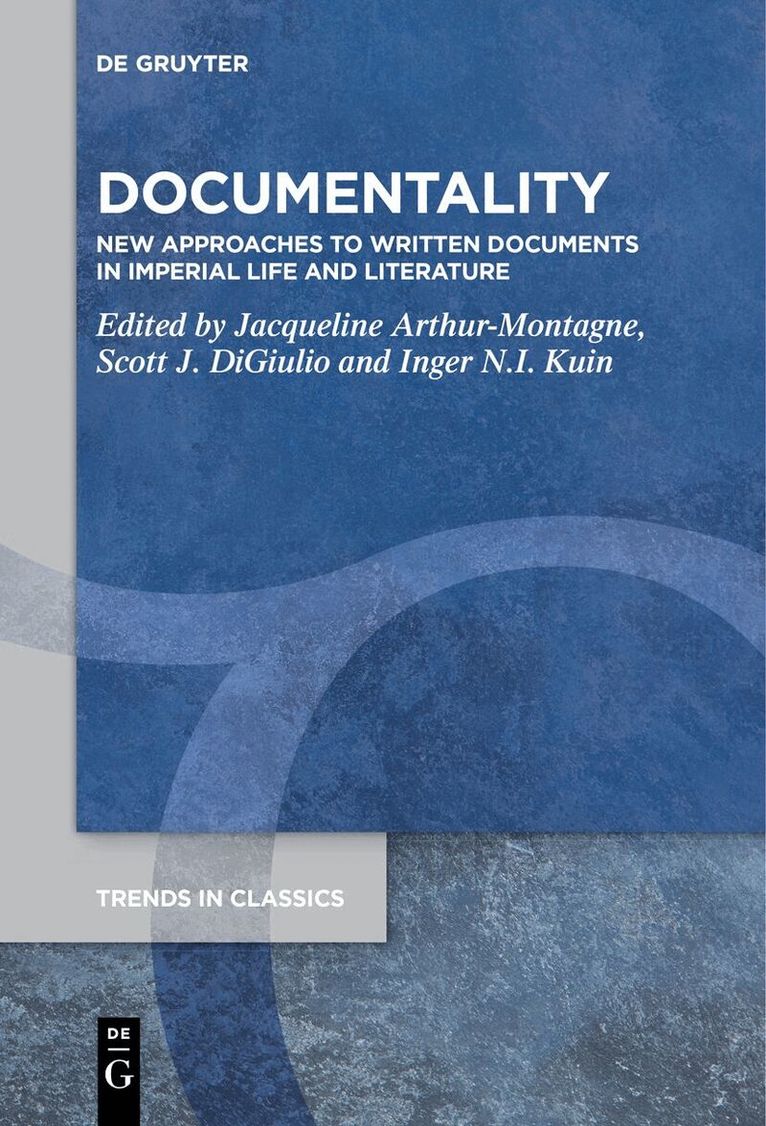
Documentality
New Approaches to Written Documents in Imperial Life and Literature
Inbunden, Engelska, 2022
1 882 kr
Skickas inom 5-8 vardagar
This volume unites scholars of classical epigraphy, papyrology, and literature to analyze the documentary habit in the Roman Empire. Texts like inscriptions and letters have gained importance in classical scholarship, but there has been limited analysis of the imaginative and sociological dimensions of the ancient document. Individual chapters investigate the definition of the document in ancient thought, and how modern understandings of documentation may (mis)shape scholarly approaches to documentary sources in antiquity. Contributors reexamine familiar categories of ancient documents through the lenses of perception and function, and reveal where the modern understanding of the document departs from ancient conceptions of documentation. The boundary between literary genres and documentary genres of writing appears more fluid than prior scholarship had allowed. Compared to modern audiences, inhabitants of the Roman Empire used a more diverse range of both non-textual and textual forms of documentation, and they did so with a more active, questioning attitude. The interdisciplinary approach to the "mentality" of documentation in this volume advances beyond standard discussions of form, genre, and style to revisit the document through the eyes of Greco-Roman readers and viewers.
Del 132 - Trends in Classics - Supplementary Volumes
Documentality
New Approaches to Written Documents in Imperial Life and Literature
Häftad, Engelska, 2024
292 kr
Skickas inom 3-6 vardagar
This volume unites scholars of classical epigraphy, papyrology, and literature to analyze the documentary habit in the Roman Empire. Texts like inscriptions and letters have gained importance in classical scholarship, but there has been limited analysis of the imaginative and sociological dimensions of the ancient document. Individual chapters investigate the definition of the document in ancient thought, and how modern understandings of documentation may (mis)shape scholarly approaches to documentary sources in antiquity. Contributors reexamine familiar categories of ancient documents through the lenses of perception and function, and reveal where the modern understanding of the document departs from ancient conceptions of documentation. The boundary between literary genres and documentary genres of writing appears more fluid than prior scholarship had allowed. Compared to modern audiences, inhabitants of the Roman Empire used a more diverse range of both non-textual and textual forms of documentation, and they did so with a more active, questioning attitude. The interdisciplinary approach to the "mentality" of documentation in this volume advances beyond standard discussions of form, genre, and style to revisit the document through the eyes of Greco-Roman readers and viewers.