Jacquelyn Schachter – författare
Visar alla böcker från författaren Jacquelyn Schachter. Handla med fri frakt och snabb leverans.
6 produkter
Linguistic Perspectives on Second Language Acquisition
Av Susan M. Gass, Jacquelyn Schachter
Häftad, 1989
786 kr
Lägg i varukorg
This volume explores how a second language is acquired and what learners must do in order to achieve proficiency. The paperback edition is a collection of original essays that approaches second language acquisition from a linguistic rather than a sociological, psychological, or purely pedagogical …
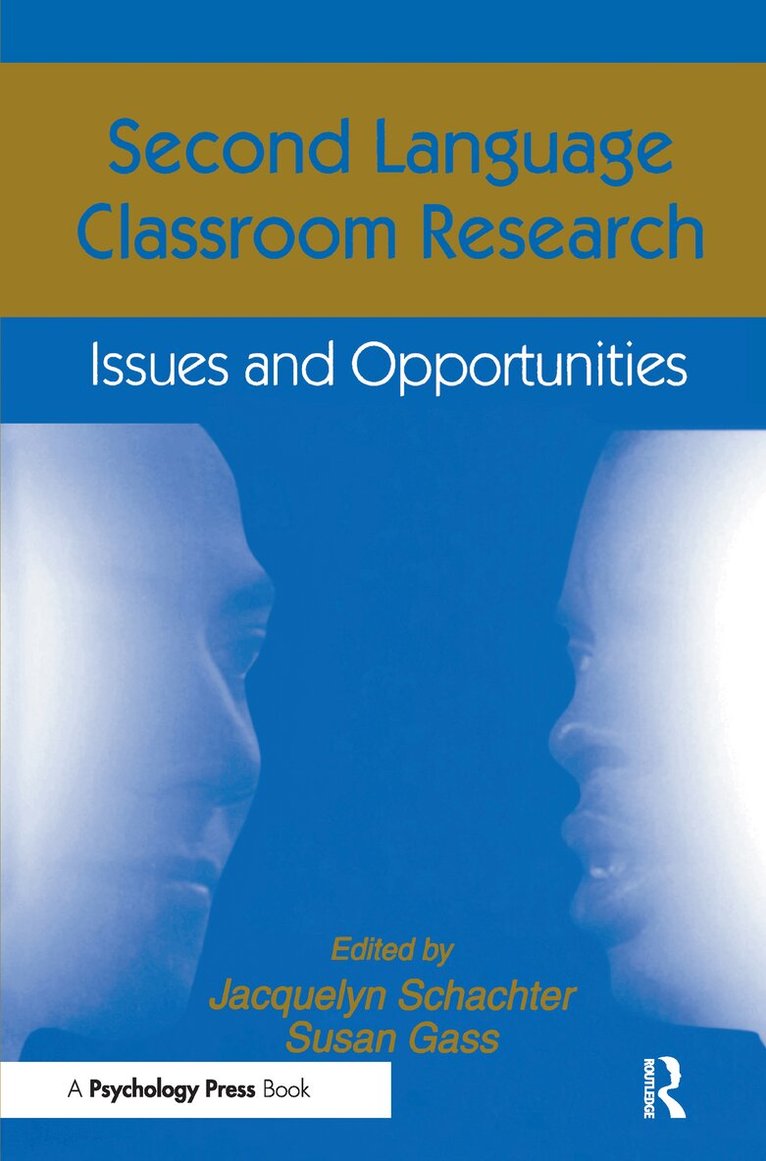
Second Language Classroom Research
Issues and Opportunities
Av Jacquelyn Schachter, Susan M. Gass
Inbunden, 1996
2665 kr
Lägg i varukorg
In an attempt to fill the gap left by the many published studies on classroom second language research, this book explores a variety of human, social, and political issues involved in the carrying out of such studies. Many journals are chock-full of the results of classroom research, with evidence …
Second Language Classroom Research
Issues and Opportunities
Av Jacquelyn Schachter, Susan M. Gass
Häftad, 1996
785 kr
Lägg i varukorg
In an attempt to fill the gap left by the many published studies on classroom second language research, this book explores a variety of human, social, and political issues involved in the carrying out of such studies. Many journals are chock-full of the results of classroom research, with evidence …
Second Language Classroom Research
Issues and Opportunities
Av Susan M. Gass, Jacquelyn Schachter
E-bok, 2013
906 kr
Lägg i varukorg
In an attempt to fill the gap left by the many published studies on classroom second language research, this book explores a variety of human, social, and political issues involved in the carrying out of such studies. Many journals are chock-full of the results of classroom research, with evidence …
Second Language Classroom Research
Issues and Opportunities
Av Susan M. Gass, Jacquelyn Schachter
E-bok, 2013
926 kr
Lägg i varukorg
In an attempt to fill the gap left by the many published studies on classroom second language research, this book explores a variety of human, social, and political issues involved in the carrying out of such studies. Many journals are chock-full of the results of classroom research, with evidence …
Linguistic Perspectives on Second Language Acquisition
Av Jacquelyn Schachter, Susan M. Gass
E-bok, 1989
423 kr
Lägg i varukorg
This volume explores how a second language is acquired and what learners must do in order to achieve proficiency. The paperback edition is a collection of original essays that approaches second language acquisition from a linguistic rather than a sociological, psychological, or purely pedagogical …