Jacques Istas - Böcker
Visar alla böcker från författaren Jacques Istas. Handla med fri frakt och snabb leverans.
3 produkter
3 produkter
536 kr
Skickas inom 10-15 vardagar
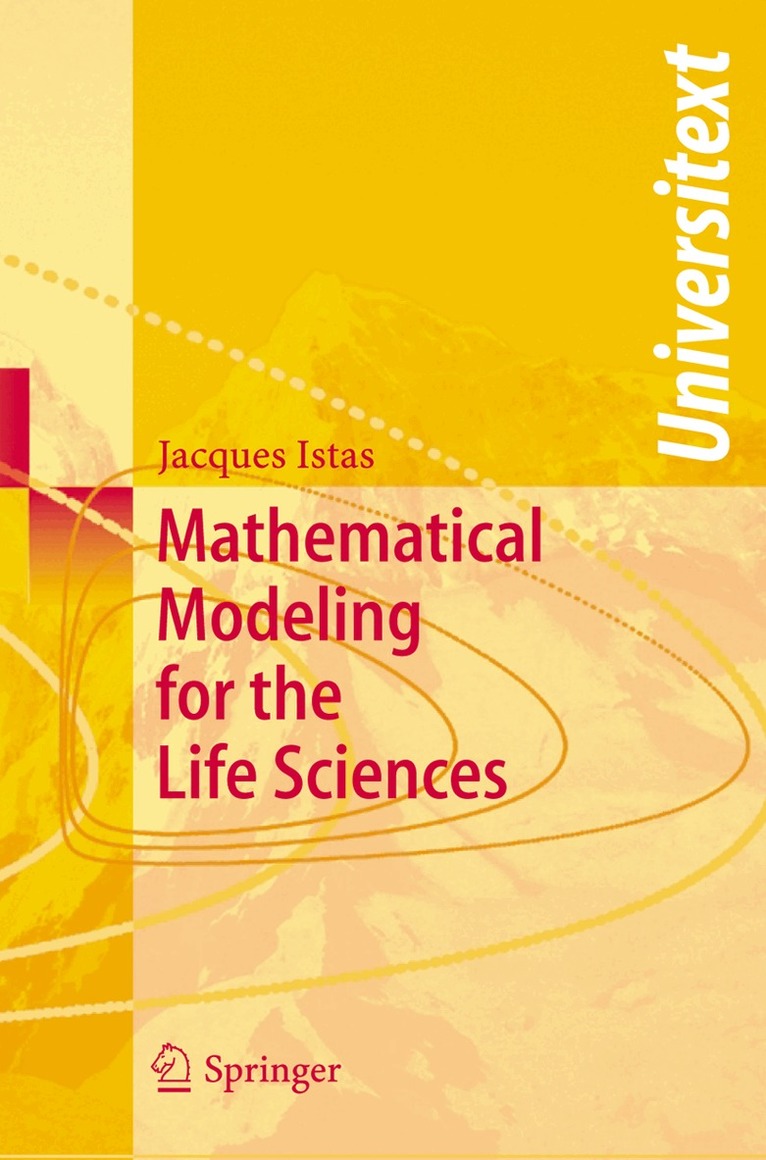
Proposing a wide range of mathematical models that are currently used in life sciences may be regarded as a challenge, and that is precisely the challenge that this book takes up. Of course this panoramic study does not claim to offer a detailed and exhaustive view of the many interactions between mathematical models and life sciences. This textbook provides a general overview of realistic mathematical models in life sciences, considering both deterministic and stochastic models and covering dynamical systems, game theory, stochastic processes and statistical methods. Each mathematical model is explained and illustrated individually with an appropriate biological example. Finally three appendices on ordinary differential equations, evolution equations, and probability are added to make it possible to read this book independently of other literature.
483 kr
Skickas inom 10-15 vardagar
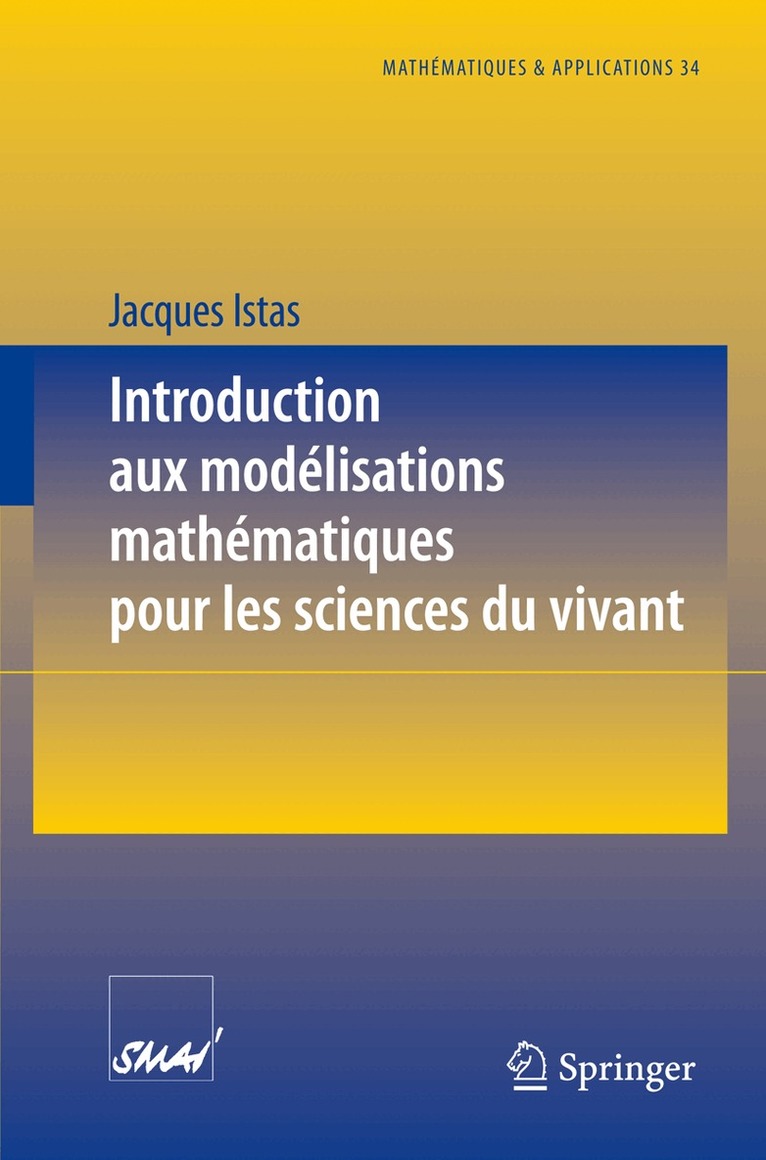
Le but de cet ouvrage est de présenter un panorama de différentes méthodes mathématiques utilisées pour la modélisation de phénomènes issus du vivant. Nous avons voulu être le plus large possible, incluant ainsi à la fois les méthodes déterministes (systèmes dynamiques, théorie des jeux) et les méthodes stochastiques (processus aléatoires, statistiques). Chaque modèle mathématique proposé est accompagné d'un exemple concret éclairant la modélisation retenue.
430 kr
Skickas inom 10-15 vardagar
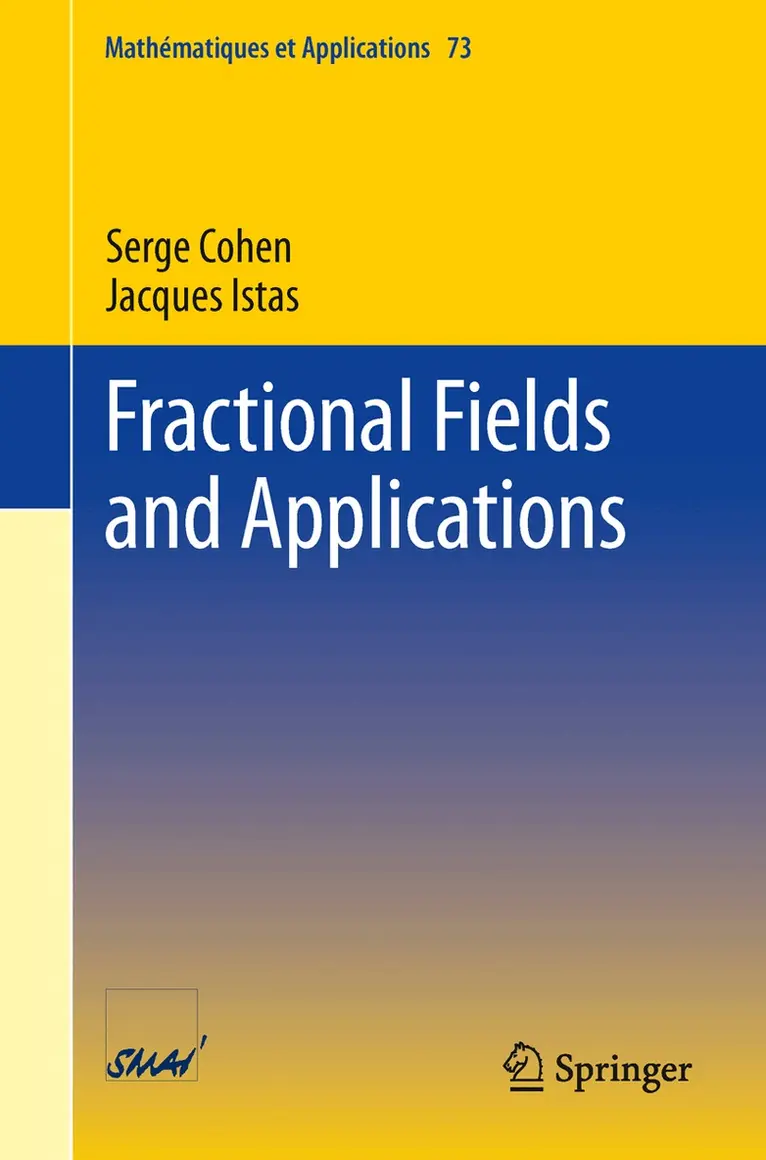
This book focuses mainly on fractional Brownian fields and their extensions. It has been used to teach graduate students at Grenoble and Toulouse's Universities. It is as self-contained as possible and contains numerous exercises, with solutions in an appendix. After a foreword by Stéphane Jaffard, a long first chapter is devoted to classical results from stochastic fields and fractal analysis. A central notion throughout this book is self-similarity, which is dealt with in a second chapter with a particular emphasis on the celebrated Gaussian self-similar fields, called fractional Brownian fields after Mandelbrot and Van Ness's seminal paper. Fundamental properties of fractional Brownian fields are then stated and proved. The second central notion of this book is the so-called local asymptotic self-similarity (in short lass), which is a local version of self-similarity, defined in the third chapter. A lengthy study is devoted to lass fields with finite variance. Among these lass fields, we find both Gaussian fields and non-Gaussian fields, called Lévy fields. The Lévy fields can be viewed as bridges between fractional Brownian fields and stable self-similar fields. A further key issue concerns the identification of fractional parameters. This is the raison d'être of the statistics chapter, where generalized quadratic variations methods are mainly used for estimating fractional parameters. Last but not least, the simulation is addressed in the last chapter. Unlike the previous issues, the simulation of fractional fields is still an area of ongoing research. The algorithms presented in this chapter are efficient but do not claim to close the debate.