Jacques Lezra - Böcker
Visar alla böcker från författaren Jacques Lezra. Handla med fri frakt och snabb leverans.
13 produkter
13 produkter
736 kr
Skickas inom 7-10 vardagar
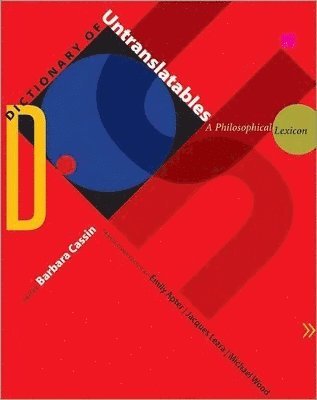
This is an encyclopedic dictionary of close to 400 important philosophical, literary, and political terms and concepts that defy easy--or any--translation from one language and culture to another. Drawn from more than a dozen languages, terms such as Dasein (German), pravda (Russian), saudade (Portuguese), and stato (Italian) are thoroughly examined in all their cross-linguistic and cross-cultural complexities. Spanning the classical, medieval, early modern, modern, and contemporary periods, these are terms that influence thinking across the humanities. The entries, written by more than 150 distinguished scholars, describe the origins and meanings of each term, the history and context of its usage, its translations into other languages, and its use in notable texts. The dictionary also includes essays on the special characteristics of particular languages--English, French, German, Greek, Italian, Portuguese, Russian, and Spanish.Originally published in French, this one-of-a-kind reference work is now available in English for the first time, with new contributions from Judith Butler, Daniel Heller-Roazen, Ben Kafka, Kevin McLaughlin, Kenneth Reinhard, Stella Sandford, Gayatri Chakravorty Spivak, Jane Tylus, Anthony Vidler, Susan Wolfson, Robert J. C. Young, and many more.The result is an invaluable reference for students, scholars, and general readers interested in the multilingual lives of some of our most influential words and ideas. * Covers close to 400 important philosophical, literary, and political terms that defy easy translation between languages and cultures * Includes terms from more than a dozen languages * Entries written by more than 150 distinguished thinkers * Available in English for the first time, with new contributions by Judith Butler, Daniel Heller-Roazen, Ben Kafka, Kevin McLaughlin, Kenneth Reinhard, Stella Sandford, Gayatri Chakravorty Spivak, Jane Tylus, Anthony Vidler, Susan Wolfson, Robert J. C. Young, and many more * Contains extensive cross-references and bibliographies * An invaluable resource for students and scholars across the humanities
1 157 kr
Skickas inom 7-10 vardagar
In groundbreaking readings linking works of Descartes, Shakespeare, and Cervantes with contemporary revisions of Freud and Nietzsche, Unspeakable Subjects argues that the concepts and discourses that have come to define European modernity—the subject's extension and responsibility, genealogies of intention and of freedom, the literary, legal, and medical construction of the body, among others—arise as strategies for evading a profound redefinition of the nature of events in early modern Europe.Negotiating the often competing claims of rhetorical reading and cultural analysis, Lezra reassesses the grounds of literary and philosophical history as a materialist practice of eventful reading. His original accounts of Don Quixote, Descartes's Second Meditation and Regulae, and Measure for Measure tack between linguistic, psychoanalytic, and cultural materialist approaches to define and discuss the double aspect of the event in early modern literature and philosophy, and in Freudian and Heideggerian critical discourse: the event is at once an accident, the unpredictable, deontic intrusion of the empirical in idealizing schemes, and the disclosing and recollecting of a subject's relation to discursive and cultural morphologies in which empirical events are said properly to take place.The advent of "modernity," Unspeakable Subjects argues, arises as the novel account of the permanently interrupted negotiation between the event's deontic and its morphological aspects. If Unspeakable Subjects considers on this level the "singularities" of textual events, it also seeks to show their complex relation to the "singularities" of the forms given material history.Drawing upon such varied sources as the proclamations of James I, the law of entail, Renaissance treatises on typography, and documents on Jacobean and Elizabethan privateering, as well as accounts of the "events" of May 1968 and of Lacan's treatment of the fort-da game, and of the cultural uses of the figure of Don Quixote in Spanish proto-Falangist thought, the author shows that the institutional setting and conditions for literary and philosophical speech-acts, and the graphic constraints upon the bodies that such acts support, also take shape according to patterns set in response to the instability of the event.
420 kr
Skickas inom 10-15 vardagar
Wild Materialism speaks to three related questions in contemporary political philosophy. How, if different social interests and demands are constitutively antagonistic, can social unity emerge out of heterogeneity? Does such unity require corresponding universals, and, if so, what are they, where are they found, or how are they built? Finally, how must the concept of democracy be revised in response to economic globalization, state and nonstate terrorism, and religious, ethnic, or national fundamentalism?Polemically rehabilitating the term terror, Lezra argues that it can and should operate as a social universal. Perched perilously somewhere between the private and the public domains, terror is an experience of unboundable, objectless anxiety. It is something other than an interest held by different classes of people; it is not properly a concept (like equality or security) of the sort universal claims traditionally rest on.Yet terror's conceptual deficiency, Lezra argues, paradoxically provides the only adequate, secular way to articulate ethical with political judgments. Social terror, he dramatically proposes, is the foundation on which critiques of terrorist fundamentalisms must be constructed. Opening a groundbreaking methodological dialoguebetween Freud's work and Althusser's late understanding of aleatory materialism, Lezra shows how an ethic of terror, and in the political sphere a radically democratic republic, can be built on what he calls "wild materialism." Wild Materialism combines the close reading of cultural texts with detailed treatment of works in the radical-democratic and radical-republican traditions. The originality of its closely argued theses is matched and complemented by the breadth of its focus—encompassing the debates over the "ticking bomb" scenario; the circumstances surrounding ETA's assassination of Admiral Luis Carrero Blanco in Madrid in 1973; the films of Gillo Pontecorvo; Sade's republican writing; Marx's Critique of Hegel's Philosophy of Right; and the roots of contemporary radical republicanism in early modern political theology (Bodin, Shakespeare, Parsons, Siliceo).
1 021 kr
Skickas inom 10-15 vardagar
On the Nature of Marx's Things is a major rethinking of the Marxian tradition, one based not on fixed things but on the inextricable interrelation between the material world and our language for it. Lezra traces to Marx's earliest writings a subterranean, Lucretian practice that he calls necrophilological translation that continues to haunt Marx's inheritors. This Lucretian strain, requiring that we think materiality in non-self-evident ways, as dynamic, aleatory, and always marked by its relation to language, raises central questions about ontology, political economy, and reading."Lezra," writes Vittorio Morfino in his preface, "transfers all of the power of the Althusserian encounter into his conception of translation." Lezra's expansive understanding of translation covers practices that put different natural and national languages into relation, often across periods, but also practices or mechanisms internal to each language. Obscured by later critical attention to the contradictory lexicons—of fetishism and of chrematistics—that Capital uses to describe how value accrues to commodities, and by the dialectical approach that's framed Marx's work since Engels sought to marry it to the natural philosophy of his time, necrophilological translation has a troubling, definitive influence in Marx's thought and in his wake. It entails a radical revision of what counts as translation, and wholly new ways of imagining what an object is, of what counts as matter, value, sovereignty, mediation, and even number. In On the Nature of Marx's Things a materialism "of the encounter," as recent criticism in the vein of the late Althusser calls it, encounters Marxological value-form theory, post-Schmittian divisible sovereignty, object-oriented-ontologies and the critique of correlationism, and philosophies of translation and untranslatability in debt to Quine, Cassin, and Derrida. The inheritors of the problems with which Marx grapples range from Spinoza's marranismo, through Melville's Bartleby, through the development of a previously unexplored Freudian political theology shaped by the revolutionary traditions of Schiller and Verdi, through Adorno's exilic antihumanism against Said's cosmopolitan humanism, through today's new materialisms.Ultimately, necrophilology draws the story of capital's capture of difference away from the story of capital's production of subjectivity. It affords concepts and procedures for dismantling the system of objects on which neoliberal capitalism stands: concrete, this-wordly things like commodities, but also such "objects" as debt traps, austerity programs, the marketization of risk; ideologies; the pedagogical, professional, legal, even familial institutions that produce and reproduce inequities today.
327 kr
Skickas inom 10-15 vardagar
On the Nature of Marx's Things is a major rethinking of the Marxian tradition, one based not on fixed things but on the inextricable interrelation between the material world and our language for it. Lezra traces to Marx's earliest writings a subterranean, Lucretian practice that he calls necrophilological translation that continues to haunt Marx's inheritors. This Lucretian strain, requiring that we think materiality in non-self-evident ways, as dynamic, aleatory, and always marked by its relation to language, raises central questions about ontology, political economy, and reading."Lezra," writes Vittorio Morfino in his preface, "transfers all of the power of the Althusserian encounter into his conception of translation." Lezra's expansive understanding of translation covers practices that put different natural and national languages into relation, often across periods, but also practices or mechanisms internal to each language. Obscured by later critical attention to the contradictory lexicons—of fetishism and of chrematistics—that Capital uses to describe how value accrues to commodities, and by the dialectical approach that's framed Marx's work since Engels sought to marry it to the natural philosophy of his time, necrophilological translation has a troubling, definitive influence in Marx's thought and in his wake. It entails a radical revision of what counts as translation, and wholly new ways of imagining what an object is, of what counts as matter, value, sovereignty, mediation, and even number. In On the Nature of Marx's Things a materialism "of the encounter," as recent criticism in the vein of the late Althusser calls it, encounters Marxological value-form theory, post-Schmittian divisible sovereignty, object-oriented-ontologies and the critique of correlationism, and philosophies of translation and untranslatability in debt to Quine, Cassin, and Derrida. The inheritors of the problems with which Marx grapples range from Spinoza's marranismo, through Melville's Bartleby, through the development of a previously unexplored Freudian political theology shaped by the revolutionary traditions of Schiller and Verdi, through Adorno's exilic antihumanism against Said's cosmopolitan humanism, through today's new materialisms.Ultimately, necrophilology draws the story of capital's capture of difference away from the story of capital's production of subjectivity. It affords concepts and procedures for dismantling the system of objects on which neoliberal capitalism stands: concrete, this-wordly things like commodities, but also such "objects" as debt traps, austerity programs, the marketization of risk; ideologies; the pedagogical, professional, legal, even familial institutions that produce and reproduce inequities today.
462 kr
Skickas inom 7-10 vardagar
This volume, the first sustained critical work on the French political philosopher Étienne Balibar, collects essays by sixteen prominent philosophers, psychoanalysts, anthropologists, sociologists, and literary critics who each identify, define, and explore a central concept in Balibar's thought. The result is a hybrid lexicon-engagement that makes clear the depth and importance of Balibar's contribution to the most urgent topics in contemporary thought. The book shows the continuing vitality of materialist thought across the humanities and social sciences and will be fundamental for understanding the philosophical bases of the contemporary left critique of globalization, neoliberalism, and the articulation of race, racism, and economic exploitation.Contributors: Emily Apter, Étienne Balbar, J. M. Bernstein, Judith Butler, Monique David-Ménard, Hanan Elsayed, Didier Fassin, Stathis Gourgouris, Bernard E. Harcourt, Jacques Lezra, Patrice Maniglier, Warren Montag, Adi Ophir, Bruce Robbins, Ann Laura Stoler, Gary Wilder
1 542 kr
Skickas inom 10-15 vardagar
This volume, the first sustained critical work on the French political philosopher Étienne Balibar, collects essays by sixteen prominent philosophers, psychoanalysts, anthropologists, sociologists, and literary critics who each identify, define, and explore a central concept in Balibar's thought. The result is a hybrid lexicon-engagement that makes clear the depth and importance of Balibar's contribution to the most urgent topics in contemporary thought. The book shows the continuing vitality of materialist thought across the humanities and social sciences and will be fundamental for understanding the philosophical bases of the contemporary left critique of globalization, neoliberalism, and the articulation of race, racism, and economic exploitation.Contributors: Emily Apter, Étienne Balbar, J. M. Bernstein, Judith Butler, Monique David-Ménard, Hanan Elsayed, Didier Fassin, Stathis Gourgouris, Bernard E. Harcourt, Jacques Lezra, Patrice Maniglier, Warren Montag, Adi Ophir, Bruce Robbins, Ann Laura Stoler, Gary Wilder
565 kr
Skickas inom 10-15 vardagar
Lucretius's long shadow falls across the disciplines of literary history and criticism, philosophy, religious studies, classics, political philosophy, and the history of science. Together, these essays present a nuanced, skeptical, passionate, historically sensitive, and complicated account of what is at stake when we claim Lucretius for modernity.
342 kr
Skickas inom 10-15 vardagar
Lucretius's long shadow falls across the disciplines of literary history and criticism, philosophy, religious studies, classics, political philosophy, and the history of science. Together, these essays present a nuanced, skeptical, passionate, historically sensitive, and complicated account of what is at stake when we claim Lucretius for modernity.
1 358 kr
Skickas inom 10-15 vardagar
Defective Institutions overturns the basis of institutionalism. Faith in classic institutions—exposed as clamorously inadequate by the failure of governance under neoliberalism--does not result in greater democracy, greater horizontality, or more equitable living. Nor does trust in the standing of decisions, in the authority of antecedent cases, in the coherence, strength, continuity, or solidity of the institutions that frame and render legitimate these decisions and the rules they buttress. To the contrary: the classically-imagined institution and our faith in it lie at the heart of neoliberal unfreedom and racialized violence.Working at the point of contact and conflict between socialist and anarcho-philosophical traditions, Defective Institutions offers an alternative, which is also an alternative to the figures of governance associated with the liberal conception of the state: an aberrant republicanism comprised of defective institutions, run through with the necessity of their abolition. Lezra's book moves from the primitive scenes of Western political institution—the city; the family; the university; the first person; "race"—through recent work in the philosophy of translation, decolonial studies, abolitionism, Afropessimism and its critiques, psvchoanalysis, and musicology.To offer an original wedding of abolition and institution, Lezra brings together genealogies of contemporary institutionalism (from Durkheim and Hauriou to Searle); post-Marxist accounts of the state (Balibar, Abensour); philosophical and anthropological anarchism (Wolff, Malabou, Graeber, Scott); critical legal theory (analyses of Marbury v. Madison as well as Dobbs v. Jackson); continental and analytic versions and critiques of foundationalism (Heidegger, Lyotard and Butler; Quine, Searle and Fine); and political and sociological abolitionism (Lewis, O'Brien). At a time when some call for strengthening institutions and for defending liberties ostensibly protected by such institutions, and others long for the destruction of institutions that have long been oppressive, Lezra's book offers today's Left a new framework for confronting institutions' necessity and their necessary abolition.
371 kr
Skickas inom 7-10 vardagar
Defective Institutions overturns the basis of institutionalism. Faith in classic institutions—exposed as clamorously inadequate by the failure of governance under neoliberalism--does not result in greater democracy, greater horizontality, or more equitable living. Nor does trust in the standing of decisions, in the authority of antecedent cases, in the coherence, strength, continuity, or solidity of the institutions that frame and render legitimate these decisions and the rules they buttress. To the contrary: the classically-imagined institution and our faith in it lie at the heart of neoliberal unfreedom and racialized violence.Working at the point of contact and conflict between socialist and anarcho-philosophical traditions, Defective Institutions offers an alternative, which is also an alternative to the figures of governance associated with the liberal conception of the state: an aberrant republicanism comprised of defective institutions, run through with the necessity of their abolition. Lezra's book moves from the primitive scenes of Western political institution—the city; the family; the university; the first person; "race"—through recent work in the philosophy of translation, decolonial studies, abolitionism, Afropessimism and its critiques, psvchoanalysis, and musicology.To offer an original wedding of abolition and institution, Lezra brings together genealogies of contemporary institutionalism (from Durkheim and Hauriou to Searle); post-Marxist accounts of the state (Balibar, Abensour); philosophical and anthropological anarchism (Wolff, Malabou, Graeber, Scott); critical legal theory (analyses of Marbury v. Madison as well as Dobbs v. Jackson); continental and analytic versions and critiques of foundationalism (Heidegger, Lyotard and Butler; Quine, Searle and Fine); and political and sociological abolitionism (Lewis, O'Brien). At a time when some call for strengthening institutions and for defending liberties ostensibly protected by such institutions, and others long for the destruction of institutions that have long been oppressive, Lezra's book offers today's Left a new framework for confronting institutions' necessity and their necessary abolition.
1 833 kr
Skickas inom 10-15 vardagar
On what basis can we establish an alternative to the unifying of cultures brought about by economic globalization? When ideas, like objects and words, can be translated and marketed everywhere, what forms of critique are available? Straddling the fields of political philosophy, comparative literature, animal studies, global studies, and political economy, Untranslating Machines proposes to this end a weakened, defective concept of “untranslatability.” The analytic frame of Jacques Lezra’s argument is rooted in Marx, Derrida and Wittgenstein. He moves historically from the moment when “translation” becomes firmly wed to mercantilism and to the consolidation of proto-national state forms, in European early modernity; to the current moment, in which the flow of information, commodities and value-creation protocols among international markets produces the regulative fantasy of a global, coherent market of markets. In a world in which translation and translatability have become a means and a model for the consolidation of a global cultural system, this book proposes an understanding of untranslatability that serves to limit the articulation between a globalized capitalist value-system and the figure and techniques of translation.
595 kr
Skickas inom 10-15 vardagar
On what basis can we establish an alternative to the unifying of cultures brought about by economic globalization? When ideas, like objects and words, can be translated and marketed everywhere, what forms of critique are available? Straddling the fields of political philosophy, comparative literature, animal studies, global studies, and political economy, Untranslating Machines proposes to this end a weakened, defective concept of “untranslatability.” The analytic frame of Jacques Lezra’s argument is rooted in Marx, Derrida and Wittgenstein. He moves historically from the moment when “translation” becomes firmly wed to mercantilism and to the consolidation of proto-national state forms, in European early modernity; to the current moment, in which the flow of information, commodities and value-creation protocols among international markets produces the regulative fantasy of a global, coherent market of markets. In a world in which translation and translatability have become a means and a model for the consolidation of a global cultural system, this book proposes an understanding of untranslatability that serves to limit the articulation between a globalized capitalist value-system and the figure and techniques of translation.