Jacqui Mulville - Böcker
Visar alla böcker från författaren Jacqui Mulville. Handla med fri frakt och snabb leverans.
2 produkter
2 produkter
Cladh Hallan
Roundhouses and the dead in the Hebridean Bronze Age and Iron Age, Part I: stratigraphy, spatial organisation and chronology
Inbunden, Engelska, 2021
482 kr
Skickas
This first of two volumes presents the archaeological evidence of a long sequence of settlement and funerary activity from the Beaker period (Early Bronze Age c. 2000 BC) to the Early Iron Age (c. 500 BC) at the unusually long-occupied site of Cladh Hallan on South Uist in the Western Isles of Scotland. Particular highlights of its sequence are a cremation burial ground and pyre site of the 18th–16th centuries BC and a row of three Late Bronze Age sunken-floored roundhouses constructed in the 10th century BC. Beneath these roundhouses, four inhumation graves contained skeletons, two of which were remains of composite collections of body parts with evidence for post-mortem soft tissue preservation prior to burial. They have proved to be the first evidence for mummification in Bronze Age Britain. Cladh Hallan's remarkable stratigraphic sequence, preserved in the machair sand of South Uist, includes a unique 500-year sequence of roundhouse life in Late Bronze Age and Iron Age Britain. One of the most important results of the excavation has come from intensive environmental and micro-debris sampling of house floors and outdoor areas to recover patterns of discard and to interpret the spatial use of 15 domestic interiors from the Late Bronze Age to the Early Iron Age. From Cladh Hallan’s roundhouse floors we gain intimate insights into how daily life was organized within the house - where people cooked, ate, worked and slept. Such evidence rarely survives from prehistoric houses in Britain or Europe, and the results make a profound contribution to long-running debates about the sunwise organisation of roundhouse activities. Activity at Cladh Hallan ended with the construction and abandonment of two unusual double-roundhouses in the Early Iron Age. One appears to have been a smokery and steam room, and the other was used for metalworking.
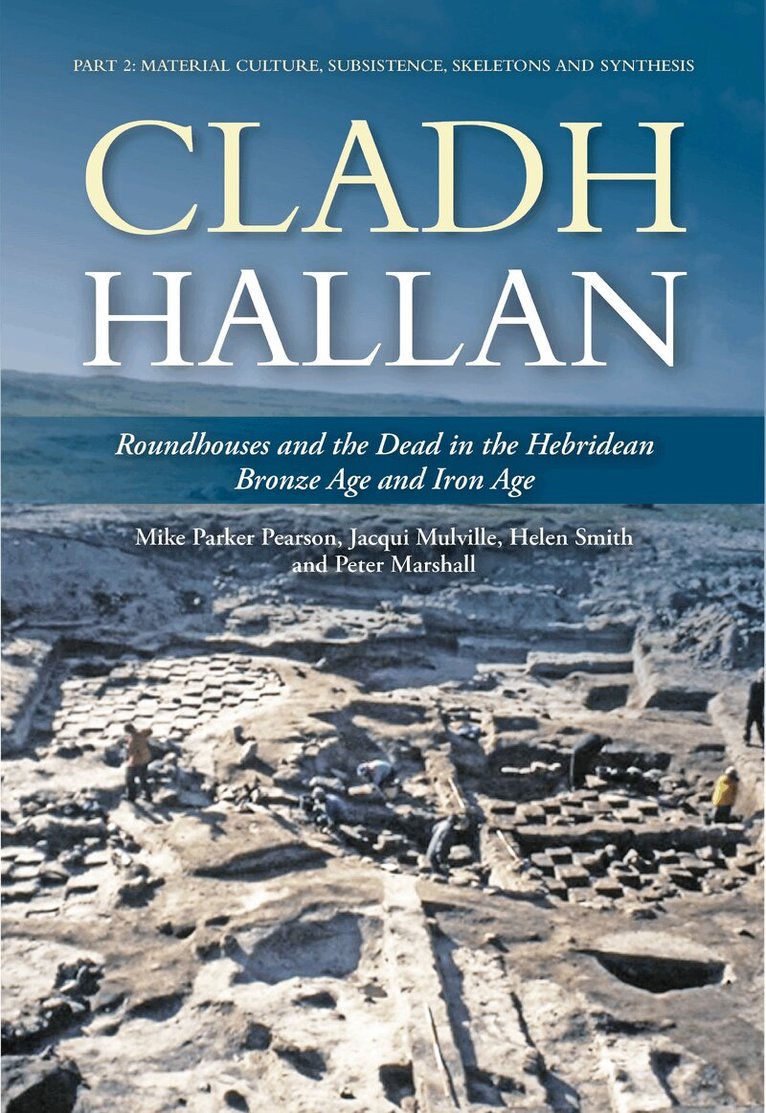
Cladh Hallan: Roundhouses and the Dead in the Hebridean Bronze Age and Iron Age
Part 2: Material Culture, Subsistence, Skeletons and Synthesis
Inbunden, Engelska, 2025
549 kr
Skickas
This second of two volumes presents archaeological and scientific studies of a wide range of materials from the unusually long-occupied Bronze Age and Iron Age site of Cladh Hallan on South Uist in the Western Isles of Scotland. These include metalworking debris, copper-alloy, gold and iron artifacts, bone and antler tools and ornaments, flint and quartz tools, coarse stone tools, pumice, shale ornaments and fuel ash slag. The metalworking assemblage, from casting weapons, tools and ornaments, is exceptional in its size and in its being stratified within a domestic context of production. Metal tools and ornaments, some placed as special deposits on house floors, include a gold-plated penannular ring and an iron object stratified within an 11th-century BC house floor, among the earliest finds of iron artefacts in Britain.The enormous and well-preserved environmental assemblage includes faunal remains of land mammals, whales, fish, birds and marine and terrestrial molluscs. Sheep were the most numerous domestic species within an assemblage of over 150,000 land mammalian remains, and Cladh Hallan has the largest collection of canine remains for any settlement in British later prehistory. Carbonized plant remains derive principally from cultivation of barley and associated weeds of cultivation.The site’s assemblage provides extensive material for chemical analysis of food residues, isotopic analysis of animal and human remains, osteological analysis of human remains, histological analysis of their processes of diagenesis, and genetic analysis of ancient DNA from animal and human remains. These analyses include full investigation of the human remains from two composite inhumations that had formerly been mummified, the first discovery of this mortuary practice in prehistoric Britain.The book concludes with a synthesis of results presented in the two volumes, presenting the rich insights provided by research on Cladh Hallan into life and death in the 2nd and early 1st millennia BC.