James D. Malley – författare
Visar alla böcker från författaren James D. Malley. Handla med fri frakt och snabb leverans.
5 produkter
5 produkter
Del 91 - Lecture Notes in Statistics
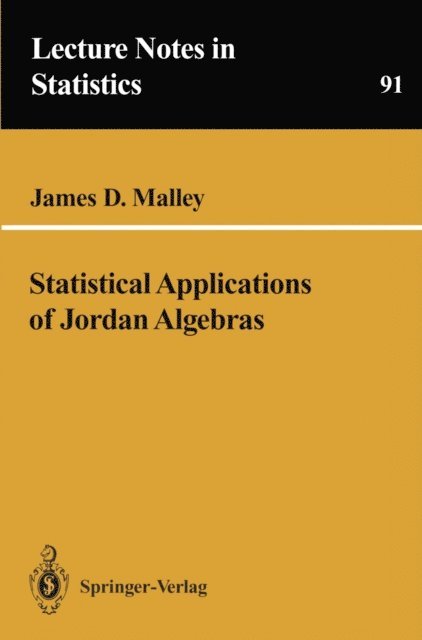
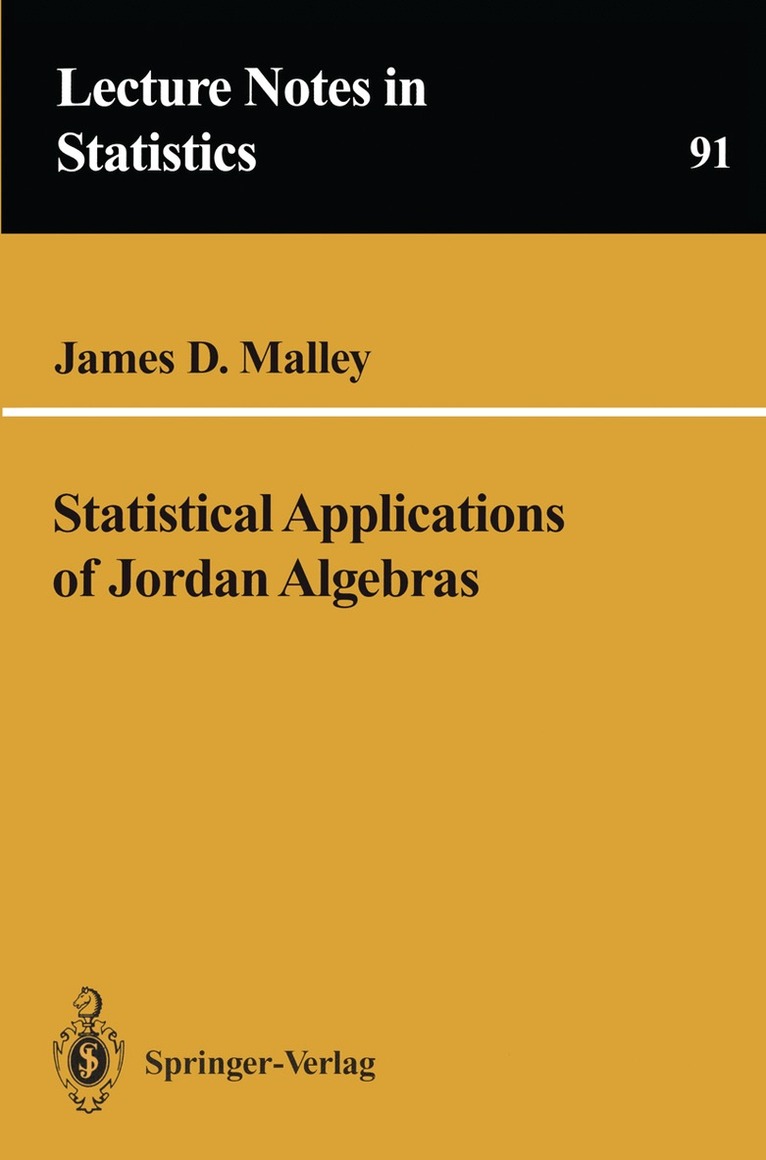
Statistical Applications of Jordan Algebras
Häftad, Engelska, 1994
550 kr
Skickas inom 10-15 vardagar
This monograph brings together my work in mathematical statistics as I have viewed it through the lens of Jordan algebras. Three technical domains are to be seen: applications to random quadratic forms (sums of squares), the investigation of algebraic simplifications of maxi mum likelihood estimation of patterned covariance matrices, and a more wide open mathematical exploration of the algebraic arena from which I have drawn the results used in the statistical problems just mentioned. Chapters 1, 2, and 4 present the statistical outcomes I have developed using the algebraic results that appear, for the most part, in Chapter 3. As a less daunting, yet quite efficient, point of entry into this material, one avoiding most of the abstract algebraic issues, the reader may use the first half of Chapter 4. Here I present a streamlined, but still fully rigorous, definition of a Jordan algebra (as it is used in that chapter) and its essential properties. These facts are then immediately applied to simplifying the M:-step of the EM algorithm for multivariate normal covariance matrix estimation, in the presence of linear constraints, and data missing completely at random. The results presented essentially resolve a practical statistical quest begun by Rubin and Szatrowski [1982], and continued, sometimes implicitly, by many others. After this, one could then return to Chapters 1 and 2 to see how I have attempted to generalize the work of Cochran, Rao, Mitra, and others, on important and useful properties of sums of squares.
Häftad, Engelska, 2011
557 kr
Skickas inom 7-10 vardagar
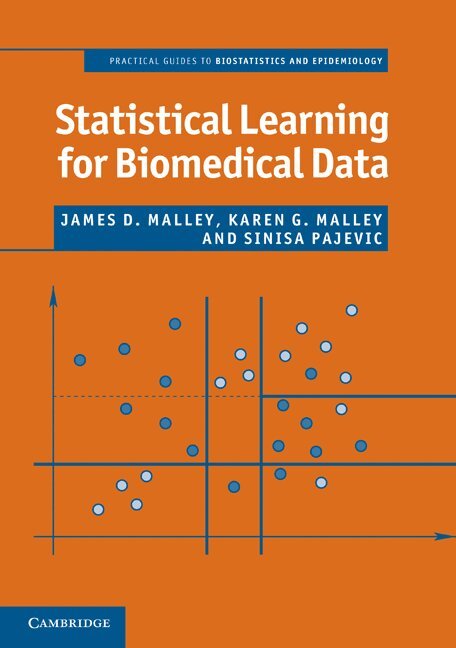
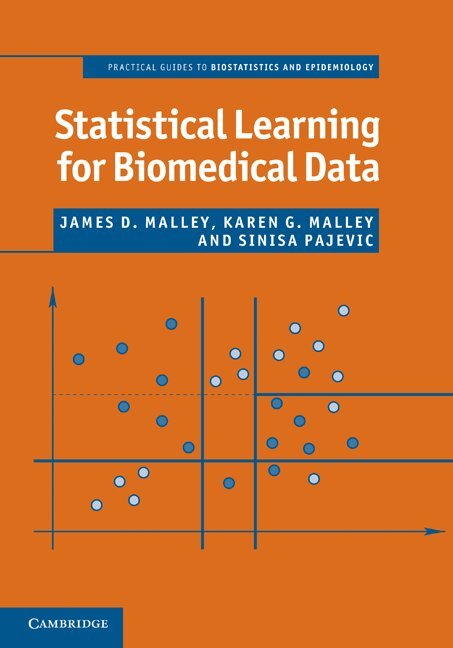
This book is for anyone who has biomedical data and needs to identify variables that predict an outcome, for two-group outcomes such as tumor/not-tumor, survival/death, or response from treatment. Statistical learning machines are ideally suited to these types of prediction problems, especially if the variables being studied may not meet the assumptions of traditional techniques. Learning machines come from the world of probability and computer science but are not yet widely used in biomedical research. This introduction brings learning machine techniques to the biomedical world in an accessible way, explaining the underlying principles in nontechnical language and using extensive examples and figures. The authors connect these new methods to familiar techniques by showing how to use the learning machine models to generate smaller, more easily interpretable traditional models. Coverage includes single decision trees, multiple-tree techniques such as Random Forests(TM), neural nets, support vector machines, nearest neighbors and boosting.
Inbunden, Engelska, 2011
1 611 kr
Skickas inom 7-10 vardagar
This book is for anyone who has biomedical data and needs to identify variables that predict an outcome, for two-group outcomes such as tumor/not-tumor, survival/death, or response from treatment. Statistical learning machines are ideally suited to these types of prediction problems, especially if the variables being studied may not meet the assumptions of traditional techniques. Learning machines come from the world of probability and computer science but are not yet widely used in biomedical research. This introduction brings learning machine techniques to the biomedical world in an accessible way, explaining the underlying principles in nontechnical language and using extensive examples and figures. The authors connect these new methods to familiar techniques by showing how to use the learning machine models to generate smaller, more easily interpretable traditional models. Coverage includes single decision trees, multiple-tree techniques such as Random Forests(TM), neural nets, support vector machines, nearest neighbors and boosting.
E-bok
PDF, Engelska, 2012687 kr
Läs direkt efter köp
This monograph brings together my work in mathematical statistics as I have viewed it through the lens of Jordan algebras. Three technical domains are to be seen: applications to random quadratic forms (sums of squares), the investigation of algebraic simplifications of maxi mum likelihood estimation of patterned covariance matrices, and a more wide open mathematical exploration of the algebraic arena from which I have drawn the results used in the statistical problems just mentioned. Chapters 1, 2, and 4 present the statistical outcomes I have developed using the algebraic results that appear, for the most part, in Chapter 3. As a less daunting, yet quite efficient, point of entry into this material, one avoiding most of the abstract algebraic issues, the reader may use the first half of Chapter 4. Here I present a streamlined, but still fully rigorous, definition of a Jordan algebra (as it is used in that chapter) and its essential properties. These facts are then immediately applied to simplifying the M:-step of the EM algorithm for multivariate normal covariance matrix estimation, in the presence of linear constraints, and data missing completely at random. The results presented essentially resolve a practical statistical quest begun by Rubin and Szatrowski [1982], and continued, sometimes implicitly, by many others. After this, one could then return to Chapters 1 and 2 to see how I have attempted to generalize the work of Cochran, Rao, Mitra, and others, on important and useful properties of sums of squares.
E-bok
PDF, Engelska, 2012687 kr
Läs direkt efter köp