James G. Shanahan - Böcker
Visar alla böcker från författaren James G. Shanahan. Handla med fri frakt och snabb leverans.
5 produkter
5 produkter
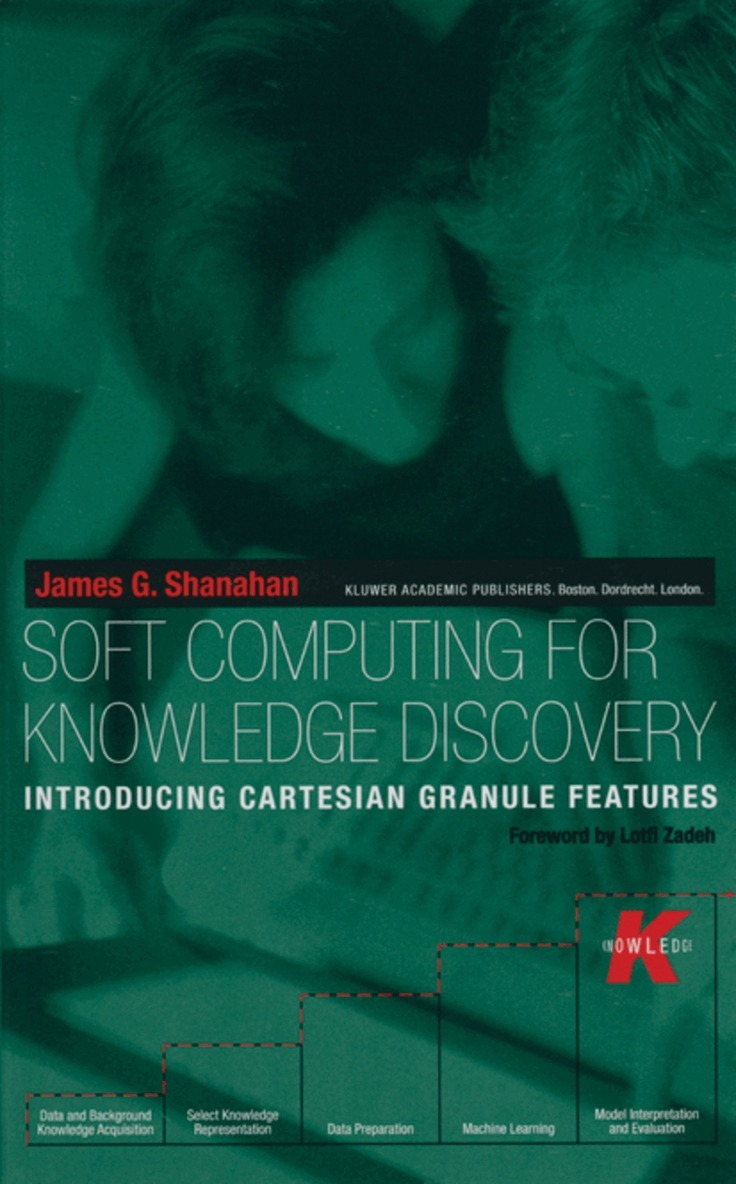
Soft Computing for Knowledge Discovery
Introducing Cartesian Granule Features
Inbunden, Engelska, 2000
1 625 kr
Skickas inom 10-15 vardagar
Knowledge discovery is an area of computer science that attempts to uncover interesting and useful patterns in data that permit a computer to perform a task autonomously or assist a human in performing a task more efficiently. This text provides a self-contained and systematic exposition of the key theory and algorithms that form the core of knowledge discovery from a soft computing perspective. It focuses on knowledge representation, machine learning, and the key methodologies that make up the fabric of soft computing - fuzzy set theory, fuzzy logic, evolutionary computing, and various theories of probability (for example naive Bayes and Bayesian networks, Dempster-Shafer theory, mass assignment theory, and others). In addition to describing many state-of-the-art soft computing approaches to knowledge discovery, the author introduces Cartesian granule features and their corresponding learning algorithms as an intuitive approach to knowledge discovery. This new approach embraces the synergistic spirit of soft computing and exploits uncertainty in order to achieve tractability, transparency and generalization.Parallels are drawn between this approach and other well known approaches (such as naive Bayes and decision trees) leading to equivalences under certain conditions. The approaches presented are further illustrated in a battery of both artificial and real-world problems. Knowledge discovery in real-world problems, such as object recognition in outdoor scenes, medical diagnosis and control, is described in detail. These case studies provide further examples of how to apply the presented concepts and algorithms to practical problems. The author provides Web page access to an online bibliography, datasets, source codes for several algorithms described in the book, and other information.
1 555 kr
Skickas inom 10-15 vardagar
Human Language Technology (HLT) and Natural Language Processing (NLP) systems have typically focused on the “factual” aspect of content analysis. Other aspects, including pragmatics, opinion, and style, have received much less attention. However, to achieve an adequate understanding of a text, these aspects cannot be ignored. The chapters in this book address the aspect of subjective opinion, which includes identifying different points of view, identifying different emotive dimensions, and classifying text by opinion. Various conceptual models and computational methods are presented. The models explored in this book include the following: distinguishing attitudes from simple factual assertions; distinguishing between the author’s reports from reports of other people’s opinions; and distinguishing between explicitly and implicitly stated attitudes. In addition, many applications are described that promise to benefit from the ability to understand attitudes and affect, including indexing and retrieval of documents by opinion; automatic question answering about opinions; analysis of sentiment in the media and in discussion groups about consumer products, political issues, etc. ; brand and reputation management; discovering and predicting consumer and voting trends; analyzing client discourse in therapy and counseling; determining relations between scientific texts by finding reasons for citations; generating more appropriate texts and making agents more believable; and creating writers’ aids. The studies reported here are carried out on different languages such as English, French, Japanese, and Portuguese. Difficult challenges remain, however. It can be argued that analyzing attitude and affect in text is an “NLP”-complete problem.
1 578 kr
Skickas inom 10-15 vardagar
Knowledge discovery is an area of computer science that attempts to uncover interesting and useful patterns in data that permit a computer to perform a task autonomously or assist a human in performing a task more efficiently.Soft Computing for Knowledge Discovery provides a self-contained and systematic exposition of the key theory and algorithms that form the core of knowledge discovery from a soft computing perspective. It focuses on knowledge representation, machine learning, and the key methodologies that make up the fabric of soft computing - fuzzy set theory, fuzzy logic, evolutionary computing, and various theories of probability (e.g. naïve Bayes and Bayesian networks, Dempster-Shafer theory, mass assignment theory, and others). In addition to describing many state-of-the-art soft computing approaches to knowledge discovery, the author introduces Cartesian granule features and their corresponding learning algorithms as an intuitive approach to knowledge discovery. This new approach embraces the synergistic spirit of soft computing and exploits uncertainty in order to achieve tractability, transparency and generalization. Parallels are drawn between this approach and other well known approaches (such as naive Bayes and decision trees) leading to equivalences under certain conditions.The approaches presented are further illustrated in a battery of both artificial and real-world problems. Knowledge discovery in real-world problems, such as object recognition in outdoor scenes, medical diagnosis and control, is described in detail. These case studies provide further examples of how to apply the presented concepts and algorithms to practical problems.The author provides web page access to an online bibliography, datasets, source codes for several algorithms described in the book, and other information.Soft Computing for Knowledge Discovery is for advanced undergraduates,professionals and researchers in computer science, engineering and business information systems who work or have an interest in the dynamic fields of knowledge discovery and soft computing.
Fuzzy Logic in Artificial Intelligence
IJCAI'97 Workshop Nagoya, Japan, August 23-24, 1997 Selected and Invited Papers
Häftad, Engelska, 1999
536 kr
Skickas inom 10-15 vardagar
This volume constitutes the thoroughly refereed post-workshop proceedings of an international workshop on fuzzy logic in Artificial Intelligence held in Negoya, Japan during IJCAI '97.The 17 revised full papers presented have gone through two rounds of reviewing and revision. Three papers by leading authorities in the area are devoted to the general relevance of fuzzy logic and fuzzy sets to AI. The remaining papers address various relevant issues ranging from theory to application in areas like knowledge representation, induction, logic programming, robotics, pattern recognition, etc.
Del 20 - Information Retrieval Series
Computing Attitude and Affect in Text: Theory and Applications
Häftad, Engelska, 2014
1 625 kr
Skickas inom 10-15 vardagar
Human Language Technology (HLT) and Natural Language Processing (NLP) systems have typically focused on the “factual” aspect of content analysis. Other aspects, including pragmatics, opinion, and style, have received much less attention. However, to achieve an adequate understanding of a text, these aspects cannot be ignored. The chapters in this book address the aspect of subjective opinion, which includes identifying different points of view, identifying different emotive dimensions, and classifying text by opinion. Various conceptual models and computational methods are presented. The models explored in this book include the following: distinguishing attitudes from simple factual assertions; distinguishing between the author’s reports from reports of other people’s opinions; and distinguishing between explicitly and implicitly stated attitudes. In addition, many applications are described that promise to benefit from the ability to understand attitudes and affect, including indexing and retrieval of documents by opinion; automatic question answering about opinions; analysis of sentiment in the media and in discussion groups about consumer products, political issues, etc. ; brand and reputation management; discovering and predicting consumer and voting trends; analyzing client discourse in therapy and counseling; determining relations between scientific texts by finding reasons for citations; generating more appropriate texts and making agents more believable; and creating writers’ aids. The studies reported here are carried out on different languages such as English, French, Japanese, and Portuguese. Difficult challenges remain, however. It can be argued that analyzing attitude and affect in text is an “NLP”-complete problem.