James J. Kaput - Böcker
Visar alla böcker från författaren James J. Kaput. Handla med fri frakt och snabb leverans.
6 produkter
6 produkter
2 616 kr
Skickas inom 10-15 vardagar
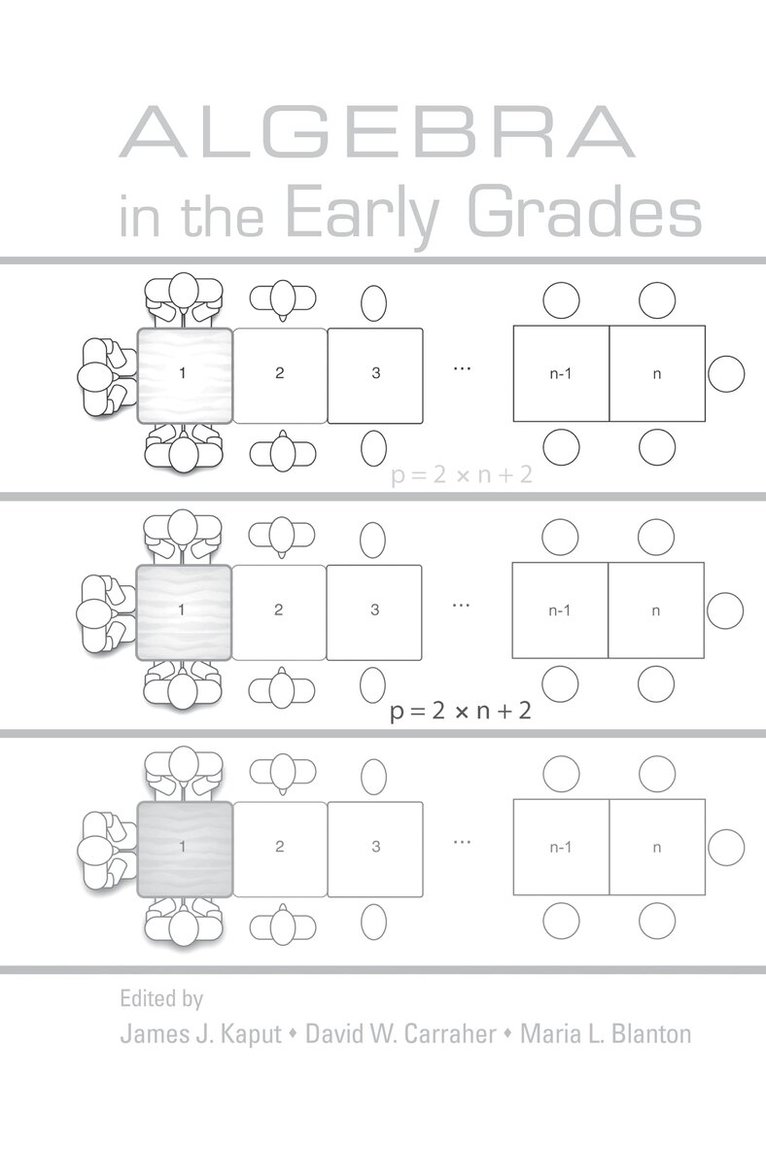
This volume is the first to offer a comprehensive, research-based, multi-faceted look at issues in early algebra. In recent years, the National Council for Teachers of Mathematics has recommended that algebra become a strand flowing throughout the K-12 curriculum, and the 2003 RAND Mathematics Study Panel has recommended that algebra be “the initial topical choice for focused and coordinated research and development [in K-12 mathematics].” This book provides a rationale for a stronger and more sustained approach to algebra in school, as well as concrete examples of how algebraic reasoning may be developed in the early grades. It is organized around three themes:The Nature of Early AlgebraStudents’ Capacity for Algebraic ThinkingIssues of Implementation: Taking Early Algebra to the Classrooms.The contributors to this landmark volume have been at the forefront of an effort to integrate algebra into the existing early grades mathematics curriculum. They include scholars who have been developing the conceptual foundations for such changes as well as researchers and developers who have led empirical investigations in school settings. Algebra in the Early Grades aims to bridge the worlds of research, practice, design, and theory for educators, researchers, students, policy makers, and curriculum developers in mathematics education.
1 021 kr
Skickas inom 10-15 vardagar
This volume is the first to offer a comprehensive, research-based, multi-faceted look at issues in early algebra. In recent years, the National Council for Teachers of Mathematics has recommended that algebra become a strand flowing throughout the K-12 curriculum, and the 2003 RAND Mathematics Study Panel has recommended that algebra be “the initial topical choice for focused and coordinated research and development [in K-12 mathematics].” This book provides a rationale for a stronger and more sustained approach to algebra in school, as well as concrete examples of how algebraic reasoning may be developed in the early grades. It is organized around three themes:The Nature of Early AlgebraStudents’ Capacity for Algebraic ThinkingIssues of Implementation: Taking Early Algebra to the Classrooms.The contributors to this landmark volume have been at the forefront of an effort to integrate algebra into the existing early grades mathematics curriculum. They include scholars who have been developing the conceptual foundations for such changes as well as researchers and developers who have led empirical investigations in school settings. Algebra in the Early Grades aims to bridge the worlds of research, practice, design, and theory for educators, researchers, students, policy makers, and curriculum developers in mathematics education.
2 485 kr
Skickas inom 7-10 vardagar
The central question addressed in Foundations for the Future in Mathematics Education is this:What kind of understandings and abilities should be emphasized to decrease mismatches between the narrow band of mathematical understandings and abilities that are emphasized in mathematics classrooms and tests, and those that are needed for success beyond school in the 21st century? This is an urgent question. In fields ranging from aeronautical engineering to agriculture, and from biotechnologies to business administration, outside advisors to future-oriented university programs increasingly emphasize the fact that, beyond school, the nature of problem-solving activities has changed dramatically during the past twenty years, as powerful tools for computation, conceptualization, and communication have led to fundamental changes in the levels and types of mathematical understandings and abilities that are needed for success in such fields. For K-12 students and teachers, questions about the changing nature of mathematics (and mathematical thinking beyond school) might be rephrased to ask: If the goal is to create a mathematics curriculum that will be adequate to prepare students for informed citizenship—as well as preparing them for career opportunities in learning organizations, in knowledge economies, in an age of increasing globalization—how should traditional conceptions of the 3Rs be extended or reconceived? Overall, this book suggests that it is not enough to simply make incremental changes in the existing curriculum whose traditions developed out of the needs of industrial societies. The authors, beyond simply stating conclusions from their research, use results from it to describe promising directions for a research agenda related to this question.The volume is organized in three sections: *Part I focuses on naturalistic observations aimed at clarifying what kind of “mathematical thinking” people really do when they are engaged in “real life” problem solving or decision making situations beyond school. *Part II shifts attention toward changes that have occurred in kinds of elementary-but-powerful mathematical concepts, topics, and tools that have evolved recently—and that could replace past notions of “basics” by providing new foundations for the future. This section also initiates discussions about what it means to “understand” the preceding ideas and abilities. *Part III extends these discussions about meaning and understanding—and emphasizes teaching experiments aimed at investigating how instructional activities can be designed to facilitate the development of the preceding ideas and abilities.Foundations for the Future in Mathematics Education is an essential reference for researchers, curriculum developers, assessment experts, and teacher educators across the fields of mathematics and science education.
876 kr
Skickas inom 10-15 vardagar
The central question addressed in Foundations for the Future in Mathematics Education is this:What kind of understandings and abilities should be emphasized to decrease mismatches between the narrow band of mathematical understandings and abilities that are emphasized in mathematics classrooms and tests, and those that are needed for success beyond school in the 21st century? This is an urgent question. In fields ranging from aeronautical engineering to agriculture, and from biotechnologies to business administration, outside advisors to future-oriented university programs increasingly emphasize the fact that, beyond school, the nature of problem-solving activities has changed dramatically during the past twenty years, as powerful tools for computation, conceptualization, and communication have led to fundamental changes in the levels and types of mathematical understandings and abilities that are needed for success in such fields. For K-12 students and teachers, questions about the changing nature of mathematics (and mathematical thinking beyond school) might be rephrased to ask: If the goal is to create a mathematics curriculum that will be adequate to prepare students for informed citizenship—as well as preparing them for career opportunities in learning organizations, in knowledge economies, in an age of increasing globalization—how should traditional conceptions of the 3Rs be extended or reconceived? Overall, this book suggests that it is not enough to simply make incremental changes in the existing curriculum whose traditions developed out of the needs of industrial societies. The authors, beyond simply stating conclusions from their research, use results from it to describe promising directions for a research agenda related to this question.The volume is organized in three sections: *Part I focuses on naturalistic observations aimed at clarifying what kind of “mathematical thinking” people really do when they are engaged in “real life” problem solving or decision making situations beyond school. *Part II shifts attention toward changes that have occurred in kinds of elementary-but-powerful mathematical concepts, topics, and tools that have evolved recently—and that could replace past notions of “basics” by providing new foundations for the future. This section also initiates discussions about what it means to “understand” the preceding ideas and abilities. *Part III extends these discussions about meaning and understanding—and emphasizes teaching experiments aimed at investigating how instructional activities can be designed to facilitate the development of the preceding ideas and abilities.Foundations for the Future in Mathematics Education is an essential reference for researchers, curriculum developers, assessment experts, and teacher educators across the fields of mathematics and science education.
1 289 kr
Tillfälligt slut
495 kr
Tillfälligt slut