James K. Galbraith - Böcker
Visar alla böcker från författaren James K. Galbraith. Handla med fri frakt och snabb leverans.
11 produkter
11 produkter
758 kr
Skickas inom 5-8 vardagar
Over the past thirty years, the issue of economic inequality has emerged from the backwaters of economics to claim center stage in the political discourse of America and beyond a change prompted by a troubling fact: numerous measures of income inequality, especially in the United States in the last quarter of the twentieth century, have risen sharply in recent years. Even so, many people remain confused about what, exactly, politicians and media persons mean when they discuss inequality. What does "economic inequality " mean? How is it measured? Why should we care? Why did inequality rise in the United States? Is rising inequality an inevitable feature of capitalism? What should we do about it? Inequality: What Everyone Needs to Know takes up these questions and more in plain and clear language, bringing to life one of the great economic and political debates of our age. Inequality expert James K. Galbraith has compiled the latest economic research on inequality and explains his findings in a way that everyone can understand. He offers a comprehensive introduction to the study of economic inequality, including its philosophical and theoretical origins, the variety of concepts in wide use, empirical measures and their advantages and disadvantages, competing modern theories of the causes and effects of rising inequality in the United States and worldwide, and a range of policy measures.This latest addition to the popular What Everyone Needs to Know series from Oxford University Press will tell you everything you need to know to make informed opinions on this significant issue.
185 kr
Skickas inom 5-8 vardagar
Over the past thirty years, the issue of economic inequality has emerged from the backwaters of economics to claim center stage in the political discourse of America and beyond a change prompted by a troubling fact: numerous measures of income inequality, especially in the United States in the last quarter of the twentieth century, have risen sharply in recent years. Even so, many people remain confused about what, exactly, politicians and media persons mean when they discuss inequality. What does "economic inequality " mean? How is it measured? Why should we care? Why did inequality rise in the United States? Is rising inequality an inevitable feature of capitalism? What should we do about it? Inequality: What Everyone Needs to Know takes up these questions and more in plain and clear language, bringing to life one of the great economic and political debates of our age. Inequality expert James K. Galbraith has compiled the latest economic research on inequality and explains his findings in a way that everyone can understand. He offers a comprehensive introduction to the study of economic inequality, including its philosophical and theoretical origins, the variety of concepts in wide use, empirical measures and their advantages and disadvantages, competing modern theories of the causes and effects of rising inequality in the United States and worldwide, and a range of policy measures.This latest addition to the popular What Everyone Needs to Know series from Oxford University Press will tell you everything you need to know to make informed opinions on this significant issue.
Inequality and Instability
A Study of the World Economy Just Before the Great Crisis
Inbunden, Engelska, 2012
366 kr
Skickas inom 5-8 vardagar
Inequality is a charged topic. Measures of income inequality rose in the USA in the 1990s to levels not seen since 1929 and gave rise to a suspicion, not for the first time, of a link between radical inequality and financial instability with a resulting crisis under capitalism. Professional macroeconomists have generally taken little interest in inequality because, within the parameters of traditional economic theory, the economy will stabilize itself at full employment. In addition, enlightened economists could enact stabilizing measures to manage any imbalances. The dominant voices among academic economists were unable to interpret the causal forces at work during both the Great Depression and the recent global financial crisis. In Inequality and Instability, James K. Galbraith argues that since there has been no serious work done on the macroeconomic effects of inequality, new sources of evidence are required. Galbraith offers for the first time a vast expansion of the capacity to calculate measures of inequality both at lower and higher levels of aggregation. Instead of measuring inequality as traditionally done, by country, Galbraith insists that to understand real differences that have real effects, inequality must be examined through both smaller and larger administrative units, like sub-national levels within and between states and provinces, multinational continental economies, and the world. He points out that inequality could be captured by measures across administrative boundaries to capture data on more specific groups to which people belong. For example, in China, economic inequality reflects the difference in average income levels between city and countryside, or between coastal regions and the interior, and a simple ratio averages would be an indicator of trends in inequality over the country as a whole. In a comprehensive presentation of this new method of using data, Inequality and Instability offers an unequaled look at the US economy and various global economies that was not accessible to us before. This provides a more sophisticated and a more accurate picture of inequality around the world, and how inequality is one of the most basic sources of economic instability.
335 kr
Kommande
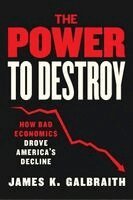
Acclaimed economist James K. Galbraith sounds an urgent alarm: how conventional economic ideas and policies are unequipped to account for the most daunting challenges of our geopolitical moment.Amid a mounting sense of American decline, Americans live with a new kind of dissonance: economists announcing that everything is fundamentally fine. Where growth is steady, unemployment is low, prices are (somewhat) stable, and stocks are high—what’s there to worry about? The Power to Destroy shows that this dissonance reflects a failure to evolve. James K. Galbraith’s incisive history of economic policy in this century is grounded in the fundamental problem that today’s experts are still deploying tools from all yesterday’s wars: obsolete economic ideas, measures, and doctrines focused on market functioning and crude economic indicators like output and prices. These methods, many of them honed a century ago against a vastly different social landscape, offer little hope in the face of today’s more existential threats. Such conventional policies, Galbraith argues, are increasingly ill-equipped to counter the daunting challenges of our moment—from inflation to trade sanctions, industrial cold wars, and climate change—and, left unacknowledged, are accelerating the end of the US economy as we know it. Shortcomings include the weak responses to the inflation of 2021-2022; the sanctions war against Russia; the rise of China; the weak and ineffective attempt at industrial revival; and the impending demographic crisis. All have roots in a flawed body of outdated economic thought that has been sustained for ideological rather than practical reasons. They now promise to hinder the United States in the emerging multipolar world. As Galbraith makes plain, for all the virtues of the market system, governments and their policies make markets possible. The ideas behind the policies—for better or worse—will determine the fate of the US economy—and new and better ideas are urgently needed. The alternative—sticking with economic ideas and policies we know and currently use—brings the power to destroy us all.
291 kr
Skickas inom 7-10 vardagar
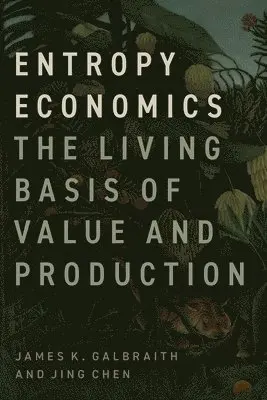
Economists dream of equilibrium. It’s time to wake up.In mainstream economics, markets are ideal if competition is perfect. When supply balances demand, economic maturity is orderly and disturbed only by shocks. These ideas are rooted in doctrines going back thousands of years, yet, as James K. Galbraith and Jing Chen show, they contradict the foundations of our scientific understanding of the physical and biological worlds. Entropy Economics discards the conventions of equilibrium and presents a new basis for thinking about economic issues, one rooted in life processes—an unequal world of unceasing change in which boundaries, plans, and regulations are essential. Galbraith and Chen’s theory of value is based on scarcity, and it accounts for the power of monopoly. Their theory of production covers increasing and decreasing returns, uncertainty, fixed investments over time, and the impact of rising resource costs. Together, their models illuminate key problems such as trade, finance, energy, climate, conflict, and demography. Entropy Economics is a thrilling framework for understanding the world as it is and will be keenly relevant to the economic challenges of a world threatened with disorder.
306 kr
Kommande
Economists dream of equilibrium. It’s time to wake up.In mainstream economics, markets are ideal if competition is perfect. When supply balances demand, economic maturity is orderly and disturbed only by shocks. These ideas are rooted in doctrines going back thousands of years, yet, as James K. Galbraith and Jing Chen show, they contradict the foundations of our scientific understanding of the physical and biological worlds. Entropy Economics discards the conventions of equilibrium and presents a new basis for thinking about economic issues, one rooted in life processes—an unequal world of unceasing change in which boundaries, plans, and regulations are essential. Galbraith and Chen’s theory of value is based on scarcity, and it accounts for the power of monopoly. Their theory of production covers increasing and decreasing returns, uncertainty, fixed investments over time, and the impact of rising resource costs. Together, their models illuminate key problems such as trade, finance, energy, climate, conflict, and demography. Entropy Economics is a thrilling framework for understanding the world as it is and will be keenly relevant to the economic challenges of a world threatened with disorder.
1 064 kr
Skickas inom 10-15 vardagar
This work contains James K. Galbraith's most influential recent writings on current affairs along with new commentary, and explores both the descent to disaster in Iraq and the ongoing transformation of the American economy under the steerage of Alan Greenspan.
1 064 kr
Skickas inom 10-15 vardagar
This work contains James K. Galbraith's most influential recent writings on current affairs along with new commentary, and explores both the descent to disaster in Iraq and the ongoing transformation of the American economy under the steerage of Alan Greenspan.
Predator State
How Conservatives Abandoned the Free Market and Why Liberals Should Too
Häftad, Engelska, 2009
158 kr
Skickas inom 5-8 vardagar
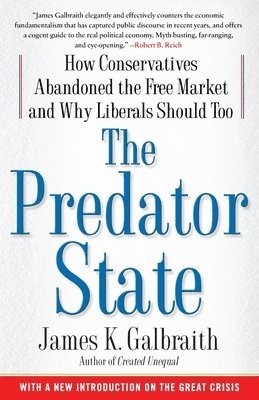
For nearly three decades, Washington has been in the grip of an economic orthodoxy defined by Ronald Reagan and embraced ardently by George W. Bush. It rests on four pillars: 1) Cut taxes on the wealthy, 2) Reduce regulation, 3) Fear inflation above all else, and 4) Insist on free-floating currency rates. Yet mainstream economists have spent much of the past decade examining the results, and declaring them rotten. Supply-side stimulation is a mirage. Deficits matter. Inequality matters. The disasters in Latin America--bread riots in Argentina, inflationary madness in Brazil - and Africa - bankrupt governments and capital flight - were a direct result of the Reagan-Bush agenda. James Galbraith is fed up, and determined to close the gap between what the economists know, and what the politicians ignore. In plain English, the Republican Party has been hijacked by political leaders who long since stopped caring if reality conformed to their message. Galbraith exposes the crumbling pillars one by one, naming names and pulling no punches.
111 kr
Tillfälligt slut
From one of the most respected economic thinkers and writers of our time, a brilliant argument about the history and future of economic growth. The years since the Great Crisis of 2008 have seen slow growth, high unemployment, falling home values, chronic deficits, a deepening disaster in Europe and a stale argument between two false solutions, "austerity" on one side and "stimulus" on the other. Both sides and practically all analyses of the crisis so far take for granted that the economic growth from the early 1950s until 2000 interrupted only by the troubled 1970s-represented a normal performance. From this perspective, the crisis was an interruption, caused by bad policy or bad people, and full recovery is to be expected if the cause is corrected. The End of Normalchallenges this view. Placing the crisis in perspective, Galbraith argues that the 1970s already ended the age of easy growth. The 1980s and 1990s saw only uneven growth, with rising inequality within and between countries. And the 2000s saw the end even of that, despite frantic efforts to keep growth going with tax cuts, war spending and financial deregulation. When the crisis finally came, stimulus and automatic stabilization were able to place a floor under economic collapse. But they are not able to bring about a return to high growth and full employment. In The End of Normal, "Galbraith puts his pessimism into an engaging, plausible frame. His contentions deserve the attention of all economists and serious financial minds across the political spectrum" (Publishers Weekly).
Innovation, Evolution and Economic Change
New Ideas in the Tradition of Galbraith
Inbunden, Engelska, 2006
2 171 kr
Skickas inom 7-10 vardagar
John Kenneth Galbraith was an eminent economist and proponent of change. The contributors to the book further his analysis on the evolution of capitalism; taking into account changes to the general economic climate since the publication of J.K. Galbraith's main thesis, they outline new ideas which form fertile ground for new research.The book begins with a penetrating analysis of the main features of today's capitalism and in particular the conflict between shareholders and managers. It moves on to focus on the consequences of globalization in the decision-making processes of large corporations and represents an important step in the development of a theory of fraud and corruption within corporations. In the final part, the authors address and explore the consequences of the domination of influential groups over major social and political decisions, on the blurred boundaries between the public and the private sectors and its consequences in the fields of technological regulation and the evolution of public services. In so doing, the authors question the meaning and power of democracy in today's society.Innovation, Evolution and Economic Change will appeal to a wide readership and audience of economists, policy makers and political organization.