James McWilliams - Böcker
Visar alla böcker från författaren James McWilliams. Handla med fri frakt och snabb leverans.
14 produkter
14 produkter
432 kr
Skickas inom 3-6 vardagar
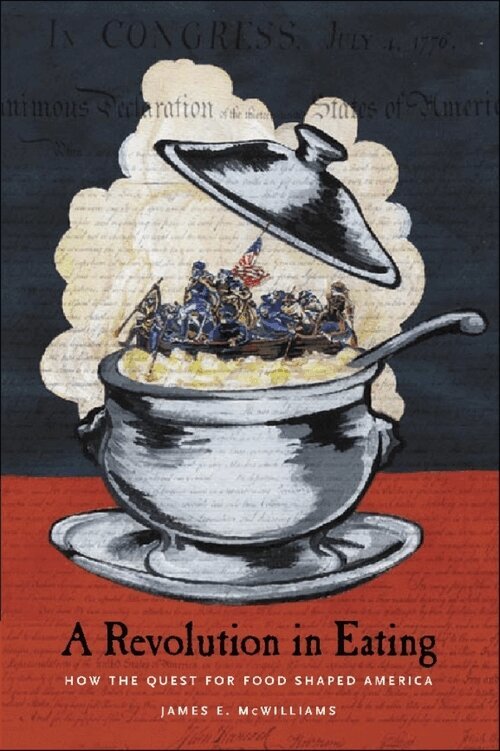
Sugar, pork, beer, corn, cider, scrapple, and hoppin' John all became staples in the diet of colonial America. The ways Americans cultivated and prepared food and the values they attributed to it played an important role in shaping the identity of the newborn nation. In A Revolution in Eating, James E. McWilliams presents a colorful and spirited tour of culinary attitudes, tastes, and techniques throughout colonial America. Confronted by strange new animals, plants, and landscapes, settlers in the colonies and West Indies found new ways to produce food. Integrating their British and European tastes with the demands and bounty of the rugged American environment, early Americans developed a range of regional cuisines. From the kitchen tables of typical Puritan families to Iroquois longhouses in the backcountry and slave kitchens on southern plantations, McWilliams portrays the grand variety and inventiveness that characterized colonial cuisine. As colonial America grew, so did its palate, as interactions among European settlers, Native Americans, and African slaves created new dishes and attitudes about food.McWilliams considers how Indian corn, once thought by the colonists as "fit for swine," became a fixture in the colonial diet. He also examines the ways in which African slaves influenced West Indian and American southern cuisine. While a mania for all things British was a unifying feature of eighteenth-century cuisine, the colonies discovered a national beverage in domestically brewed beer, which came to symbolize solidarity and loyalty to the patriotic cause in the Revolutionary era. The beer and alcohol industry also instigated unprecedented trade among the colonies and further integrated colonial habits and tastes. Victory in the American Revolution initiated a "culinary declaration of independence," prompting the antimonarchical habits of simplicity, frugality, and frontier ruggedness to define American cuisine. McWilliams demonstrates that this was a shift not so much in new ingredients or cooking methods, as in the way Americans imbued food and cuisine with values that continue to shape American attitudes to this day.
344 kr
Skickas inom 3-6 vardagar
Sugar, pork, beer, corn, cider, scrapple, and hoppin' John all became staples in the diet of colonial America. The ways Americans cultivated and prepared food and the values they attributed to it played an important role in shaping the identity of the newborn nation. In A Revolution in Eating, James E. McWilliams presents a colorful and spirited tour of culinary attitudes, tastes, and techniques throughout colonial America. Confronted by strange new animals, plants, and landscapes, settlers in the colonies and West Indies found new ways to produce food. Integrating their British and European tastes with the demands and bounty of the rugged American environment, early Americans developed a range of regional cuisines. From the kitchen tables of typical Puritan families to Iroquois longhouses in the backcountry and slave kitchens on southern plantations, McWilliams portrays the grand variety and inventiveness that characterized colonial cuisine. As colonial America grew, so did its palate, as interactions among European settlers, Native Americans, and African slaves created new dishes and attitudes about food.McWilliams considers how Indian corn, once thought by the colonists as "fit for swine," became a fixture in the colonial diet. He also examines the ways in which African slaves influenced West Indian and American southern cuisine. While a mania for all things British was a unifying feature of eighteenth-century cuisine, the colonies discovered a national beverage in domestically brewed beer, which came to symbolize solidarity and loyalty to the patriotic cause in the Revolutionary era. The beer and alcohol industry also instigated unprecedented trade among the colonies and further integrated colonial habits and tastes. Victory in the American Revolution initiated a "culinary declaration of independence," prompting the antimonarchical habits of simplicity, frugality, and frontier ruggedness to define American cuisine. McWilliams demonstrates that this was a shift not so much in new ingredients or cooking methods, as in the way Americans imbued food and cuisine with values that continue to shape American attitudes to this day.
285 kr
Skickas inom 7-10 vardagar
The world of insects is one we only dimly understand. Yet from using arsenic, cobalt, and quicksilver to kill household infiltrators to employing the sophisticated tools of the Orkin Man, Americans have fought to eradicate the "bugs" they have learned to hate. Inspired by the still-revolutionary theories of Rachel Carson's Silent Spring, James E. McWilliams argues for a more harmonious and rational approach to our relationship with insects, one that does not harm our environment and, consequently, ourselves along the way. Beginning with the early techniques of colonial farmers and ending with the modern use of chemical insecticides, McWilliams deftly shows how America's war on insects mirrors its continual struggle with nature, economic development, technology, and federal regulation. He reveals a very American paradox: the men and women who settled and developed this country sought to control the environment and achieve certain economic goals; yet their methods of agricultural expansion undermined their efforts and linked them even closer to the inexorable realities of the insect world.As told from the perspective of the often flamboyant actors in the battle against insects, American Pests is a fascinating investigation into the attitudes, policies, and practices that continue to influence our behavior toward insects. Asking us to question, if not abandon, our reckless (and sometimes futile) attempts at insect control, McWilliams convincingly argues that insects, like people, have an inherent right to exist and that in our attempt to rid ourselves of insects, we compromise the balance of nature.
220 kr
Skickas inom 10-15 vardagar
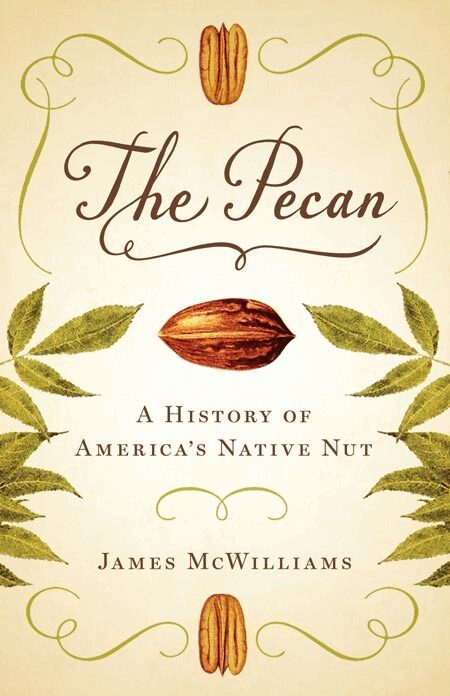
What would Thanksgiving be without pecan pie? New Orleans without pecan pralines? Southern cooks would have to hang up their aprons without America’s native nut, whose popularity has spread far beyond the tree’s natural home. But as familiar as the pecan is, most people don’t know the fascinating story of how native pecan trees fed Americans for thousands of years until the nut was “improved” a little more than a century ago-and why that rapid domestication actually threatens the pecan’s long-term future.In The Pecan, acclaimed writer and historian James McWilliams explores the history of America’s most important commercial nut. He describes how essential the pecan was for Native Americans-by some calculations, an average pecan harvest had the food value of nearly 150,000 bison. McWilliams explains that, because of its natural edibility, abundance, and ease of harvesting, the pecan was left in its natural state longer than any other commercial fruit or nut crop in America. Yet once the process of “improvement” began, it took less than a century for the pecan to be almost totally domesticated. Today, more than 300 million pounds of pecans are produced every year in the United States-and as much as half of that total might be exported to China, which has fallen in love with America’s native nut. McWilliams also warns that, as ubiquitous as the pecan has become, it is vulnerable to a “perfect storm” of economic threats and ecological disasters that could wipe it out within a generation. This lively history suggests why the pecan deserves to be recognized as a true American heirloom.
202 kr
Skickas inom 10-15 vardagar
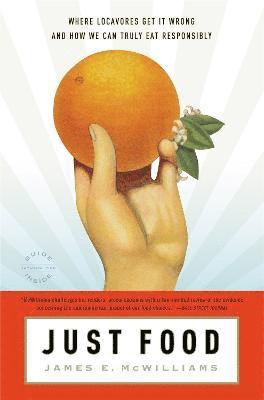
We suffer today from food anxiety, bombarded as we are with confusing messages about how to eat an ethical diet. Should we eat locally? Is organic really better for the environment? Can genetically modified foods be good for you? JUST FOOD does for fresh food what Fast Food Nation did for fast food, challenging conventional views, and cutting through layers of myth and misinformation. Informative and surprising, JUST FOOD tells us how to decide what to eat, and how our choices can help save the planet and feed the world.
141 kr
Skickas inom 11-20 vardagar
On 8 August 1918, the Allied forces launched the surprise attack that heralded the end of the First World War. With skill and daring, 21 divisions of men breached the German lines, supported by 500 tanks (the largest number to have been active in any one battle of the war) and 1,000 aircraft. In their wake they left 50,000 dead or wounded German soldiers along a stretch of 11 miles. On this 'black day' for the Germans the Allied forces began to see a glimmer of hope and the dawn of victory that was to come only 100 days later with the Armistice on 11 November 1918.Amiens 1918 not only considers the successes and failures of both sides in this conflict but also brings the slaughter and chaos of the Western Front to life, through the startling and emotive eyewitness accounts of battle survivors.
275 kr
Skickas inom 3-6 vardagar
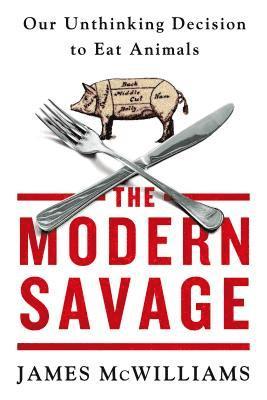
In the last four decades, food reformers have revealed the ecological and ethical problems of eating animals raised in industrial settings, turning what was once the boutique concern of radical eco-freaks into a mainstream movement. Although animal products are often labeled "cage free," "free range," and "humanely raised," can we trust these goods to be safe, sound, or ethical? In The Modern Savage, renowned writer, historian, and animal advocate James McWilliams pushes back against the questionable moral standards of a largely omnivorous world and explores the "alternative to the alternative", not eating domesticated animals at all. In poignant, powerful, and persuasive prose, McWilliams reveals the scope of the cruelty that takes place even on the smallest and supposedly most humane animal farms. In a world increasingly aware of animals' intelligence and the range of their emotions, McWilliams advocates for the only truly moral, sustainable choice, a diet without meat, dairy, or other animal products.In the spirit of Fast Food Nation and The Omnivore's Dilemma, McWilliams's The Modern Savage is a riveting expose of an industry that has typically hidden behind a veil of morality, and a compelling account of how to live a more economical, environmental, and ethical life.
428 kr
Skickas inom 5-8 vardagar
147 kr
Tillfälligt slut
511 kr
Skickas inom 7-10 vardagar
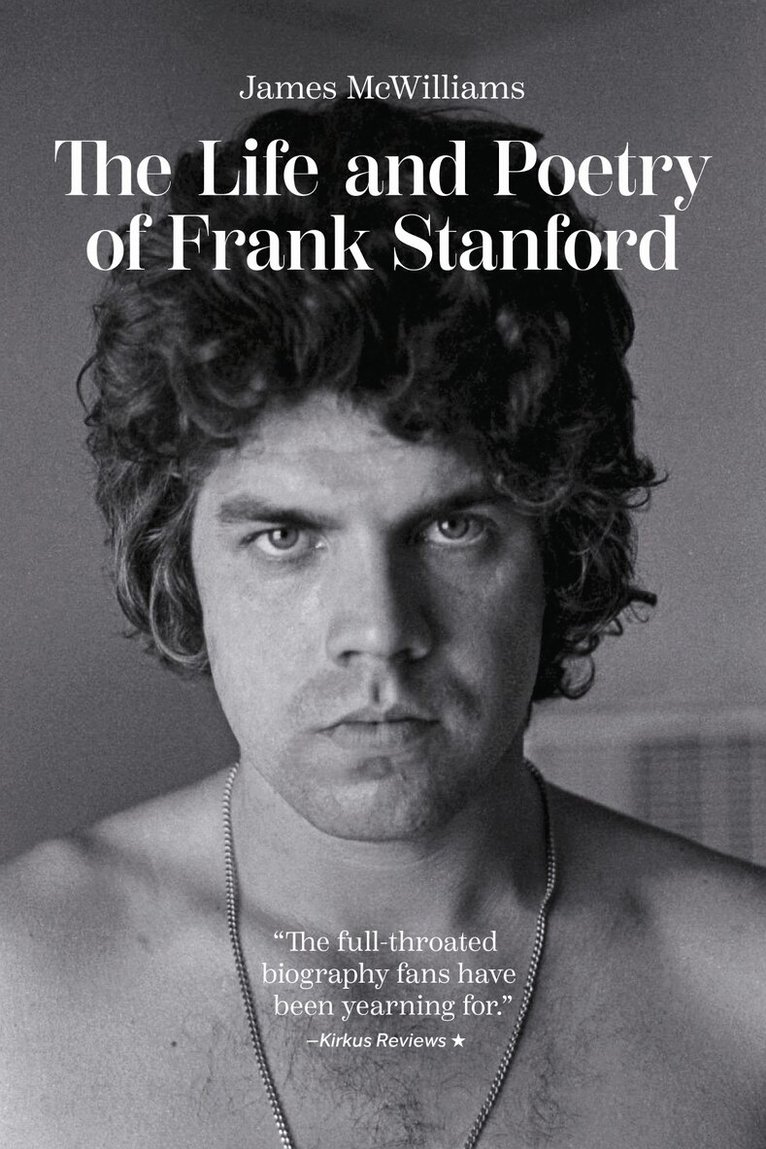
When twenty-nine-year-old Frank Stanford put three bullets in his chest on June 3, 1978, he ended a life that had been inextricably linked with poetry since childhood. Deeply influential but largely unknown outside his corner of the poetry world, this prodigy of the American South inspired a cult following that has kept his reputation and work flickering on the periphery of the American literary tradition ever since.The Life and Poetry of Frank Stanford offers for the first time a comprehensive study of Stanford’s life and work, introducing to a broad readership poetry that remains both captivating to poets and, in its celebration of everyday experience over academic erudition, accessible to those who rarely read poetry.Stanford’s poems range from one line to his 15,263-line epic, The Battlefield Where the Moon Says I Love You. The vital thread running through all of his poetry is an ear for language that vies with Walt Whitman in its expansiveness and generosity. Stanford’s omnivorous attraction to vernacular, particularly Black and rural vernacular, centered on an admiration for the marginalized and eccentric. Blending the Southern Gothic of Faulkner and O’Connor with a racially egalitarian vision, his poetry thrives on the stories and traditions of the oppressed and forgotten.The themes that preoccupied Stanford’s prolific output—language, sex, death, class, geography, commercialism, surrealism, film, race—also preoccupied the poet in his daily life, which was marked by heavy drinking, philandering, mental instability, emotional abuse, and, through it all, an inveterate desire for beauty. Constantly attentive to this tension, biographer James McWilliams traces the short and painfully complicated life of this hidden talent who left a lifetime’s worth of poetry that, through its grounding in the mundane, achieved a vision of the transcendent.
329 kr
Skickas inom 7-10 vardagar
When twenty-nine-year-old Frank Stanford put three bullets in his chest on June 3, 1978, he ended a life that had been inextricably linked with poetry since childhood. Deeply influential but largely unknown outside his corner of the poetry world, this prodigy of the American South inspired a cult following that has kept his reputation and work flickering on the periphery of the American literary tradition ever since.The Life and Poetry of Frank Stanford offers for the first time a comprehensive study of Stanford’s life and work, introducing to a broad readership poetry that remains both captivating to poets and, in its celebration of everyday experience over academic erudition, accessible to those who rarely read poetry.Stanford’s poems range from one line to his 15,263-line epic, The Battlefield Where the Moon Says I Love You. The vital thread running through all of his poetry is an ear for language that vies with Walt Whitman in its expansiveness and generosity. Stanford’s omnivorous attraction to vernacular, particularly Black and rural vernacular, centered on an admiration for the marginalized and eccentric. Blending the Southern Gothic of Faulkner and O’Connor with a racially egalitarian vision, his poetry thrives on the stories and traditions of the oppressed and forgotten.The themes that preoccupied Stanford’s prolific output—language, sex, death, class, geography, commercialism, surrealism, film, race—also preoccupied the poet in his daily life, which was marked by heavy drinking, philandering, mental instability, emotional abuse, and, through it all, an inveterate desire for beauty. Constantly attentive to this tension, biographer James McWilliams traces the short and painfully complicated life of this hidden talent who left a lifetime’s worth of poetry that, through its grounding in the mundane, achieved a vision of the transcendent.
296 kr
Skickas inom 7-10 vardagar
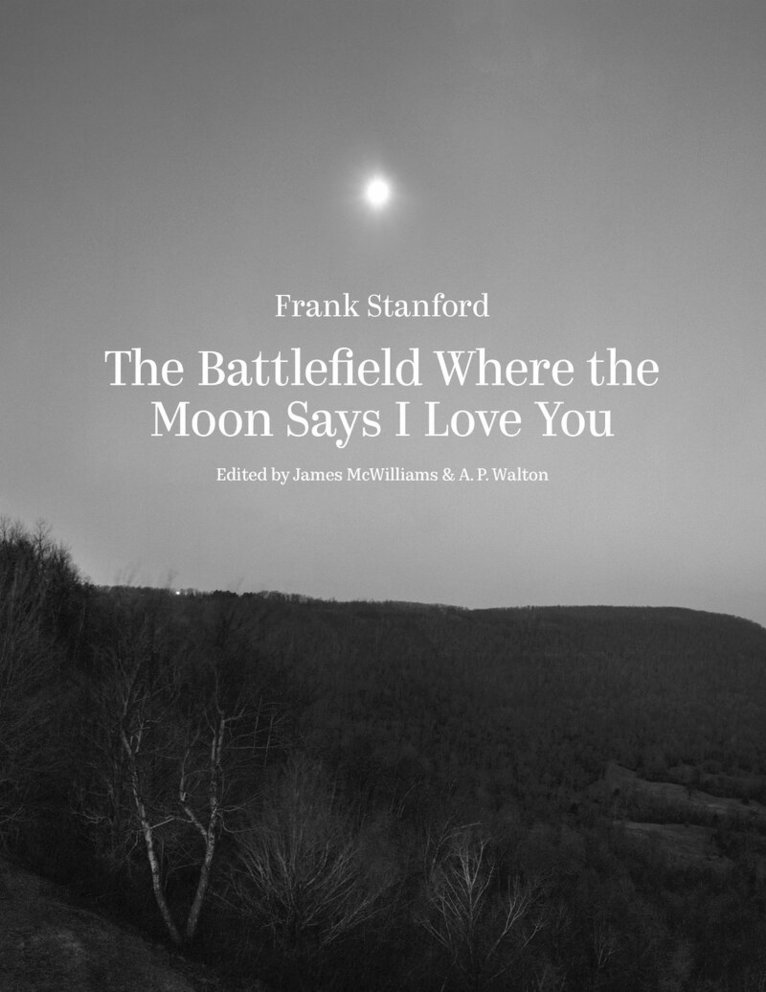
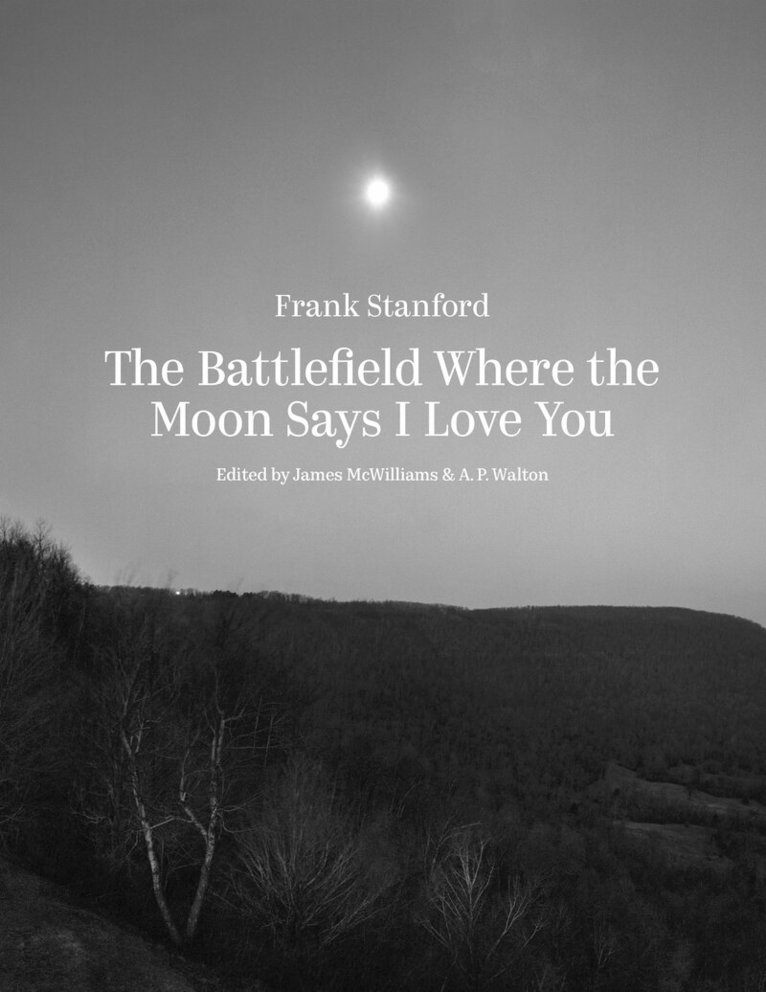
Frank Stanford's The Battlefield Where the Moon Says I Love You is a truly original Southern epic with immense cultural and creative range. Revered by a devoted cult following since it was first published posthumously in 1978, the poem unfolds over more than fifteen thousand lines without stanza breaks or punctuation, creating an unstoppable linguistic flow that mirrors the chaos and beauty it depicts. In this third edition, meticulously edited by James McWilliams and A. P. Walton, Stanford's sprawling vision is revived not as a lost relic but as a towering work fiercely alive in its ethical and aesthetic extremes.Beginning with poetry composed in his teens, Stanford worked feverishly in his early twenties to transform and expand fragments into this colossal, labyrinthine poem that captures the terrains of Tennessee, Mississippi, and Arkansas circa 1960. A few years later, he helped prepare the poem for its initial publication before ending his brief life at twenty-nine. The Battlefield blends vernacular speech and dream logic, creating a mythic landscape inhabited by Francis, the epic's twelve-year-old hero—orphan, seer, street hustler—who navigates racial injustice, cinematic visions, and historical collisions with unflinching poetic force, wandering through myth and memory and armed with a bard's ear and a trickster's tongue.A one-of-a-kind outlaw epic, The Battlefield has hidden in the literary shadows for half a century as a mystical artifact. Now, in this first scholarly edition, Stanford's visionary masterpiece returns, fortified by the editorial precision and contextual care it deserves.
1 996 kr
Tillfälligt slut
945 kr
Tillfälligt slut