Frank Stanford - Böcker
Visar alla böcker från författaren Frank Stanford. Handla med fri frakt och snabb leverans.
7 produkter
7 produkter
176 kr
Tillfälligt slut
"The big event in poetry for 2015 will likely be the long-awaited resurrection of Frank Stanford, a legendary badass from Arkansas, much of whose poetry has been unavailable since his suicide at the age of 29 in 1978...Stanford was a hell of a metaphor-maker and simile-slinger, and could cast a spell of extreme intensity with a flick of his wrist."--NPR.org "His love poems can sound like the cry of an angel falling backward through an open window, to borrow Dwight Yoakam's line about Roy Orbison's voice...Mr. Stanford could lose his heart without blowing his cool." --New York Times "It is astounding to me that I was not even aware of this accomplished and moving poet. There is a great deal of pain on the poems, but it is a pain that makes sense, a tragic pain whose meaning rises from the way the poems are so firmly molded and formed from within."--James Wright Hidden Water: From the Frank Stanford Archives is 200 pages of unpublished poems, photographs, artwork, and facsimiles of typesheets, handwrtten drafts, and letters. A preface is written by editor Michael Wiegers and an appreciation by Stanford's friend Steve Stern.The book also includes downloadable audio of special guests reading Stanford's poetry. Hidden Water complements Copper Canyon Press's definitive Frank Stanford collection What About This and is a must for any lover of Stanford. My wallet was thick as the bible I carried around Graphs of Elvis Presley John Lee Hooker Brigitte Bardot and the sodbuster Burns I thought up nom-de-plumes in the outhouse and sent off for things cryptic ads I used stamps that made the postmaster ask where I was from Born in 1948, Frank Stanford was a prolific poet known for his originality and ingenuity. He has been dubbed "a swamprat Rimbaud" by Lorenzo Thomas and "one of the great voices of death" by Franz Wright. He grew up in Mississippi, Tennessee, and then Arkansas, where he lived for most of his life and wrote many of his most powerful poems. Stanford died in 1978. He authored over ten books of poetry, including eight volumes in the last seven years of his life.
372 kr
Tillfälligt slut
236 kr
Skickas inom 7-10 vardagar
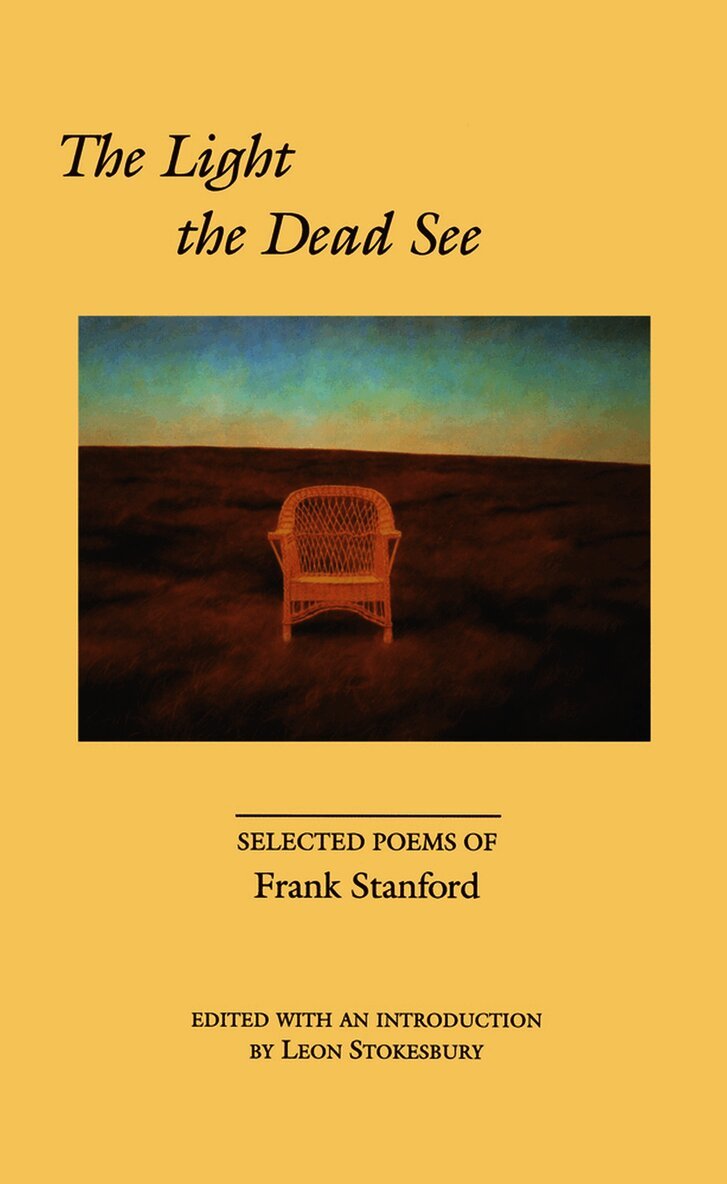
Between 1972, when he published his first book, The Signing Knives, and 1978, when he died at the age of twenty-nine, Frank Stanford published seven volumes of poetry. Within a year of his death, two posthumous collections were published. At the time of this death, as Leon Stokesbury asserts in his introduction, “Stanford was the best poet in America under the age of thirty-five.”The Light the Dead See collects the best work from those nine volumes and six previously unpublished poems. In the earlier poems, Stanford creates a world where he could keep childhood alive, deny time and mutability, and place a version of himself at the center of great myth and drama.Later, the denial of time and mutability gives way to an obsessive and familiar confrontation with death. Although Stanford paid an enormous price for his growing familiarity with Death as a presence, the direct address to that presence is a source of much of the striking originality and stunning power in the poetry.
849 kr
Skickas inom 3-6 vardagar
Frank Stanford's The Battlefield Where the Moon Says I Love You is a truly original Southern epic with immense cultural and creative range. Revered by a devoted cult following since it was first published posthumously in 1978, the poem unfolds over more than fifteen thousand lines without stanza breaks or punctuation, creating an unstoppable linguistic flow that mirrors the chaos and beauty it depicts. In this third edition, meticulously edited by James McWilliams and A. P. Walton, Stanford's sprawling vision is revived not as a lost relic but as a towering work fiercely alive in its ethical and aesthetic extremes.Beginning with poetry composed in his teens, Stanford worked feverishly in his early twenties to transform and expand fragments into this colossal, labyrinthine poem that captures the terrains of Tennessee, Mississippi, and Arkansas circa 1960. A few years later, he helped prepare the poem for its initial publication before ending his brief life at twenty-nine. The Battlefield blends vernacular speech and dream logic, creating a mythic landscape inhabited by Francis, the epic's twelve-year-old hero—orphan, seer, street hustler—who navigates racial injustice, cinematic visions, and historical collisions with unflinching poetic force, wandering through myth and memory and armed with a bard's ear and a trickster's tongue.A one-of-a-kind outlaw epic, The Battlefield has hidden in the literary shadows for half a century as a mystical artifact. Now, in this first scholarly edition, Stanford's visionary masterpiece returns, fortified by the editorial precision and contextual care it deserves.
283 kr
Skickas
Frank Stanford's The Battlefield Where the Moon Says I Love You is a truly original Southern epic with immense cultural and creative range. Revered by a devoted cult following since it was first published posthumously in 1978, the poem unfolds over more than fifteen thousand lines without stanza breaks or punctuation, creating an unstoppable linguistic flow that mirrors the chaos and beauty it depicts. In this third edition, meticulously edited by James McWilliams and A. P. Walton, Stanford's sprawling vision is revived not as a lost relic but as a towering work fiercely alive in its ethical and aesthetic extremes.Beginning with poetry composed in his teens, Stanford worked feverishly in his early twenties to transform and expand fragments into this colossal, labyrinthine poem that captures the terrains of Tennessee, Mississippi, and Arkansas circa 1960. A few years later, he helped prepare the poem for its initial publication before ending his brief life at twenty-nine. The Battlefield blends vernacular speech and dream logic, creating a mythic landscape inhabited by Francis, the epic's twelve-year-old hero—orphan, seer, street hustler—who navigates racial injustice, cinematic visions, and historical collisions with unflinching poetic force, wandering through myth and memory and armed with a bard's ear and a trickster's tongue.A one-of-a-kind outlaw epic, The Battlefield has hidden in the literary shadows for half a century as a mystical artifact. Now, in this first scholarly edition, Stanford's visionary masterpiece returns, fortified by the editorial precision and contextual care it deserves.
251 kr
Skickas inom 5-8 vardagar
569 kr
Tillfälligt slut
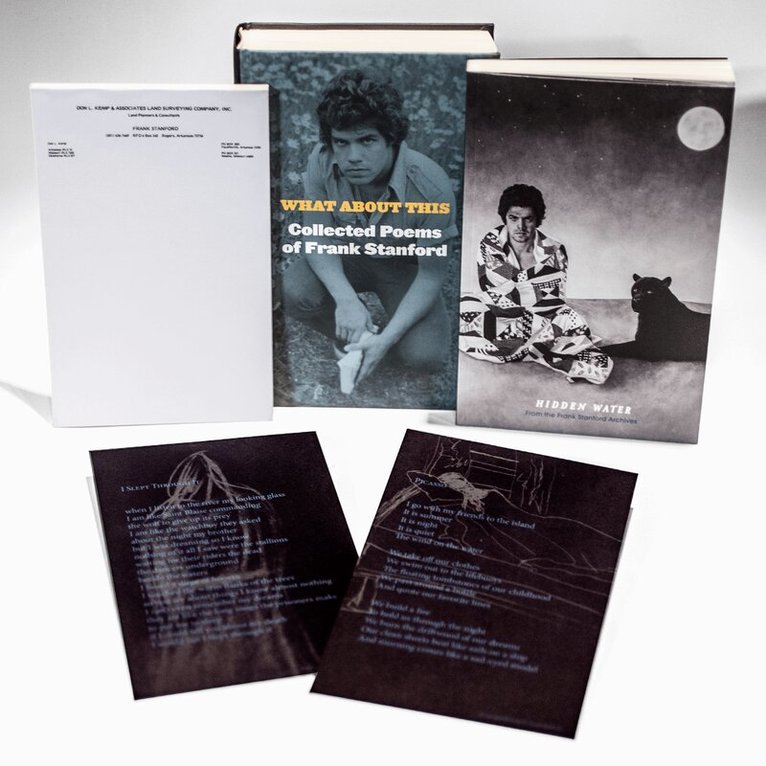
A very special collaboration between Third Man Books and Copper Canyon Press, THE HIDDEN WATER SPECIAL EDITION is a limited edition, multi-media set that includes two books: the 730+ page What About This (Copper Canyon) and the 200+ page Hidden Water (Third Man Books), plus two broadsides reproducing original sketches by Stanford, and a custom notepad inspired by the workpad Stanford used at his day job as a land surveyor. The Hidden Water Special Edition is the definitive collection of Stanford poetry, drafts, letters, and ephemera. The set comes shrink-wrapped and in a custom made sleeve.Born in 1948, Frank Stanford was a prolific poet known for his originality and ingenuity. He has been dubbed “a swamp rat Rimbaud” by Lorenzo Thomas and “one of the great voices of death” by Franz Wright. He grew up in Mississippi, Tennessee, and then Arkansas, where he lived for most of his life and wrote many of his most powerful poems. Stanford died in 1978. He authored over ten books of poetry, including eight volumes in the last seven years of his life.“What About This… introduces to a broader audience an important and original American poet — sensitive, death-haunted, surreal, carnal, dirt-flecked and deeply Southern — whose promise, only partly fulfilled, it hurts to contemplate. His poems flick on a heretofore unnoticed porch light in your mind.” —The New York Times“Hidden Water offers a broad and beautiful collection of photographs, drawings, letters and drafts of poems with notes and edits scribbled in the poet’s own hand. It even features a partial inventory of Stanford’s record collection (John Coltrane, Miles Davis, Leadbelly) and a picture of the business card he used for his day job . . .And in the end, Stanford’s voice is as clear, plain and death-obsessed as ever: “I wandered I sang / I made promises to death and I kept them / so having done / with my work in this world / I dove into that pool. —The Houston Chronicle