James P. McClure – Författare
Visar alla böcker från författaren James P. McClure. Handla med fri frakt och snabb leverans.
10 produkter
10 produkter
1 432 kr
Skickas inom 7-10 vardagar
Confessing that he may be acting "with more boldness than wisdom," Jefferson in November 1803 drafts a bill to create Orleans Territory, which he entrusts to John Breckinridge for introduction in the Senate. The administration sends stock certificates to France in payment for Louisiana. Relieved that affairs in the Mediterranean have improved with the evaporation of a threat of war with Morocco, the president does not know yet that Tripoli has captured the frigate Philadelphia with its officers and crew. He deals with never-ending issues of appointment to office and quarreling in his own party, while hearing that some Federalists are "as Bitter as wormwood." He shares seeds of the Venus flytrap with Elizabeth Leathes Merry, the British minister's wife. She and her husband, however, create a diplomatic storm over seating arrangements at dinner parties. Having reached St. Louis, Meriwether Lewis reports on the progress of the western expedition. Congress passes the Twelfth Amendment, which will provide for the separate election of president and vice president.In detailed notes made after Aaron Burr calls on him in January, Jefferson records his long-standing distrust of the New Yorker. Less than a month later, a congressional caucus nominates Jefferson for a second term, with George Clinton to replace Burr as vice president. Jefferson makes his first trials of the "double penned writing box" called the polygraph.
1 432 kr
Skickas inom 7-10 vardagar
After the congressional session ends, Jefferson leaves Washington and goes home to Monticello, where his ailing daughter Mary dies on 17 April. Among the letters of condolence he receives is one from Abigail Adams that initiates a brief resumption of their correspondence. While in Virginia, Jefferson immerses himself in litigations involving land. Back in the capital, he finds that he must reconcile differing opinions of James Madison and Albert Gallatin to settle a claim for diplomatic expenses. He corresponds with Charles Willson Peale about modifications to the polygraph writing machine. He prepares instructions for an expedition to explore the Arkansas and Red Rivers. William Clark and Meriwether Lewis send him maps and natural history specimens from St. Louis. Alexander von Humboldt visits Washington. News arrives that a daring raid led by Stephen Decatur Jr. has burned the frigate Philadelphia to deprive Tripoli of its use. Jefferson is concerned that mediation by Russia or France to obtain the release of the ship's crew could make the United States appear weak. Commodore Samuel Barron sails with frigates to reinforce the squadron in the Mediterranean.Jefferson appoints John Armstrong to succeed Robert R. Livingston as minister to France and attempts to persuade Lafayette to move to Louisiana. In Paris, Napoleon is proclaimed Emperor of the French. Jefferson has "brought peace to our Country and comfort to our Souls," John Tyler writes from Virginia.
1 477 kr
Skickas inom 7-10 vardagar
Aaron Burr fells Alexander Hamilton in a duel in July, but Jefferson, caring little for either adversary or for disruptive partisan warfare, gives the event only limited notice. He contends with the problem of filling the offices necessary for the establishment of Orleans Territory on October 1. He is constrained by his lack of knowledge about potential officeholders. Meanwhile, a delegation with a memorial from disgruntled Louisianians travels to Washington. In August, the U.S. Mediterranean squadron bombards Tripoli. The United States has uneasy relationships around its periphery. Jefferson compiles information on British "aggressions" in American ports and waters, and drafts a bill to allow federal judges and state governors to call on military assistance when British commanders spurn civil authority. Another bill seeks to prevent merchant ships from arming for trade with Haiti. Contested claims to West Florida, access to the Gulf of Mexico, tensions along the Texas-Louisiana boundary, and unresolved maritime claims exacerbate relations with Spain. Jefferson continues his policy of pushing Native American nations to give up their lands east of the Mississippi River. Yellow fever has devastating effects in New Orleans. Abigail Adams terminates the brief revival of their correspondence, musing that "Affection still lingers in the Bosom, even after esteem has taken its flight." In November, Jefferson delivers his annual message to Congress. He also commences systematic records to manage his guest lists for official dinners.
1 432 kr
Skickas inom 7-10 vardagar
A definitive scholarly edition of the correspondence and papers of Thomas JeffersonThis volume opens soon after the start of the second session of the Eighth Congress and ends a few days after the session closes. During the period, Jefferson receives twice as many documents as he writes. He sits for portraits by Charles Févret de Saint-Mémin and Rembrandt Peale. The nation endures an extreme winter. William Dunbar begins to send information from the exploration of the Ouachita River. Acts of Congress create new territories and give Orleans Territory an assembly and a path to statehood. The Senate ratifies a treaty to acquire an estimated 50 million acres of land from the Sac and Fox tribes. Levi Lincoln resigns, Robert Smith asks to succeed him as attorney general, and Jefferson seeks a new secretary of the navy. Jefferson and vice-presidential candidate George Clinton receive 162 electoral ballots against 14 for their opponents, Charles Cotesworth Pinckney and Rufus King. Napoleon is crowned emperor of the French, and Spain declares war on Great Britain. The Senate acquits Samuel Chase of eight articles of impeachment. Jefferson prepares his inaugural address and is sworn into office for his second term on 4 March. He refuses to consider serving a third term.
1 432 kr
Skickas inom 7-10 vardagar
A definitive scholarly edition of the correspondence and papers of Thomas JeffersonCongress adjourns early in March, and Jefferson goes home to Monticello for a month. After his return to Washington, he corresponds with territorial governors concerning appointments to legislative councils. He peruses information about Native American tribes, Spanish and French colonial settlements, and the geography of the Louisiana Territory. He seeks the consent of Spanish authorities to a U.S. exploration along the Red River while asserting privately that Spain “has met our advances with jealousy, secret malice, and ill faith.” A new law extends civil authority over foreign warships in U.S. harbors, and he considers using it also to constrain privateers. Federalist opponents bring up “antient slanders” to question his past private and official actions. His personal finances are increasingly reliant on bank loans. He starts a search for a new farm manager at Monticello. Meriwether Lewis and William Clark write from Fort Mandan in April before setting out up the Missouri River. Jefferson will not receive their reports until mid-July. In the Mediterranean, William Eaton coordinates the capture of the port of Derna and Tobias Lear negotiates terms of peace with Pasha Yusuf Qaramanli to end the conflict with Tripoli. News of those events will not reach the United States until September.
1 432 kr
Skickas inom 7-10 vardagar
A definitive scholarly edition of the correspondence and papers of Thomas JeffersonJefferson continues his pattern of returning home to Monticello for the summer months. He makes a brief visit to Poplar Forest in Bedford County to plan the development of that property. James Hubbard, a young enslaved worker at Monticello, escapes but is captured in Fairfax County. Another slave who has fled, James Hemings, rejects efforts to persuade him to return and disappears. Receiving news of the end of the conflict with Tripoli, Jefferson states that although it is “a small war in fact, it is big in principle.” He devotes much of his attention to relations with Spain. He considers alliance with Great Britain to force a resolution with Spain, then chooses instead to negotiate with France for the purchase of Florida and settlement of matters in dispute with Spain. He drafts bills to organize the militia by age and create a naval militia. Specimens sent by Lewis and Clark arrive. Jefferson calculates that the United States has recently acquired cessions of well over 9 million acres of land from Native Americans. He meets with visiting Creek leaders. Answering a query, Jefferson states that Patrick Henry was “the greatest orator that ever lived” but “avaritious & rotten hearted.”
1 432 kr
Skickas inom 7-10 vardagar
A definitive scholarly edition of the correspondence and papers of Thomas JeffersonJefferson sends his annual message to Congress. He submits the peace treaty with Tripoli, but ratification takes months as the Senate asks for supporting documentation and Congress considers the request of Ahmad Qaramanli for compensation. The president desires action to make Spain negotiate outstanding issues and urges defensive preparations in the event of armed conflict. Congress appropriates $2 million for the purchase of Florida and approves the appointment of James Bowdoin and John Armstrong as commissioners to negotiate. New restrictive measures by Great Britain that threaten to choke off American trade with the West Indies spark memorials by merchants in seaport cities. After Congress passes an act outlawing trade with Haiti for a year, Timothy Pickering decries the administration’s “spaniel servility” to France. Representatives of the Cherokee, Potawatomi, Sac, Fox, Osage, Missouri, Kansas, Otoe, Iowa, Pawnee, and Sioux nations come to Washington. South American revolutionary Francisco de Miranda travels in the United States, secretly collecting men and materials for a projected uprising in Venezuela. Tunisian envoy Sulayman Melmelli is in Washington. Jefferson’s daughter Martha Randolph and her family make an extended visit to the capital, during which his newest grandchild, James Madison Randolph, is born in the President’s House.
1 778 kr
Kommande
A definitive scholarly edition of the correspondence and papers of Thomas JeffersonThe Senate confirms John Armstrong and James Bowdoin as commissioners to negotiate with Spain and James Monroe and William Pinkney to do the same with Great Britain. In speeches in the House of Representatives, John Randolph attacks the administration’s measures and declares that the president has lost the confidence of the cabinet. Jefferson shrugs this off, maintaining that Randolph can pull away only a few Republicans. In the approaches to New York harbor, a shot from a British warship causes the death of an American mariner. Jefferson issues a proclamation that calls for the apprehension of Henry Whitby, the captain of the warship, and bars his ship and others with it from American ports and waters. Congress passes an act to limit the navy to 925 seamen, capping the number of ships and raising Jefferson’s concerns in light of a potential war with Tunis. He plans to use gunboats and militia to protect Orleans Territory in the event of conflict with Spain. Aaron Burr calls on him and hints that he could do “much harm.” Jefferson’s mentor George Wythe dies by poisoning, leaving Jefferson his books. Jefferson plans and begins to lay out the large garden for vegetables at Monticello.
1 841 kr
Kommande
A definitive scholarly edition of the correspondence and papers of Thomas JeffersonThis volume covers Jefferson’s residence in Virginia in the summer of 1806 and an intense period of work after he returns to the capital in the fall. The summer is marked by a prolonged lack of rainfall in Virginia and other parts of the country. Jefferson goes home to Monticello in July, and in August makes a brief trip to Bedford County to arrange for the shipment to market of tobacco from his Poplar Forest plantation. At Monticello, Edmund Bacon takes on the position of overseer. Jefferson’s detailed instructions for Bacon outline work to be completed and include information about the enslaved laborers. James and Dolley Madison and Henry and Dorcas Dearborn visit in September. Back in Washington in October, Jefferson argues with Benjamin Henry Latrobe about the installation of skylights in the roof of the Capitol and receives Meriwether Lewis’s letter announcing that his expedition safely reached the Pacific and has returned to St. Louis. Reports from the lower Mississippi Valley indicate that friction in the Orleans Territory boundary zone could tip Spain and the United States into war. Unverified intelligence warns that Aaron Burr may be planning to raise an armed force of several thousand volunteers for an unknown purpose. In addition, questions have been raised about the loyalty of General James Wilkinson. Jefferson consults with the cabinet five times in October and November. After a confidential dispatch from Wilkinson alleges that Burr’s objective is Vera Cruz, Jefferson issues a proclamation prohibiting expeditions “against the dominions of Spain.”
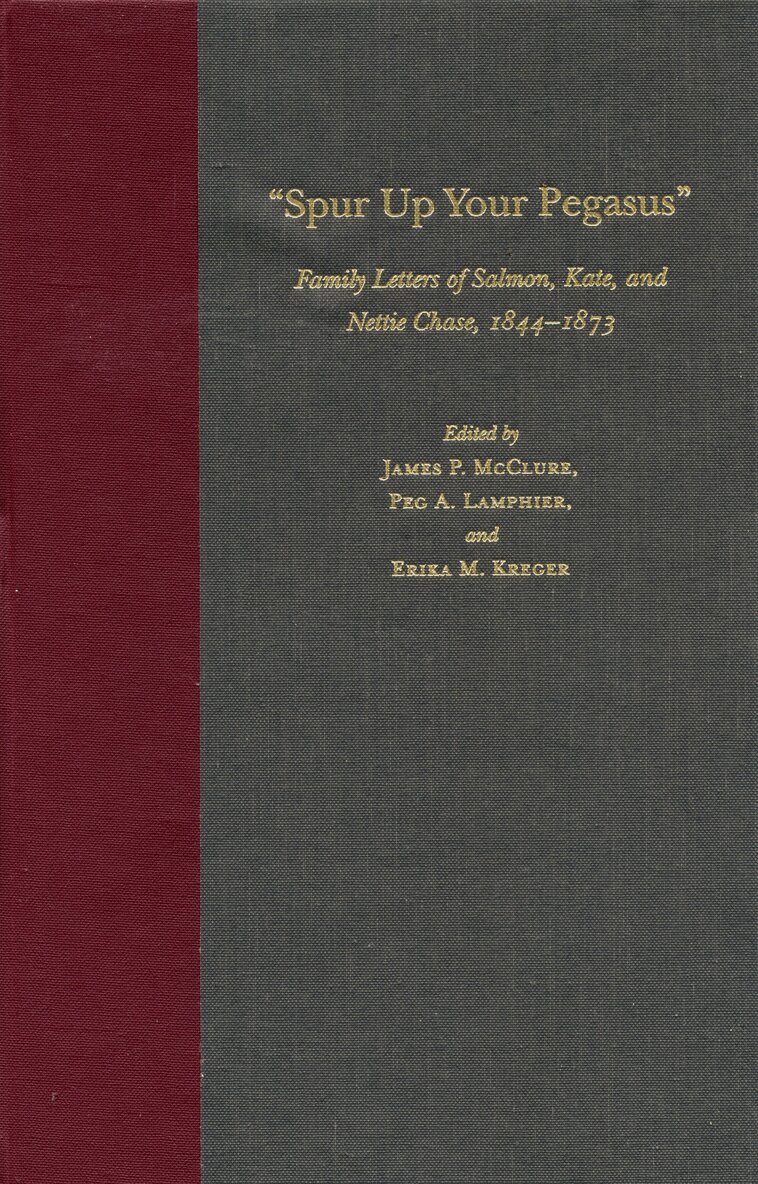
Spur Up Your Pegasus
Family Letters of Salmon, Kate, and Nettie Chase, 1844-1873
Inbunden, Engelska, 2009
791 kr
Skickas inom 7-10 vardagar
Married three times, Salmon P. Chase lost four children in infancy. Two daughters survived to adulthood and were their father's companions during his service as a U.S. senator from Ohio, governor of Ohio, Abraham Lincoln's secretary of the Treasury, and Chief Justice of the Supreme Court. Kate, his older daughter, acted as an unofficial political advisor to her father and was a prominent Washington, D.C., hostess, while Nettie eschewed a life in the public eye, becoming a wife, mother, and creator of children's books.Often separated from his family due to the demands of his career as a lawyer and antislavery politician, Chase maintained his relationship with his daughters by the frequent exchange of letters. Chase's letters show an ambitious father trying to school his daughters from afar, admonishing them to study and encouraging them to develop self-discipline and personal responsibility. The letters in this volume - from Chase to his daughters, from his daughters to him and to each other - span from when Kate was a young child and Nettie not yet born to their father's death in 1873.This collection of correspondence, many letters previously unpublished, stresses familial relationships, the daughters' education, and the role of women in nineteenth-century America. ""Spur Up Your Pegasus"" provides important insights into the personal lives and private thoughts of a prominent political family.