James Taylor Carson - Böcker
Visar alla böcker från författaren James Taylor Carson. Handla med fri frakt och snabb leverans.
4 produkter
4 produkter
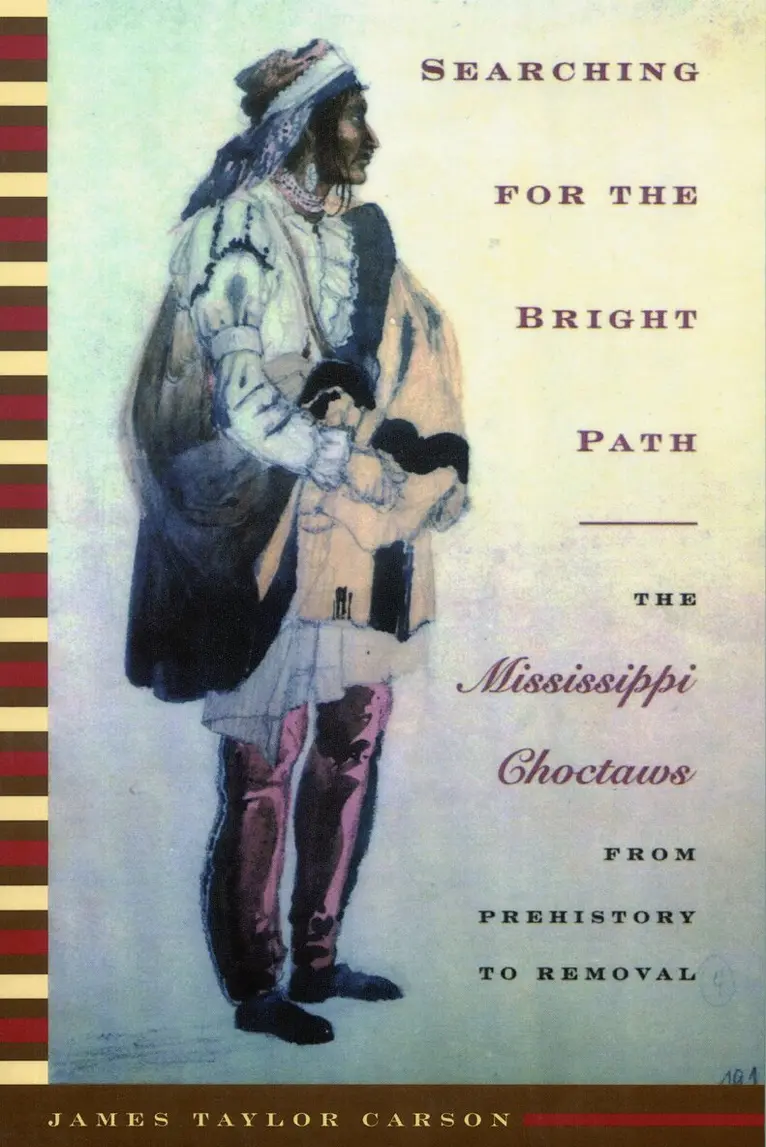
Searching for the Bright Path
The Mississippi Choctaws from Prehistory to Removal
Häftad, Engelska, 2003
324 kr
Skickas inom 10-15 vardagar
Blending an engaging narrative style with broader theoretical considerations, James Taylor Carson offers the most complete history to date of the Mississippi Choctaws. Tracing the Choctaws from their origins in the Mississippian cultures of late prehistory to the early nineteenth century, Carson shows how the Choctaws struggled to adapt to life in a New World altered radically by contact while retaining their sense of identity and place. Despite changes in subsistence practices and material culture, the Choctaws made every effort to retain certain core cultural beliefs and sensibilities, a strategy they conceived of as following "the straight bright path." This work also makes a significant theoretical contribution to ethnohistory as Carson confronts common problems in the historical analysis of Native peoples.
394 kr
Tillfälligt slut
Wide ranging, interdisciplinary look at the emergence and persistence of the concept of American Exceptionalism in US culture and history.An incisive and wide ranging look at a powerful force and myth in American culture and history, American Exceptionalisms reveals the centuries-old persistence of the notion that the United States is an exceptional nation, in being both an example to the world and exempt from the rules of international law. Scholars from North America and Europe trace versions of the rhetoric of exceptionalism through a multitude of historical, cultural, and political phenomena, from John Winthrop's vision of the "cittie on a hill" and the Salem witch trials in the seventeenth century to The Blair Witch Project and Oprah Winfrey's "Child Predator Watch List" in the twenty-first century. The first set of essays focus on constitutive historical moments in the development of the myth, rom early exploration narratives through political debates in the early republic to twentieth-century immigration debates. The latter essays address the role of exceptionalism in the "war on terror" and such cornerstones of modern popular culture such as the horror stories of H.P. Lovecraft, the songs of Steve Earle, and the Oprah Winfrey show.Sylvia Söderlind is Associate Professor of English Language and Literature at Queen's University, Kingston, Ontario, Canada. She is the author of Margin/Alias: Language and Colonization in Canadian and Québécois Fiction (Toronto: University of Toronto Press, 1991) and articles on American, Canadian and Québécois fiction, "ghostmodernism" and translation, and the politics of metaphor published in, among others, Canadian Review of Comparative Literature, Ariel, Essays in Canadian Writing, Voix et images, RS/SI, New Feminism Review (Japan), ARTES (Sweden).James Taylor Carson is Professor of History and Associate Dean in the Faculty of Arts and Science at Queen's University, Kingston, Ontario, Canada. His scholarship focuses on the ethnohistory of native peoples in the American South, and he has published two books on the subject, Searching for the Bright Path: The Mississippi Choctaws from Prehistory to Removal (Lincoln: University of Nebraska Press, 1999) and Making an Atlantic World: Circles, Paths, and Stories from the Colonial South (Knoxville: University of Tennessee Press, 2007).
1 088 kr
Tillfälligt slut
Wide ranging, interdisciplinary look at the emergence and persistence of the concept of American Exceptionalism in US culture and history.An incisive and wide ranging look at a powerful force and myth in American culture and history, American Exceptionalisms reveals the centuries-old persistence of the notion that the United States is an exceptional nation, in being both an example to the world and exempt from the rules of international law. Scholars from North America and Europe trace versions of the rhetoric of exceptionalism through a multitude of historical, cultural, and political phenomena, from John Winthrop's vision of the "cittie on a hill" and the Salem witch trials in the seventeenth century to The Blair Witch Project and Oprah Winfrey's "Child Predator Watch List" in the twenty-first century. The first set of essays focus on constitutive historical moments in the development of the myth, rom early exploration narratives through political debates in the early republic to twentieth-century immigration debates. The latter essays address the role of exceptionalism in the "war on terror" and such cornerstones of modern popular culture such as the horror stories of H.P. Lovecraft, the songs of Steve Earle, and the Oprah Winfrey show.Sylvia Söderlind is Associate Professor of English Language and Literature at Queen's University, Kingston, Ontario, Canada. She is the author of Margin/Alias: Language and Colonization in Canadian and Québécois Fiction (Toronto: University of Toronto Press, 1991) and articles on American, Canadian and Québécois fiction, "ghostmodernism" and translation, and the politics of metaphor published in, among others, Canadian Review of Comparative Literature, Ariel, Essays in Canadian Writing, Voix et images, RS/SI, New Feminism Review (Japan), ARTES (Sweden).James Taylor Carson is Professor of History and Associate Dean in the Faculty of Arts and Science at Queen's University, Kingston, Ontario, Canada. His scholarship focuses on the ethnohistory of native peoples in the American South, and he has published two books on the subject, Searching for the Bright Path: The Mississippi Choctaws from Prehistory to Removal (Lincoln: University of Nebraska Press, 1999) and Making an Atlantic World: Circles, Paths, and Stories from the Colonial South (Knoxville: University of Tennessee Press, 2007).
269 kr
Skickas inom 10-15 vardagar
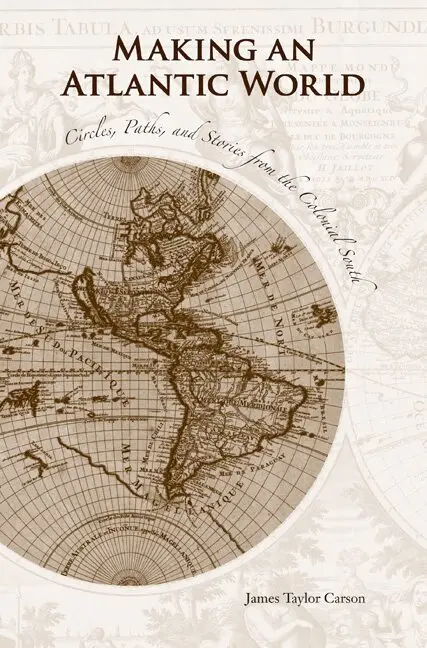
In the South, colonialism threw together three peoples who each played important roles in the creation of a new kind of society. Making an Atlantic World explores how Native Americans, Africans, and Europeans understood the landscapes they inhabited and how, after contact, their views of the world had to accommodate and then accept the presence of the others.Based on the notion of “founding peoples” rather than “founding fathers,” Making an Atlantic World uses an innovative, interdisciplinary approach to interpret the Colonial South. James Taylor Carson uses historical ethnogeography - a new methodology that brings together the study of history, anthropology, and geography. This method seeks to incorporate concepts of space and landscape with social perspectives to give students and scholars a better understanding of the forces that shaped the development of a synthesized southern culture.Unlike previous studies, which considered colonization as a contest over land but rarely considered what the land was and how people understood their relationships to it, Making an Atlantic World shows how the founding peoples perceived their world before contact and how they responded to contact and colonization.The author contends that each of the three groups involved-the first people, the invading people, and the enslaved people-possessed a particular worldview that they had to adapt to each other to face the challenges brought about by contact.