Jan Ambjorn - Böcker
Visar alla böcker från författaren Jan Ambjorn. Handla med fri frakt och snabb leverans.
3 produkter
3 produkter
1 145 kr
Skickas inom 10-15 vardagar
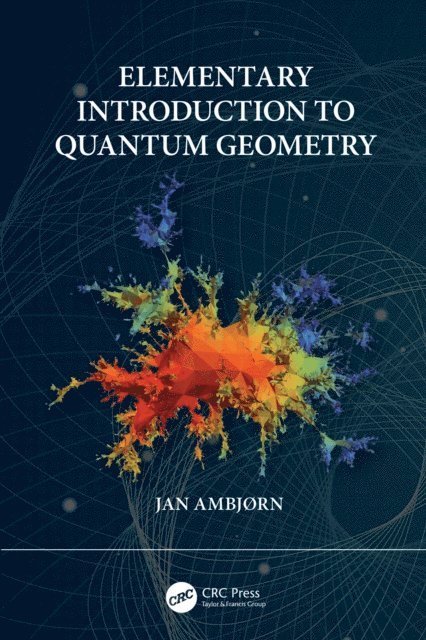
This graduate textbook provides an introduction to quantum gravity, when spacetime is two-dimensional. The quantization of gravity is the main missing piece of theoretical physics, but in two dimensions it can be done explicitly with elementary mathematical tools, but it still has most of the conceptional riddles present in higher dimensional (not yet known) quantum gravity. It provides an introduction to a very interdisciplinary field, uniting physics (quantum geometry) and mathematics (combinatorics) in a non-technical way, requiring no prior knowledge of quantum field theory or general relativity. Using the path integral, the chapters provide self-contained descriptions of random walks, random trees and random surfaces as statistical systems where the free relativistic particle, the relativistic bosonic string and two-dimensional quantum gravity are obtained as scaling limits at phase transition points of these statistical systems. The geometric nature of the theories allows one to perform the path integral by counting geometries. In this way the quantization of geometry becomes closely linked to the mathematical fields of combinatorics and probability theory. By counting the geometries, it is shown that the two-dimensional quantum world is fractal at all scales unless one imposes restrictions on the geometries. It is also discussed in simple terms how quantum geometry and quantum matter can interact strongly and change the properties both of the geometries and of the matter systems. It requires only basic undergraduate knowledge of classical mechanics, statistical mechanics and quantum mechanics, as well as some basic knowledge of mathematics at undergraduate level. It will be an ideal textbook for graduate students in theoretical and statistical physics and mathematics studying quantum gravity and quantum geometry.Key features: Presents the first elementary introduction to quantum geometry Explores how to understand quantum geometry without prior knowledge beyond bachelor level physics and mathematics. Contains exercises, problems and solutions to supplement and enhance learning
671 kr
Skickas inom 10-15 vardagar
This graduate textbook provides an introduction to quantum gravity, when spacetime is two-dimensional. The quantization of gravity is the main missing piece of theoretical physics, but in two dimensions it can be done explicitly with elementary mathematical tools, but it still has most of the conceptional riddles present in higher dimensional (not yet known) quantum gravity. It provides an introduction to a very interdisciplinary field, uniting physics (quantum geometry) and mathematics (combinatorics) in a non-technical way, requiring no prior knowledge of quantum field theory or general relativity. Using the path integral, the chapters provide self-contained descriptions of random walks, random trees and random surfaces as statistical systems where the free relativistic particle, the relativistic bosonic string and two-dimensional quantum gravity are obtained as scaling limits at phase transition points of these statistical systems. The geometric nature of the theories allows one to perform the path integral by counting geometries. In this way the quantization of geometry becomes closely linked to the mathematical fields of combinatorics and probability theory. By counting the geometries, it is shown that the two-dimensional quantum world is fractal at all scales unless one imposes restrictions on the geometries. It is also discussed in simple terms how quantum geometry and quantum matter can interact strongly and change the properties both of the geometries and of the matter systems. It requires only basic undergraduate knowledge of classical mechanics, statistical mechanics and quantum mechanics, as well as some basic knowledge of mathematics at undergraduate level. It will be an ideal textbook for graduate students in theoretical and statistical physics and mathematics studying quantum gravity and quantum geometry.Key features: Presents the first elementary introduction to quantum geometry Explores how to understand quantum geometry without prior knowledge beyond bachelor level physics and mathematics. Contains exercises, problems and solutions to supplement and enhance learning
2 341 kr
Tillfälligt slut
Already in 1997, the topics included in this meeting had been enlarged to include all different phases and phase transitions relevant on laboratory scales or in cosmology. The '98 meeting followed this trend, and there was a balanced combination of the physics associated with both strong and electroweak interactions (and beyond). The main motivation continues to be the understanding of the standard model in “extreme” situations, particularly relevant on the cosmological scale. Most contributions were in one way or another concerned with the finite-temperature aspects of strong and electroweak interactions, and, as in the previous meeting, one persistent theme was the present understanding of baryon-number asymmetry: how it can be created, and how it can be maintained beyond the earliest stages of the Universe. The recent progress in describing the real-time and nonequilibrium dynamics of the non-Abelian gauge was covered in a number of the main talks, as well as in several shorter contributions and posters. The conference presented examples of impressive analytical progress and equally impressive results from numerical simulations: the two techniques continue to fruitfully complement each other. One completely new theme at this conference was the recent suggestion that finite-density QCD may contain new and interesting condensed phases in the neighborhood of the conventional critical density separating quark matter from hadronic matter. All of these developments, and many more, are reflected in this book.