Jan Vytopil - Böcker
Visar alla böcker från författaren Jan Vytopil. Handla med fri frakt och snabb leverans.
4 produkter
4 produkter
1 637 kr
Skickas inom 10-15 vardagar
This text focuses on the state of the art in formal specification, development and verification of fault-tolerant computing systems. The term "fault-tolerance" refers to a system having properties which enable it to deliver its specified function and despite (certain) faults of its subsystem. Fault-tolerance is achieved by adding extra hardware and/or software which corrects the effects of faults. In this sense, a system can be called fault-tolerant if it can be proved that the resulting (extended) system under some model of reliability meets the reliability requirements. The main theme of this text can be formulated as follows: how do the specification, development and verification of conventional and fault-tolerant systems differ? How do the notations, methodology and tools used in design and development of fault-tolerant and conventional systems differ? This volume is divided into two parts. The chapters in Part 1 set the stage for what follows by defining the basic notions and practices of the field of design and specification of fault-tolerant systems.The chapters in Part 2 represent the "how-to" section, containing examples of the use of formal methods in specification and development of fault-tolerant systems. The book serves as a reference for researchers in both academia and industry, and may be used as a text for advanced courses on the subject.
Del 221 - Springer International Series in Engineering and Computer Science
Formal Techniques in Real-Time and Fault-Tolerant Systems
Häftad, Engelska, 2012
1 637 kr
Skickas inom 10-15 vardagar
Formal Techniques in Real-Time and Fault-Tolerant Systems focuses on the state of the art in formal specification, development and verification of fault-tolerant computing systems. The term `fault-tolerance' refers to a system having properties which enable it to deliver its specified function despite (certain) faults of its subsystem. Fault-tolerance is achieved by adding extra hardware and/or software which corrects the effects of faults. In this sense, a system can be called fault-tolerant if it can be proved that the resulting (extended) system under some model of reliability meets the reliability requirements.The main theme of Formal Techniques in Real-Time and Fault-Tolerant Systems can be formulated as follows: how do the specification, development and verification of conventional and fault-tolerant systems differ? How do the notations, methodology and tools used in design and development of fault-tolerant and conventional systems differ?Formal Techniques in Real-Time and Fault-Tolerant Systems is divided into two parts. The chapters in Part One set the stage for what follows by defining the basic notions and practices of the field of design and specification of fault-tolerant systems. The chapters in Part Two represent the `how-to' section, containing examples of the use of formal methods in specification and development of fault-tolerant systems.The book serves as an excellent reference for researchers in both academia and industry, and may be used as a text for advanced courses on the subject.
Formal Techniques in Real-Time and Fault-Tolerant Systems
Second International Symposium, Nijmegen, The Netherlands, January 8-10, 1992. Proceedings
Häftad, Engelska, 1991
1 062 kr
Skickas inom 10-15 vardagar
This book presents state-of-the-art research results in thearea of formal methods for real-time and fault-tolerantsystems. The papers consider problems and solutions insafety-critical system design and examine how wellthe useof formal techniques for design, analysis and verificationserves in relating theory to practical realities. The book contains papers on real-time and fault-toleranceissues. Formal logic, process algebra, and action/eventmodels are applied:- to specify and model qualitative and quantitativereal-time and fault-tolerant behavior,- to analyze timeliness requirements and consequences offaulthypotheses,- to verify protocols and program code,- to formulate formal frameworks for development ofreal-time and fault-tolerant systems,- to formulate semantics of languages. The integration and cross-fertilization of real-time andfault-tolerance issues have brought newinsights in recentyears, and these are presented in this book.
1 094 kr
Skickas inom 10-15 vardagar
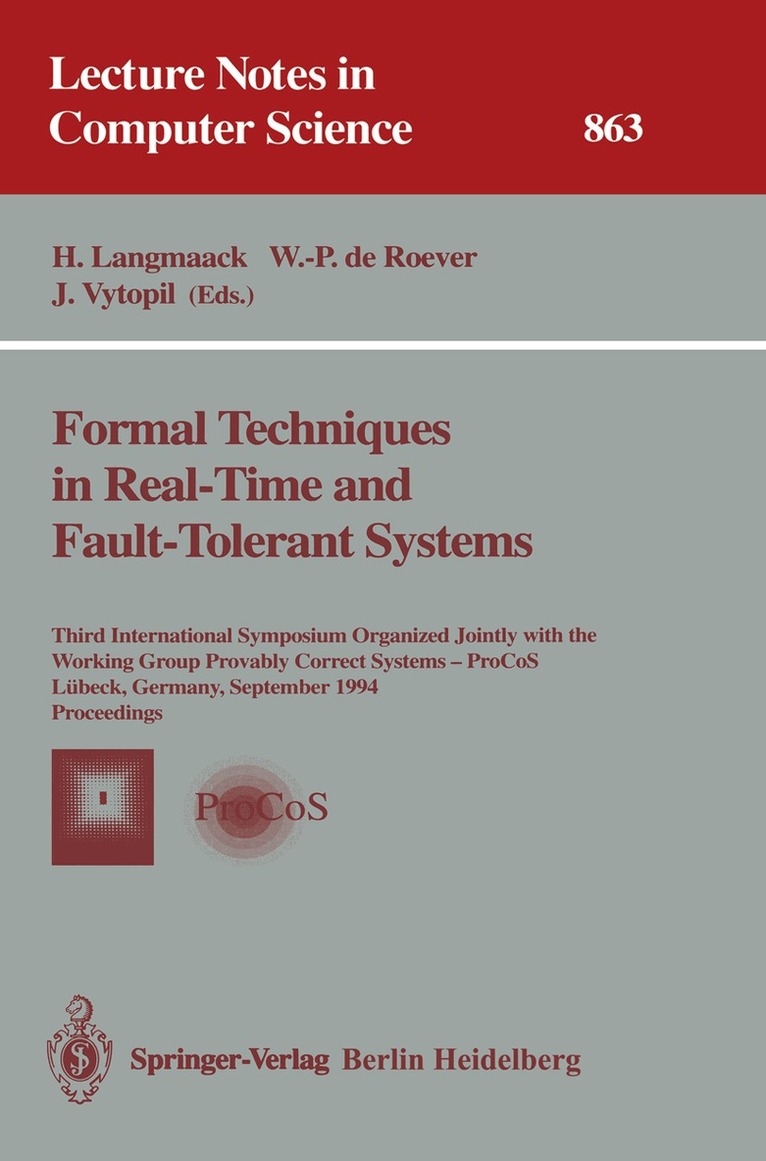
This volume presents the proceedings of the Third International Symposium on Formal Techniques in Real-Time and Fault-Tolerant Systems held jointly with the Working Group Provably Correct Systems (ProCoS) at Lübeck, Germany in September 1994.The book contains full versions of 5 invited talks and 33 carefully selected refereed contributions as well as 12 tool demonstrations. It documents that formal techniques constitute the foundation of a systematic design of real-time, fault-tolerant, and hybrid systems, throughout the whole engineering process, from the capture of requirements through specification, design, coding and compilation, right down to the hardware that embeds the system into its environment.