Janet Kraynak - Böcker
Visar alla böcker från författaren Janet Kraynak. Handla med fri frakt och snabb leverans.
5 produkter
5 produkter
722 kr
Skickas inom 5-8 vardagar
533 kr
Skickas inom 7-10 vardagar
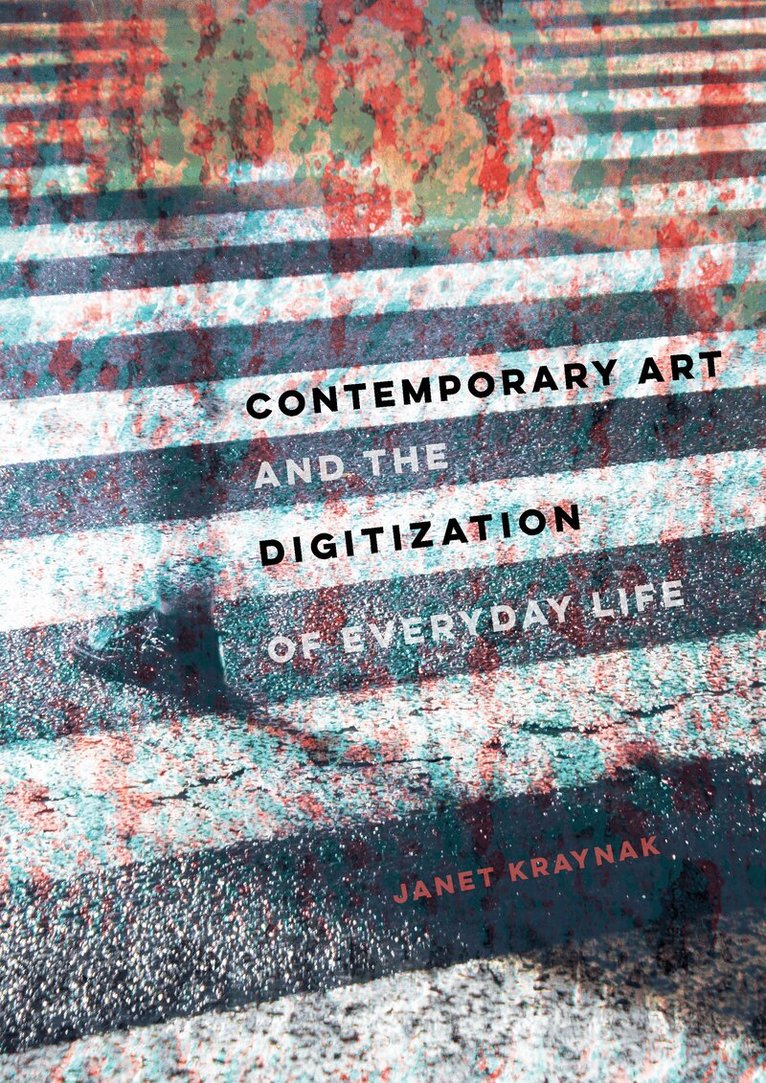
Digitization is the animating force of everyday life. Rather than defining it as a technology or a medium, Contemporary Art and the Digitization of Everyday Life argues that digitization is a socio-historical process that is contributing to the erosion of democracy and an increase in political inequality, specifically along racial, ethnic, and gender lines. Taking a historical approach, Janet Kraynak finds that the seeds of these developments are paradoxically related to the ideology of digital utopianism that emerged in the late 1960s with the rise of a social model of computing, a set of beliefs furthered by the neo-liberal tech ideology in the 1990s, and the popularization of networked computing. The result of this ongoing cultural worldview, which dovetails with the principles of progressive artistic strategies of the past, is a critical blindness in art historical discourse that ultimately compromises art’s historically important role in furthering radical democratic aims.
396 kr
Skickas inom 7-10 vardagar
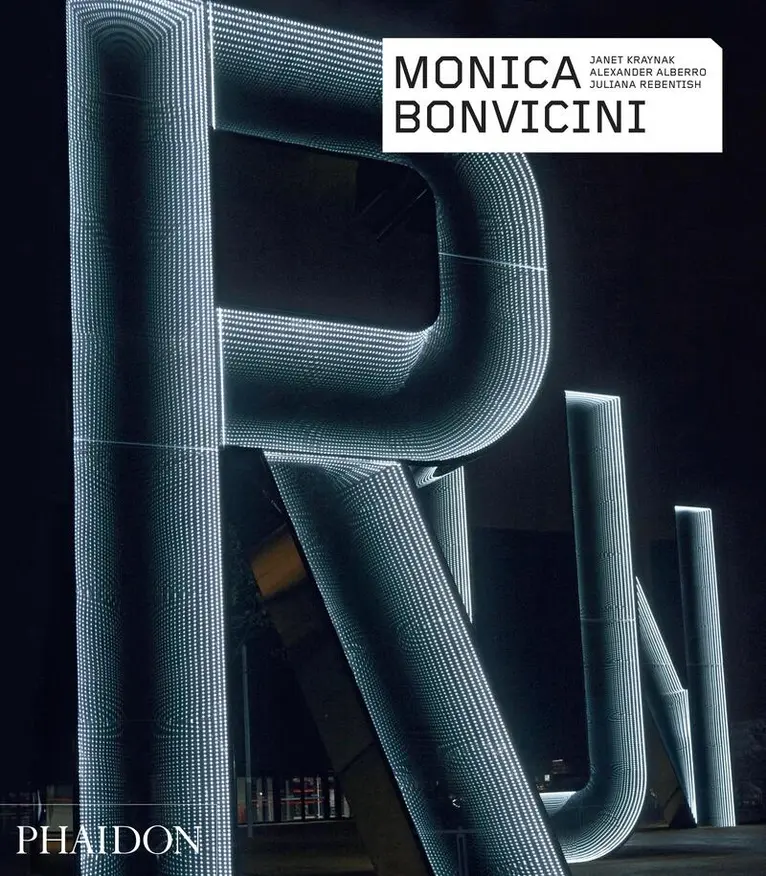
The most comprehensive monograph on the work of Monica Bonvicini
319 kr
Skickas inom 7-10 vardagar
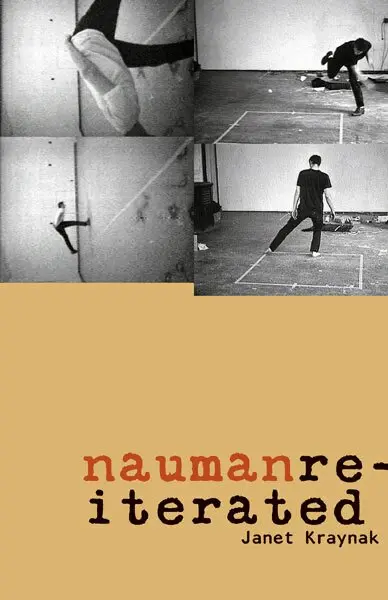
Bruce Nauman has been a force in the art world since the early 1960s with his challenging audio and video installations, photographic art, neon art, and sculptures. However, until now there has been surprisingly little sustained critical analysis of his extraordinary oeuvre. Nauman Reiterated offers the first scholarly assessment of the artist’s production with an in-depth thematic investigation of key works created between the mid-1960s and mid-1970s. Janet Kraynak argues that the coherence of Nauman’s art can be found not in conventional categorizations of style, medium, or technique, but through understanding the artistic and cultural conditions that led to an interdisciplinary aesthetic of performance, which emerged in relation to technologies of reproduction, inscription, and recording. Kraynak provides a portrait of an artist who regularly defies expectations and genres, showing how Nauman’s work responds to historical problems that have only increased in importance since he first addressed them, especially the technologization of society initiated by electronic media. Nauman’s reaction to the technological takeover of modern society, Kraynak suggests, is reiteration. Building from these observations, Kraynak explores how performance is intimately associated with the acceleration toward a fully technological society, which sees new modes of electronic recording and reproduction, the growth of information technologies, and the consolidation of technocracy.Through extensive archival research Kraynak has written a revealing examination of Nauman’s thought-provoking and protean work.
2 160 kr
Skickas inom 10-15 vardagar
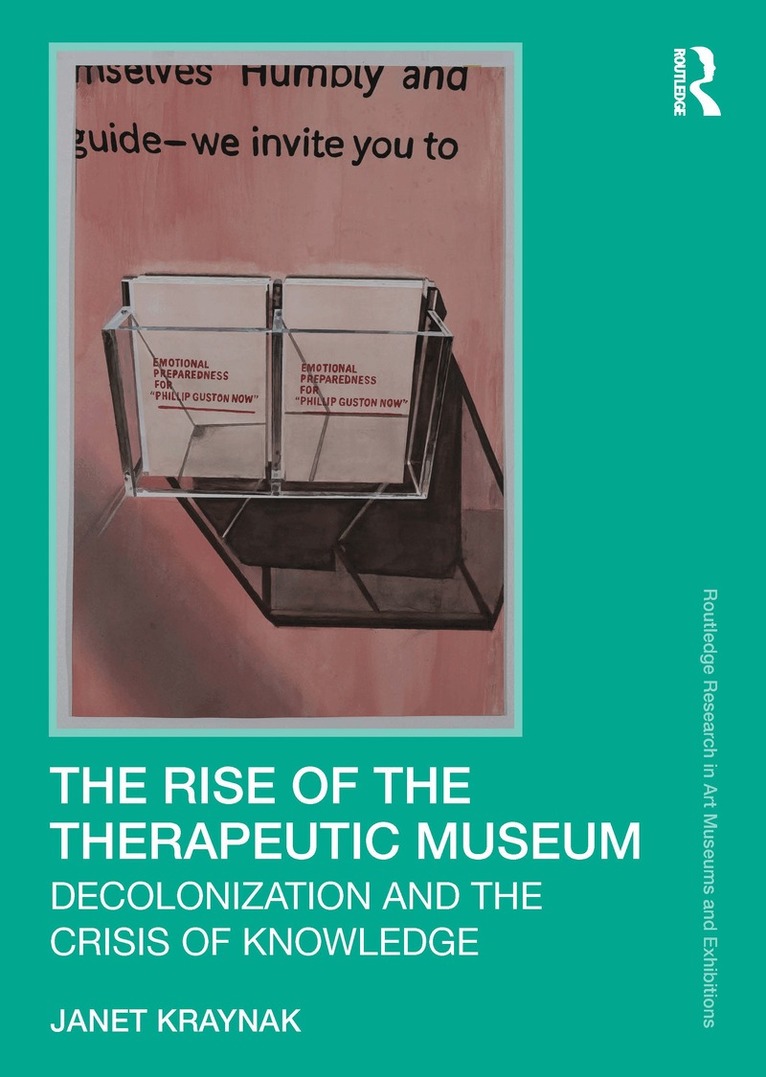
This book considers how and why respite rooms, emotional support brochures, well-being guides, psychological consultants, and care days are becoming common features in the museum of art.Kraynak poses and answers this question, arguing that under its rightful ambition to decolonize––i.e., to rectify past and present inequalities–– the museum of the Global North is gradually replacing a commitment to knowledge, teaching, and learning with a focus upon care, healing, and well-being (the “therapeutic”). While this transformation might appear, on the surface, benign, culturally familiar, and politically desirable, the author counters these presumptions, probing the history and implications of “the therapeutic museum.” Here, curatorial attention shifts away from the art on view and onto the spectator, whom the museum imagines as a precarious psychological subject, and primary source of meaning. External forces–– new forms of knowledge, encounters with difficulty, even an engagement with art––are treated as a potential threat. As a result, the therapeutic museum not only encourages thebeholder to turn inward, but in so doing deflects attention from or scrutiny of its own practices and systems that perpetuate inequality. Among these are the ongoing legacies colonialism’s epistemic violence, which elevated the knowledge and aesthetic traditions of the Global North while suppressing those of the Global South. In contrast, the book proposes a “pluriversal” (versus universal) museum that maintains the political necessity of knowledge and views pedagogy as a path to emancipation. Emphasizing epistemic justice and the moral right to learn during a time when such freedoms are increasingly under attack, the book makes a powerful case for questioning rather than romanticizing the therapeutic museum, which it ultimately reveals to reinforce rather than challenge dominant power.This is an important intervention that is essential reading for researchers and scholars in Art History, Visual Studies, Museum Studies, and Cultural Studies.