Janet M. Atwill - Böcker
Visar alla böcker från författaren Janet M. Atwill. Handla med fri frakt och snabb leverans.
4 produkter
4 produkter
1 088 kr
Tillfälligt slut
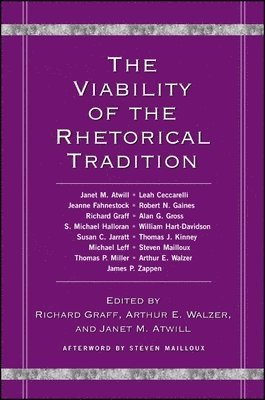
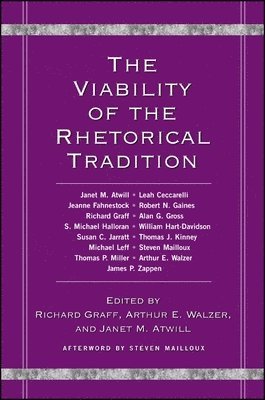
Interrogates the story of rhetoric promoted in standard historical accounts and reconsiders the relationship between rhetorical theory, practice, and pedagogy.The Viability of the Rhetorical Tradition reconsiders the relationship between rhetorical theory, practice, and pedagogy. Continuing the line of questioning begun in the 1980s, contributors examine the duality of a rhetorical canon in determining if past practice can make us more (or less) able to address contemporary concerns. Also examined is the role of tradition as a limiting or inspiring force, rhetoric as a discipline, rhetoric's contribution to interest in civic education and citizenship, and the possibilities digital media offer to scholars of rhetoric.
394 kr
Tillfälligt slut
Interrogates the story of rhetoric promoted in standard historical accounts and reconsiders the relationship between rhetorical theory, practice, and pedagogy.The Viability of the Rhetorical Tradition reconsiders the relationship between rhetorical theory, practice, and pedagogy. Continuing the line of questioning begun in the 1980s, contributors examine the duality of a rhetorical canon in determining if past practice can make us more (or less) able to address contemporary concerns. Also examined is the role of tradition as a limiting or inspiring force, rhetoric as a discipline, rhetoric's contribution to interest in civic education and citizenship, and the possibilities digital media offer to scholars of rhetoric.
672 kr
Skickas inom 10-15 vardagar
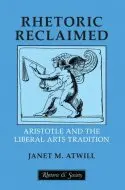
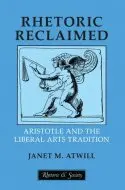
Thoroughly embedded in postmodern theory, this book offers a critique of traditional conceptions of the liberal arts, exploring the challenges posed by cultural diversity to the aims and methods of a humanist education. Janet M. Atwill investigates a neglected tradition of rhetoric, exemplified by Protagoras and Isocorates, and preserved in Aristotle's Rhetoric. This tradition was rooted in the ancient sophistic and platonic conceptions of techné, or productive knowledge, that appears both in literary texts from the seventh century B.C.E. and in medical and technical treatises from the fifth century B.C.E. Atwill examines these traditions, together with sophistic and platonic conceptions, and considers the commentaries on Aristotle's Rhetoric by E. M. Cope and William S. J. Grimaldi, where the concepts of techné and productive knowledge disappear in the modern opposition between theory and practice. Since models of knowledge are closely tied to models of subjectivity, Atwill's examination of techné also explores the role of political, economic, and educational institutions in standardizing a specific model for subjectivity. She argues that the liberal arts traditions largely eclipsed the social and political functions of rhetoric, transforming it from an art of disrupting and reinventing lines of power to a discipline of producing a normative subject, defined by virtue but modeled on a specific gender and class type.
432 kr
Skickas inom 10-15 vardagar
Thoroughly embedded in postmodern theory, this book offers a critique of traditional conceptions of the liberal arts, exploring the challenges posed by cultural diversity to the aims and methods of a humanist education. Janet M. Atwill investigates a neglected tradition of rhetoric, exemplified by Protagoras and Isocorates, and preserved in Aristotle's Rhetoric. This tradition was rooted in the ancient sophistic and platonic conceptions of techné, or productive knowledge, that appears both in literary texts from the seventh century B.C.E. and in medical and technical treatises from the fifth century B.C.E. Atwill examines these traditions, together with sophistic and platonic conceptions, and considers the commentaries on Aristotle's Rhetoric by E. M. Cope and William S. J. Grimaldi, where the concepts of techné and productive knowledge disappear in the modern opposition between theory and practice. Since models of knowledge are closely tied to models of subjectivity, Atwill's examination of techné also explores the role of political, economic, and educational institutions in standardizing a specific model for subjectivity. She argues that the liberal arts traditions largely eclipsed the social and political functions of rhetoric, transforming it from an art of disrupting and reinventing lines of power to a discipline of producing a normative subject, defined by virtue but modeled on a specific gender and class type.