Jay Caplan - Böcker
Visar alla böcker från författaren Jay Caplan. Handla med fri frakt och snabb leverans.
4 produkter
4 produkter
900 kr
Skickas inom 7-10 vardagar
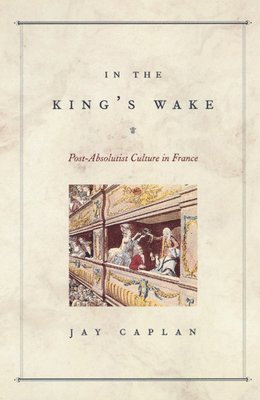
Long before the guillotines of the 1789 Revolution brought a grisly political end to the ancien regime, Jay Caplan argues, the culture of absolutism had already perished. This book traces the emergence of a post-absolutist culture across a range of works and genres: Saint-Simon's memoirs of Louis XIV and the Regency; Voltaire's first tragedy, "Oedipe"; Watteau's last great painting, "L'Enseigne de Gersaint"; the plays of Marivaux; and Casanova's "History of My Life". While absolutist culture had focused on value directly represented in people (for example, those of noble blood) and things (for example, coins made of precious metals), post-absolutist culture instead explored the capacity of signs to stand for something real (for example, John Law's banknotes or Marivaux's plays in which actions rather than birth signify nobility). Between the image of the Sun King and visions of the godlike Romantic self, Caplan discovers a post-absolutist France wracked by surprisingly modern conflicts over the true sources of value and legitimacy.
369 kr
Skickas inom 7-10 vardagar
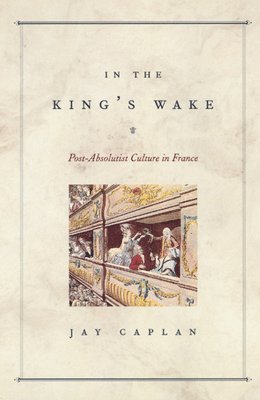
Long before the guillotines of the 1789 Revolution brought a grisly political end to the ancien regime, Jay Caplan argues, the culture of absolutism had already perished. This book traces the emergence of a post-absolutist culture across a range of works and genres: Saint-Simon's memoirs of Louis XIV and the Regency; Voltaire's first tragedy, "Oedipe"; Watteau's last great painting, "L'Enseigne de Gersaint"; the plays of Marivaux; and Casanova's "History of My Life". While absolutist culture had focused on value directly represented in people (for example, those of noble blood) and things (for example, coins made of precious metals), post-absolutist culture instead explored the capacity of signs to stand for something real (for example, John Law's banknotes or Marivaux's plays in which actions rather than birth signify nobility). Between the image of the Sun King and visions of the godlike Romantic self, Caplan discovers a post-absolutist France wracked by surprisingly modern conflicts over the true sources of value and legitimacy.
1 592 kr
Skickas inom 7-10 vardagar
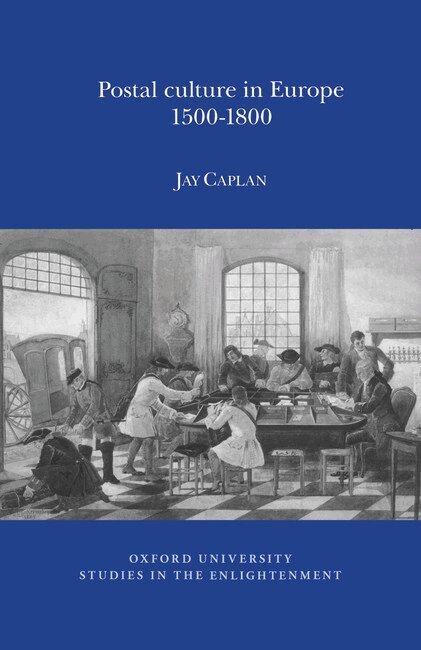
During the early modern period the public postal systems became central pillars of the emerging public sphere. Despite the importance of the post in the transformation of communication, commerce and culture, little has been known about the functioning of the post or how it affected the lives of its users and their societies. In Postal culture in Europe, 1500-1800, Jay Caplan provides the first historical and cultural analysis of the practical conditions of letter-exchange at the dawn of the modern age.Caplan opens his analysis by exploring the economic, political, social and existential interests that were invested in the postal service, and traces the history of the three main European postal systems of the era, the Thurn and Taxis, the French Royal Post and the British Post Office. He then explores how the post worked, from the folding and sealing of letters to their collection, sorting, and transportation. Beyond providing service to the general public, these systems also furnished early modern states with substantial revenue and effective surveillance tools in the form of the Black Cabinets or Black Chambers. Caplan explains how postal services highlighted the tension between state power and the emerging concept of the free individual, with rights to private communication outside the public sphere. Postal systems therefore affected how letter writers and readers conceived and expressed themselves as individuals, which the author demonstrates through an examination of the correspondence of Voltaire and Rousseau, not merely as texts but as communicative acts.Ultimately, Jay Caplan provides readers with both a comprehensive overview of the changes wrought by the newly-public postal system – from the sounds that one heard to the perception of time and distance – and a thought provoking account of the expectations and desires that have led to our culture of instant communication.
412 kr
Skickas inom 10-15 vardagar
Framed Narratives was first published in 1985. Minnesota Archive Editions uses digital technology to make long-unavailable books once again accessible, and are published unaltered from the original University of Minnesota Press editions.The work of French philosophe Denis Diderot (1713-1784) has inspired conflicting reactions in those who encounter him. Diderot has been admired and despised; he has moved his readers and irritated them - often at the same time. His work continually shifts between mutually exclusive positions - neither of which provides an entirely satisfactory answer to the question at hand, yet neither of which can be disregarded. The nature of these paradoxes has been the fundamental problem in Diderot, a problem that his interpreters have approached by imagining synthetic perspectives or frames within which the paradoxes could be resolved.In Framed Narratives, Jay Caplan focuses on the problem of framing in and of Diderot. He proposes an interpretive model that draws upon the notion of dialogue developed by Mikhail Bakhtin. For Bakhtin, no utterance can be reduced to a univocal meaning; one's discourse is always marked by other voices. In Diderot, Caplan shows, the narrative device of the tableau engages the reader (or beholder) in a dialogic relationship with the author and the characters. Diderot defines the players of those roles as members of a family, one of whom is always missing, and that sacrificial relationship becomes an integral part of the text. Caplan then uses the concept of the tableau to interpret the rhetoric of gender, genre, and pathos in Diderot's works for and about the theater, his novel The Nun, the philosophical dialogue D'Alembert's Dream,and his correspondence.What emerges from these readings is not only an interpretation of certain texts, but a description of Diderot's—and, by implication, early bourgeois—poetics. Framed Narratives is, in addition, one of the first attempts to rely upon Bakhtin's concepts in the interpretation of specific texts, in this case the work of an essentially dialogic writer. A socio-historical supplement to Framed Narratives is provided in Jochen Schulte-Sasse's afterword.