Jean-Marc Ginoux – författare
Visar alla böcker från författaren Jean-Marc Ginoux. Handla med fri frakt och snabb leverans.
23 produkter
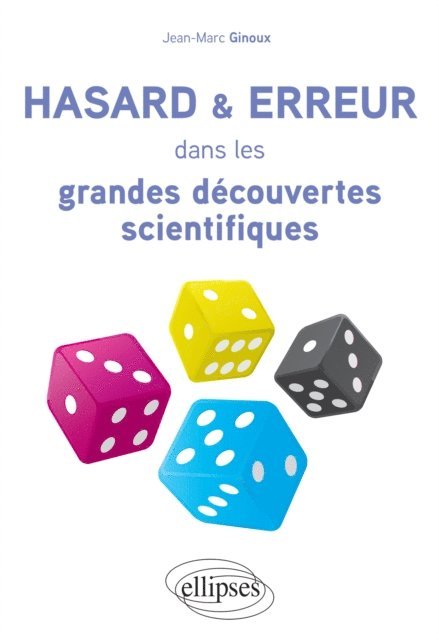
Hasard et erreur dans les grandes découvertes scientifiques
E-bok, 2022
295 kr
Lägg i varukorg
L’histoire des sciences nous montre que si la logique et le raisonnement sont pour beaucoup dans les grandes découvertes scientifiques, le hasard et l’erreur interviennent également dans bon nombre d’entre elles. À côté des plus célèbres comme celle de la radioactivité, cet ouvrage présente …
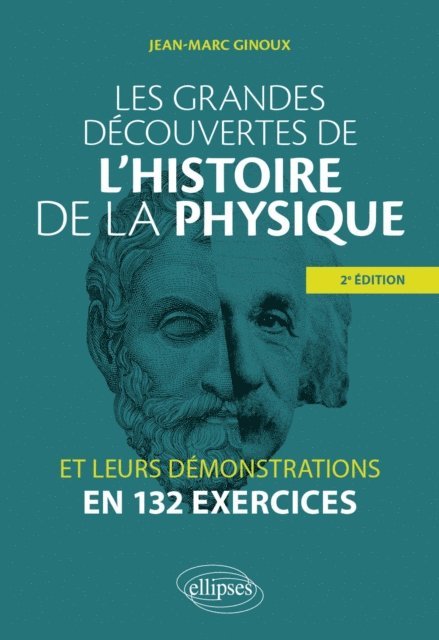
Les grandes découvertes de l'histoire de la physique et leurs démonstrations en 132 exercices
E-bok, 2023
624 kr
Lägg i varukorg
Cet ouvrage a pour but de présenter les Grandes Découvertes de l’Histoire de la Physique depuis Thalès de Milet jusqu’à Albert Einstein en replaçant le lecteur dans les conditions de connaissances dans lesquelles elles ont été réalisées. Ainsi, après avoir rappelé les éléments essentiels de la …
Henri Poincaré : une biographie au(x) quotidien(s)
Av Christian Gerini, Jean-Marc Ginoux
E-bok, 2023
458 kr
Lägg i varukorg
Ce livre présente un portrait inédit du mathématicien français Henri Poincaré à partir de ce qu’en disaient les journaux de son temps . Un choix abondant de coupures de presse permet en effet une approche originale du personnage : on y découvre les faits les plus marquants de sa carrière mais aussi …
Petites chroniques scientifiques extraordinaires
E-bok, 2019
295 kr
Lägg i varukorg
Cet ouvrage a pour but de présenter les anecdotes les plus insolites et les aspects les plus inattendus de l’Histoire des Sciences sous une forme vulgarisée, amusante, drôle et accessible à tout public puisque dénuée de tout développement mathématique. Il s'articule autour de cinq grandes parties : …
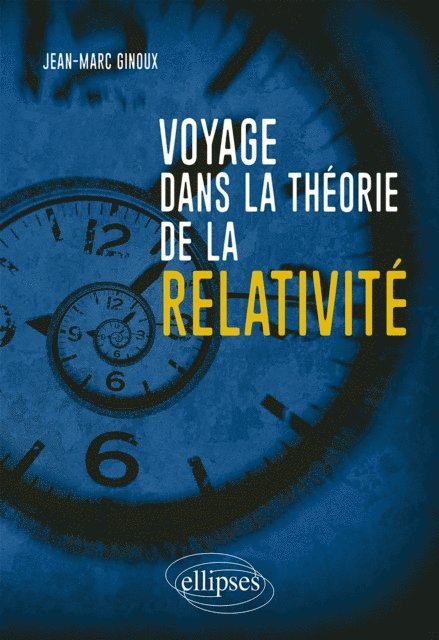
Voyage dans la théorie de la relativité
E-bok, 2024
285 kr
Lägg i varukorg
Qui n’a jamais entendu parler de la formule E = mc2 ? Personne. Et pourtant … La première grande difficulté de la théorie de la relativité restreinte est liée à son formalisme mathématique qui rend très difficile voire impossible sa compréhension. Aussi, le premier objectif de ce livre est de …
Mathematiques pour le BUT
Cours avec plus de 160 exercices corriges
E-bok, 2025
459 kr
Lägg i varukorg
Ce cours contient l'ensemble des douze chapitres abordes durant les trois annees de BUT. Chaque chapitre comporte le cours complet, les definitions, les theoremes et leurs demonstrations illustres par de nombreux exemples et representations graphiques realisees avec le logiciel GeoGebra.Il est …
Poincaré, Einstein and the Discovery of Special Relativity
An End to the Controversy
Inbunden, 2024
1541 kr
Lägg i varukorg
1905 is probably the best-known year in physics, since it was the year of the discovery of the special theory of relativity. For decades, historiography has told us that Albert Einstein, then a patent examiner in Bern, succeeded in developing this theory on his own, overcoming all the difficulties …
Poincare, Einstein and the Discovery of Special Relativity
An End to the Controversy
E-bok, 2024
1956 kr
Lägg i varukorg
1905 is probably the best-known year in physics, since it was the year of the discovery of the special theory of relativity. For decades, historiography has told us that Albert Einstein, then a patent examiner in Bern, succeeded in developing this theory on his own, overcoming all the difficulties …
Poincaré, Einstein and the Discovery of Special Relativity
An End to the Controversy
Häftad, 2025
1541 kr
Lägg i varukorg
1905 is probably the best-known year in physics, since it was the year of the discovery of the special theory of relativity. For decades, historiography has told us that Albert Einstein, then a patent examiner in Bern, succeeded in developing this theory on his own, overcoming all the difficulties …
History of Nonlinear Oscillations Theory in France (1880-1940)
Inbunden, 2017
1980 kr
Lägg i varukorg
This book reveals the French scientific contribution to the mathematical theory of nonlinear oscillations and its development. The work offers a critical examination of sources with a focus on the twentieth century, especially the period between the wars. Readers will see that, contrary to what is …
History of Nonlinear Oscillations Theory in France (1880-1940)
E-bok, 2017
2543 kr
Lägg i varukorg
This book reveals the French scientific contribution to the mathematical theory of nonlinear oscillations and its development. The work offers a critical examination of sources with a focus on the twentieth century, especially the period between the wars. Readers will see that, contrary to what is …
History of Nonlinear Oscillations Theory in France (1880-1940)
Häftad, 2018
1970 kr
Lägg i varukorg
This book reveals the French scientific contribution to the mathematical theory of nonlinear oscillations and its development. The work offers a critical examination of sources with a focus on the twentieth century, especially the period between the wars. Readers will see that, contrary to what is …
NONLINEAR DYNAMICS OF LASERS
Av Riccardo Meucci, Jean-Marc Ginoux
Inbunden, 2023
981 kr
Lägg i varukorg
In the early 1980s, the late luminary Tito Arecchi was the first to highlight the existence of chaos in a laser model. Since then, along with several colleagues, he developed many important lines of research in this field, such as generalized multistability, laser with injected signal, laser with …
HENRI POINCARE: A BIOGRAPHY THROUGH THE DAILY PAPERS
Av Jean-Marc Ginoux, Christian Gerini
Inbunden, 2013
535 kr
Lägg i varukorg
On July 17, 2012, the centenary of Henri Poincaré's death was commemorated; his name being associated with so many fields of knowledge that he was considered as the Last Universalist. In Pure and Applied Mathematics, Physics, Astronomy, Engineering and Philosophy, his works have had a great impact …
Albert Einstein demystified
E-bok, 2020
356 kr
Lägg i varukorg
What with his extraordinary personality, his outspokenness, and his somewhat “extravagant” appearance for his time, Einstein has gradually shaped, throughout his life, his image: that of a genius, an iconoclast, an eccentric, a pacifist, an atheist or a person committed to his convictions. It is …
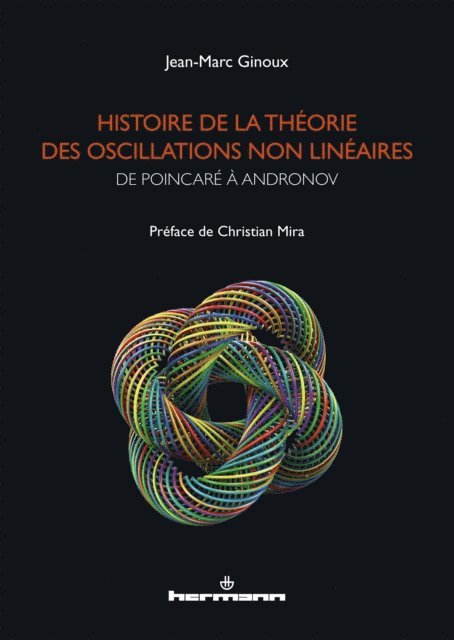
Histoire de la théorie des oscillations non linéaires
De Poincaré à Andronov
E-bok, 2015
654 kr
Lägg i varukorg
Cet ouvrage retrace de façon inédite le processus d’élaboration de la théorie des oscillations non linéaires durant une période qui s''étend de 1880 à 1940 avec en toile de fond l’essor de la radiocommunication. Dans ce processus, la France joue un rôle déterminant tant au niveau de sa situation …
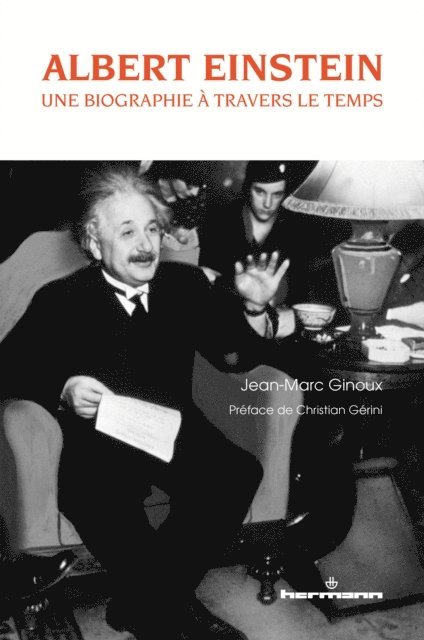
Albert Einstein : une biographie à travers le temps
E-bok, 2016
717 kr
Lägg i varukorg
Cette biographie présente un portrait inédit du célèbre physicien Albert Einstein entièrement réalisé à partir de coupures de presse d’un grand quotidien new-yorkais, le New York Times. Le nombre impressionnant d’articles rédigés sur sa vie et sur son œuvre offre une approche originale du …
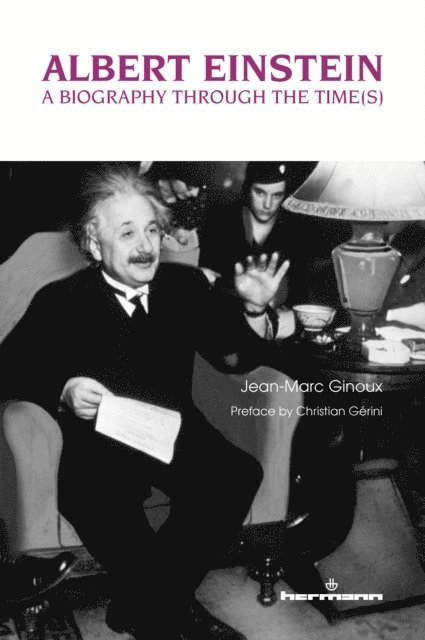
Albert Einstein: A Biography Through the Time(s)
E-bok, 2016
680 kr
Lägg i varukorg
Cet ouvrage présente un portrait inédit du célèbre physicien Albert Einstein entièrement réalisé à partir de coupures de presse d’un grand quotidien new-yorkais. Le nombre impressionnant d’articles rédigés sur sa vie et sur son œuvre offre une approche originale du personnage. Il permet d’une part …
Pour en finir avec le mythe d'Albert Einstein
E-bok, 2019
364 kr
Lägg i varukorg
Avec sa personnalité hors norme, son franc-parler et son allure quelque peu extravagante pour l’époque, Einstein façonna tout au long de sa vie l’image qui est devenue peu à peu celle du génie iconoclaste, excentrique, pacifiste, athée et engagé. En le présentant comme un simple vérificateur de …
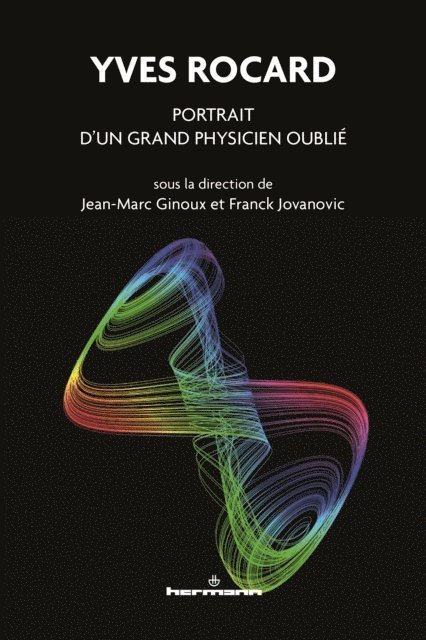
Yves Rocard
Portrait d''un grand physicien oublié
E-bok, 2023
329 kr
Lägg i varukorg
À l’occasion du 30e anniversaire de la disparition d’Yves Rocard, ce livre dresse un portrait unique des premières années de la vie et de la carrière de ce chercheur éclectique. À travers le témoignage de ceux qui l’ont connu, on y découvre la vie incroyable de ce physicien quelque peu oublié. …
Pour en finir avec le mythe d'Albert Einstein
Nouvelle édition
E-bok, 2023
364 kr
Lägg i varukorg
Avec sa personnalité hors norme, son franc-parler et son allure quelque peu extravagante pour l’époque, Einstein façonna tout au long de sa vie l’image qui est devenue peu à peu celle du génie iconoclaste, excentrique, pacifiste, athée et engagé. En le présentant comme un simple vérificateur de …
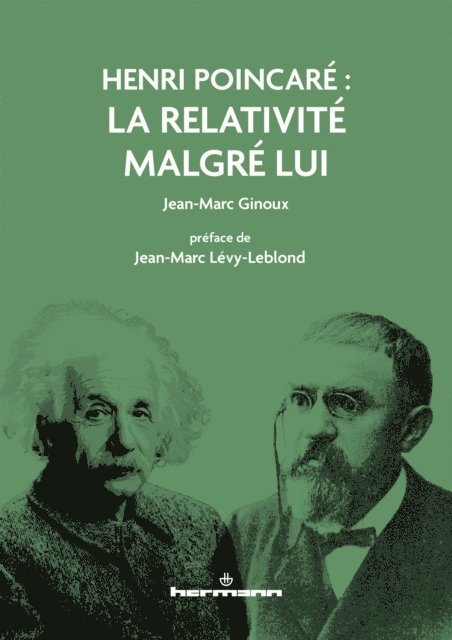
Henri Poincaré : la relativité malgré lui
E-bok, 2024
339 kr
Lägg i varukorg
Depuis plus de soixante-dix ans maintenant, une vive controverse oppose ceux qui créditent le physicien Albert Einstein de la paternité de la théorie de la relativité restreinte à ceux qui estiment que c’est le mathématicien français Henri Poincaré qui en est l’auteur. Après avoir présenté de …
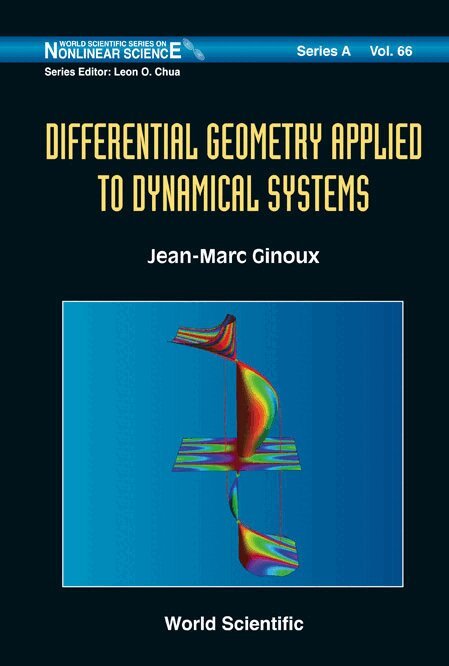
DIFFERENTIAL GEOMETRY APPLIED TO DYNAMICAL SYSTEMS (WITH CD-ROM)
Inbunden, 2009
1670 kr
Tillfälligt slut
This book aims to present a new approach called Flow Curvature Method that applies Differential Geometry to Dynamical Systems. Hence, for a trajectory curve, an integral of any n-dimensional dynamical system as a curve in Euclidean n-space, the curvature of the trajectory — or the flow — may be …